
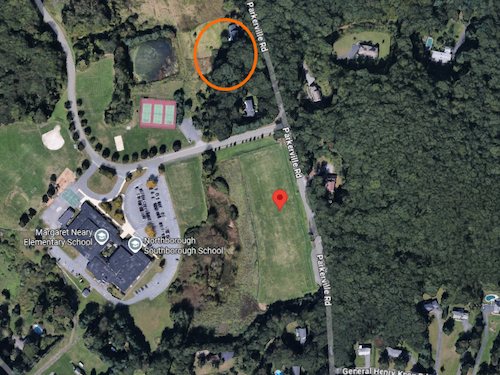
Above: Based on MassDEP’s new reaction to the Town’s environmental monitoring reports on the landfill under Lundblad field, the Town is conducting tests to determine any impacts to nearby homeowners’ wells. (image edited from Google Maps)
On this Tuesday’s Select Board agenda, the board will discuss a request from MassDEP (Dept of Environmental Protection) for “additional sampling/risk assessment for Parkerville Road landfill”.
The letter was in response to above standard results for some hazardous contaminants in samples from the groundwater testing wells.
While the Town’s contractor continued to reassure that he wasn’t concerned about an impact to Neary School (which is downhill from the landfill), he did plan to follow up on potential risk for residents with nearby drinking water wells.
In response to MassDEP’s letter, the Town’s contractor scheduled to conduct groundwater tests to include samples from drinking wells at two private homes yesterday.
The packet from the meeting for the Select Board’s upcoming meeting on January 20th includes a January 7th letter from MassDEP and a memo issued by the Town’s contractor responsible for the ongoing environmental monitoring of the old landfill, Tim Thies of PARE Corporation.
The letter from MassDEP raises concerns about “one or more water quality parameters in exceedance of application standards” in the groundwater testing wells near the old landfill under Lundblad field.
The letter from MassDEP gave the Town until this Wednesday, January 21st, to submit a response to several questions.
Thies’ memo describes that while MassDEP’s reaction to the findings reported in 2025 are new, the findings weren’t. He characterized levels for one compound that MassDEP highlighted as exceeding standards as consistent with the data reported to MassDEP annually since 2015, and the second with levels reported since 2019. (See the tables below that were attached to the memo.)
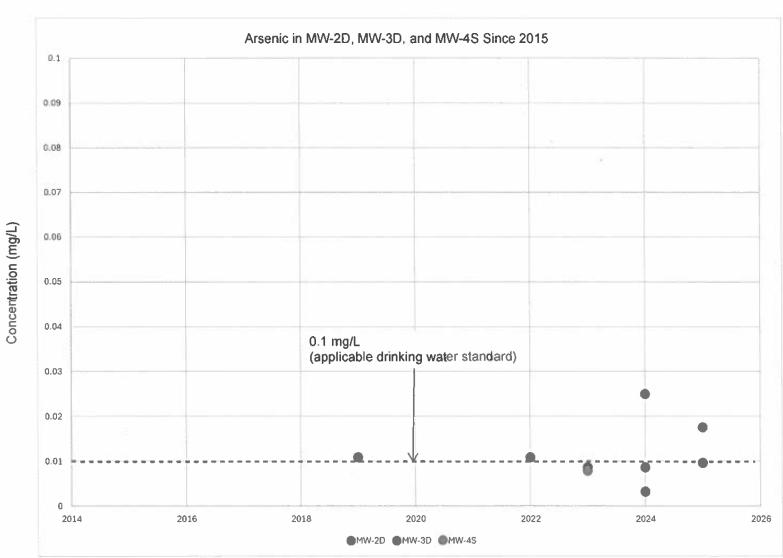

The memo describes the serious health hazards that can be posed by 1,4 dioxane and arsenic. But it also describes that “while it is important to monitor groundwater for these parameters now and in the future, at their current concentrations, they pose a low risk to human health.”
The memo explains:
Neary School and the majority of residences around the landfill are connected to the Town of Southborough public water system . . . and do not drink the groundwater from beneath or near the landfill. . .
There are no public water supplies located downgradient of the landfill, or within at least one mile of the landfill in any direction. . .
The risk of volatilization into an indoor space, which would be the primary concern for an inhalation hazard, is very low because the landfill, where the parameters were detected, is over 100 feet to the nearest residence and 350 feet to the school. It also appears that groundwater is flowing toward a nearby pond and wetland and not toward any occupied structures.
But it also described the exception of some homeowners with private wells nearby and mentioned the health risks for long term exposure to drinking the water every day. And in response to MassDEP’s requests that the Town provide details related to that issue, Thies recommended:
With regard to the homeowners on Parkerville Road who have private wells, the wells closest to the landfill should be sampled and analyzed for arsenic and 1,4-dioxane
Thies noted that DPW Superintendent Bill Cundiff had gotten permission from the property owners at 39 and 41 Parkerville Road to participate in the risk assessment.
While Thies planned to help the Town preliminarily respond to MassDEP by the 21st. But analysis of the testing will take longer. Results from the sampling are expected back from the lab within 2 weeks, and Thies planned to issue a “response and assessment” to MassDEP by March 8, 2026.
Below is the list of questions that MassDEP asked the Town to respond to within 14 days of the letter issued on January 7th:
- Identify the current MCP groundwater category (GW-1, GW-2, GW-3) on the site and immediately downgradient of the site.
- Indicate specifically whether the site and areas immediately down gradient of the site are located in a Current Drinking Water Source Area (Zone II, IWPA, Zone A, within 500 feet of a private well) and/or a Potential Drinking Water Source Area (potentially productive aquifer, etc.).
- Indicate the location of and the distance to the closest private drinking water wells to groundwater monitoring wells MW-3S, MW-3D, and MW-4S.
- Provide conclusions indicating 1 of 2 things: 1) Potential Exposure issues have been evaluated and there is presently No Significant Risk associated with exceedance(s) OR 2) Notification that additional assessment work is warranted (including the specific details proposed).
- Provide a figure showing the location and distance to all private and public drinking water wells within 2-mile from the limit of landfilled waste.
You can view the memo and letter here.
Whether or not it is reasonable to worry about future potential contamination at the school grounds downhill from the landfill has been one of the flashpoints in debates around Neary School and future potential school building projects at the site. With a Special Town Meeting scheduled to take place in early March on which potential school building projects voters want to fund studying, MassDEP’s letter may reignite those debates.

very concerning information. I think any school talk or contracts for studies to build classrooms at Neary should be delayed till several specialists in the contamination field are consulted to assure the people in this town that a building that will hold their children for many hours per day will not pose a threat to their health. Jack Barron, concerned citizen
To be quite frank – as a parent who will have a child at Neary next year – I am more concerned about ceiling tiles falling on them, the lack of a fire suppression system, the leaks in the gym, and the building not being ADA compliant than I am about potentially contaminated water that they won’t even be drinking.
I agree with you that it should be reviewed — but delaying repairs to an already dangerous building is not the solution.
Mr. Thies,
It appears clear that the DEP’s January 7 letter was a direct response to your long-delayed report, not a coincidence of timing.
Your report was submitted six months late and when it arrived the DEP responded on the same day to formally notify the Town of Southborough that it was not complying with the legal obligations it accepted when it capped the former dump on Parkerville Road. The DEP’s letter reads as a reaction to what they saw—or failed to see—in your submittal. They do not sound satisfied.
This raises several serious and unavoidable questions.
Why was the required follow-up testing not performed?
The graphs attached to the DEP’s letter strongly suggest that monitoring data has not been adequately reviewed or acted upon.
Why does the Town still lack the waivers or approvals required to remain in compliance and avoid enforcement action?
These are not optional administrative items; they are explicit conditions of the cap and post-closure requirements.
If this level of performance continues, the Town should expect a formal enforcement order from the DEP, potentially requiring an expensive cleanup of the old dump—not because conditions have changed, but because the Town, through its consultant, has failed to follow the law.
This is precisely the kind of regulatory failure the Select Board did not need while trying to navigate the already difficult Neary School situation. For residents concerned about having a school downhill from a large, capped dump, this episode demonstrates how consultant inattention and missed obligations can quickly undermine confidence in the safety and suitability of the site.
The Town deserves clear, specific answers.
Sincerely,
Carl Guyer