
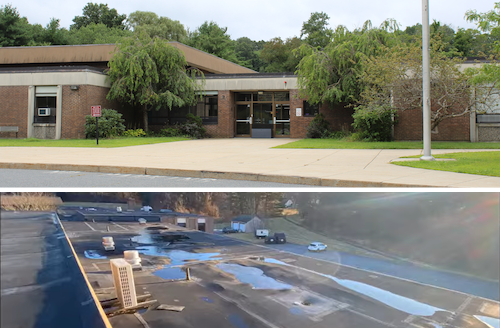
Above: The Select Board and School Committee discussed their plans to ask voters to address the school buildings’ short term needs (mainly Neary’s roof) and potentially longer term projects. (images from school website and roof report)
Town officials made a breakthrough this week related to the upcoming March 2nd Special Town Meeting (STM). After a lot of debate about “Article 1”, the thorniest issue among Select Board members was resolved on Tuesday night.
But they might not be as close to the final draft as those who watched this week’s Select Board Meeting would think.
The board may reconsider wording for the Warrant on Articles funding the Neary School roof replacement (and triggered additional repairs) plus studying potential school building projects.
Regardless of what voters decide to pursue for longer term building projects, the Select Board, Southborough School Committee, and Advisory Committee did unanimously agree on the need to turnout voters to approve replacing Neary School’s roof this summer (under “Article 4”).
Article 4 – Neary Roof Replacement & Related Work
After a presentation by the school’s roof consultants, the full Select Board was convinced of the need for a full roof replacement. They also agreed that the “30 year” roof is the right plan.
(You can read more about the roof report in my coverage of the presentation to the School Committee here. A detail specified on Tuesday, is that the insulation in the new roof would be graded to channel water towards the roof’s drains.)
The STM Article for the roof will ask for $6.85M (but will be reduced if Article 1 passes).
The Article would cover the roof work, estimated as up to $4.5M expense (with contingencies built in). The other $2.35M is are based on the School Committee’s belief that the work will trigger legally required additional building improvements.
On Tuesday night, School Committee Chair Chelsea Malinowski stressed that voters will need to understand, that approving the roof replacement Article is just the beginning. She believes the work will have a domino impact that the Town needs to pay to have studied. That would lead to a future construction project.
Under state law, spending over 30% of the building’s assessed value on building improvements (within three years) triggers a certain level of ADA improvements. The ADA estimate came in as adding $2.2M to the project. Malinowski assumed that Neary’s assessed value for 2026 won’t be higher than $13M. (The 2025 assessment was $11,183,900.)
According to Malinowski, once the Town made the roof and ADA improvements, that would also set off other building code compliance triggers, requiring more building investments. Funding a study to analyze those details is also included in the Article’s ask.
On Tuesday, Select Board member Tim Fling said he wanted to talk to the Building Commissioner again about the triggers. He believed that there may be a “variance” the Town could get.1 He wasn’t sure how that would impact the “whole picture”.
The following night, Select Board member Kathy Cook told the Advisory Committee not to assume Malinowski’s assumptions are correct for a different reason. Based on her recent conversation with the Town’s assessor, she believes Neary’s 2026 assessed value may go up enough to avoid the ADA trigger. (By my calculation, the assessed value would need to increase to $15M, an over 30% increase.) She told Advisory that Assessor Paul Cibelli hadn’t really been paying attention to the importance of the building’s value.2
In the meeting, the public asked questions about the School Committee’s plan if Article 4 fails. NSBORO Schools Superintendent Gregory Martineau said Neary School would remain open next year and they would keep fixing leaks as they occur. (You can read more about the administration’s response to the roof report here.)
But he made it clear (as did other officials) that they don’t believe failure is an option. If voters don’t approve the ask, they’ll have to keep bringing it back to Town Meeting. He reiterated the School Committee’s position — they will not use modular classrooms to allow relocating students to other schools unless a building construction project is underway. (This week, the public was also reminded that using trailers costs $1M per year.)
Parents who voiced concerned about the situation for Neary students next year were encouraged to attend STM on March 2nd, and to help convince other voters to show up in support of the Article.
Because the expense entails borrowing, it will need over 2/3 approval to pass.
Building Study Articles
The first three Articles will each only require a majority vote to pass.
The improvements Malinowski described as triggered by a roof replacement, are the same as ones identified to be studied under Article 1. And that’s the only building study Article that the School Committee is recommending voters approve at the STM.
If Article 1 passes, the committee would ask STM voters to amend Article 4, lowering the cost by over $2M. The initially triggered improvement work would be temporarily postponed, to be incorporated into the study under Article 1 of bigger picture projects to be tackled.
Articles 1, 2, and 3 cover the feasibility studies and documents that would be needed to get accurate cost estimates for potential school building projects for improving Neary School (Article), or eventually closing Neary by adding one grade each to Finn School & Trottier Middle School (Article 2) or adding two grades to Finn (Article 3).
This week, the Select Board, School Committee, and Advisory Committee unanimously supported “Article 1”, to study two “options” for renovations/repairs to Neary School.
The second option will ask for the study to detail a short-term building project with only the barebones fixes (including improved safety) needed to extend the building’s life for just 15 years. The board agreed to wording that would “target” a project budget cap of $15M.
The agreement was hard won from member Al Hamilton. In a prior meeting, on this blog, and for much of Tuesday’s discussion, he adamantly pushed for a mandated $15M cap. He argued that without it, there would be “budget creep”.
At one point, Hamilton asserted that if a contracted consultant came back to the board the news that it wasn’t possible to come up with a project for $15M, they should be fired.
Select Board member Kathy Cook rebutted that understanding what the barebones project would cost (even if $16-18M) was data worth getting, rather than just telling voters $15M wasn’t possible. And School Committee members cautioned that reputable firms the Town would want working on the project wouldn’t bid on an RFP with those terms.
Before the wording was changed, Malinowski suggested the School Committee might postpone taking an official position until “at Town Meeting”. If asked, they could explain to voters their objections to Option 2.
Hamilton didn’t indicate he was persuaded by arguments in favor of the revised wording. Instead, he seemed to accept the version that would go into STM with unified support from both committees.
At the end of the discussion, members had planned to sign the final Warrant that night after the meeting.3 But that didn’t happen.
And questions raised in a meeting Wednesday night highlighted to some members that the language still needed tweaks. The biggest issue Advisory Committee members asked the board to reconsider is how to address overlapping work in Article 1 and Article 4.
The School Committee purposely included the overlap in case voters agreed to the roof project, but not to fund the studies under Article 1.
Some Advisory members were unsure that was the right approach. A suggestion was made that if the roof fix passes, but Article 1 fails, any necessary, triggered work could be addressed at Annual Town Meeting. There was some discussion about how the Article and/or summary could be reworded.
Advisory member Andrew Pfaff disagreed with including the ADA fixes as part of the Article. He suggested Advisory table its votes on Article 4 until the Select Board reconsiders the wording. (In a “straw poll”, members all supported the roof replacement portion of the Article.)
Select Board members and other committees spent a lot of time Tuesday, and in past weeks, on the best way to lay out options for voters. And still, there was confusion about the intent of wording when members spoke with Advisory last night. Based on questions asked, and suggestions made, Select Board Vice Chair Marguerite Landry recommended making some clarifying edits.
If Article wording changes, that will also mean the School Committee will need to recast its position votes. (Especially on the two Articles they unanimously supported on Tuesday.) That won’t be necessary if changes are just to the “Summary” descriptions under the Articles.
Plus, the board may include changes in the motions made on the floor. But to avoid voter confusion, they would need to keep it as close as possible, and make the changes clear.
One detail the Select Board plans to include in motions, but not in the Warrant, is that Articles 1-3 would be fully funded by “Free Cash”. (That means the work won’t have to wait for the start of the next fiscal year. It also avoids paying interest from borrowing the funds.)
If the first three Articles are all approved, the studies would cost up to an estimated $919K. On Tuesday, Cook corrected an earlier public statement by Chair Andrew Dennington about the funding methods. He had said that borrowing for the studies, instead of using Free Cash, would reduce the impact on the FY27 budget headed to Annual Town Meeting. She pointed out that for this kind of lower value, short term borrowing, the cost would be applied to the immediately upcoming Fiscal Year.
The Town could save money by not approving Articles 2 and 3. And removing those Articles would make things less confusing at the STM. But, it would also anger many of the voters at last spring’s STM, who had demanded more school building project options to choose from.
Four of the five Select Board members decided the best option was to provide voters with the ability to vote on Articles 2 & 3 – but to make clear that they don’t support them. (On Wednesday, Landry said she was curious about what a study on a Finn School renovation would find. But she didn’t think it was worth spending that much money on.)
The fifth member, Fling, voted to support both Articles. Not only did he want to give voters the data, he believes they might reveal the best building plan.
Articles 1-3 Updated Warrant Language & Details
Below are updated details on the Articles as of this week’s meetings, including an edit that Landry made to a Summary on Wednesday night:
Article 1:
Article 1: To see if the Town will vote transfer from Free Cash a sum not to exceed $175,000 for the purpose of funding a Feasibility Study and associated design, planning, architectural, engineering work and wetlands analysis for renovation and improvement options for the Margaret A. Neary Elementary School. Said evaluation shall at a minimum include 2 options:
Option 1: A comprehensive renovation and improvement of the Neary School;
Option 2: A plan to address the deferred maintenance items and necessary improvements to extend the practical life of the current Neary School by 15 years. Said plan shall include the following items: (a) a new or repaired Roof; (b) ADA Compliance, (c) removal and/or containment of asbestos, (d) a fire suppression system, (e) maintenance and component replacement of HVAC system; (f) pointing and repair of exterior brick and concrete. Option 2 shall target a cost that does not exceed $15,000,000.00 less the cost of the roof and/or ADA compliance if otherwise appropriated; or to do or act anything in relation thereto.
Summary: This article proposes to fund a feasibility study for renovation and building improvement options for the Margaret A. Neary Elementary School, with the goal of estimating the cost of these options.
The least expensive study would be Article 1, because it utilizes research from the previous studies of Neary. On Wednesday, Cook advocated for it as a solution, noting that it would be the quickest project to get going to improve the schools for Southborough students.
On Wednesday, Landry said she thought the Option 2 wording was meant for a $15M project that would be on top of the roof replacement. Cook explained that the cap includes the up to $4.5M for the roof repairs. Landry believed an edit was needed to clarify. (But the language appears to be accurate. So it may be just the summary text that needs to be edited.)
Article 2
Article 2: To see if the Town will vote to transfer from Free Cash a sum not to exceed $500,000 for the purpose of funding a Two Phased Feasibility Study and associated design, planning, architectural, and engineering work for renovation and expansions to the P. Brent Trottier Middle School and Mary E. Finn Elementary Schools; or do or act anything in relation thereto.
Summary: This article proposes funding a feasibility study for the P. Brent Trottier Middle School and the Mary E. Finn Elementary Schools to determine the feasibility of constructing additions to accommodate Grade 5 at Trottier and Grade 2 at Finn. This world result in the Margaret A Neary Elementary School no longer being used as a school. Phase One of the study will include building system capacity analyses, and land and wetland surveys, for both schools. If Phase One indicates feasibility, then Phase Two will include schematic design, architectural and engineering work, preliminary site development plans, and cost estimates.
On Tuesday, Malinowski clarified that the Select Board had previously reversed figures on the estimates for Articles 2 & 3.
Based on questions raised by Advisory, I reached out to Martineau. He clarified that the budget covers $160K for Phase One ($80 per site study). If it proceeds to Phase Two, it would also cover $240K (for the building study), and $100K for the Owners Project Manager. (That’s detail that Advisory ask be included in the article summary.)
Fling clarified on Wednesday that the study would include verifying the School Administration and School Committee’s assertion that, to meet the district’s educational plan needs, adding a grade to each school would require expanding both buildings.
The School Committee unanimously opposed it, and only one member of Advisory supported it (Erik Glaser).
Article 3
Article 3: To see if the Town will vote to transfer from Free Cash a sum not to exceed $324,000 for the purpose of funding a Feasibility Study and associated design, planning, architectural and engineering work for the renovation and expansion of the Mary E. Finn Elementary School, or do or act anything in relation thereto.
Summary: This article proposes to fund a Feasibility Study for the Mary E. Finn Elementary School to evaluate renovation and expansion of the existing facility to accommodate grades PreK3, including schematic design, architectural and engineering work, preliminary site development plans, and cost estimates. This would result in the Margaret A Neary Elementary School no longer being used as a school.
If Article 2 passes, Article 3 will be amended to remove $80K budgeted for the site study. The remaining budget covers $180K for the building study and $64K.
As a former member of the PreK-8 School Building Committee, Fling told Advisory that believed this could be the best project for the Town’s long term financial needs.
The School committee, which had supported the option last summer, voted unanimously to oppose it this week. Cook told Advisory that she believed that was because the full renovation of Neary is their preferred option.
Glaser noted the irony about that position, given the push the committee made for New Neary last year.
Article 1 keeps the number of grades at each school the same. Article 3 would turn Finn into a 5 grade school. bring together “more grades”. Last year, the School Committee and NSBORO administration repeatedly touted educational benefits of having more grades in the same building. (They had also touted the importance of fewer school transitions.)
Cook defended the committee’s updated stance. She said that a Finn project would take much longer to get going than a Neary building project. That would delay educational benefits for students from improving the schools.
Advisory voted by a 4-3 majority to not support the Article.
Next Steps
The Select Board needs to sign the Warrant by next Friday, February 13th. So far, no meeting has been posted for next week. (Their next regularly scheduled meeting is on February 24th.)
Reminder, the Special Town Meeting is open to all registered Southborough voters. It is scheduled to begin on Monday, March 2nd at 6:00 pm at Trottier Middle School. (If you aren’t registered to vote yet in Southborough, that deadline is 5:00 pm on February 20th.)
The Select Board plans to ask the moderator and hall to allow combining the discussion on all four of the Articles together prior to voting.
- According to the state website, a building owner who thinks that full compliance with the ADA triggers is “impracticable” can apply to the state Architectural Access Board for a variance.
- Note: In a past (unrelated) conversation with Cibelli, the Assessor indicated to me that his department focuses its attention on updating assessments of taxable properties.
- The Select Board voted in public to approve the Warrant language as revised that night. They hoped that staff could print off a clean version for them to physically sign while the board discussed other matters in an (unrelated) Closed Executive session following the public session.
