
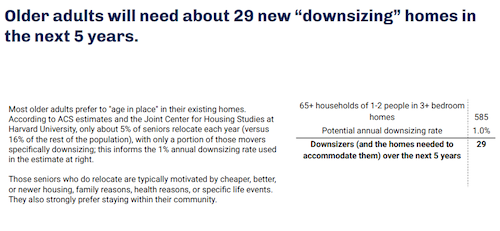
Above: In the Housing Production Plan, the AHT presented that about 6 new “downsizing” homes per year would be needed to accommodate Southborough’s aging population. A proposed bylaw seeks to help address that market gap. (image from 2025 HPP)
As I posted yesterday, the Planning Board is holding hearings on several Southborough’s zoning bylaw revisions that will be proposed to voters at the Annual Town Meeting in April.
Today, I’m spotlighting the proposed “55+ Housing Bylaw Update”. Notably, up to 20% of the units in housing projects under the draft bylaw wouldn’t have age (or disability) requirements.
The Public Hearings on zoning changes that opened on Monday, included a proposal to expand the options for 55+ Housing in Southborough.
The AHT is seeking to address the Town’s deficit of reasonably priced housing options. One of the needs they are seeking to meet is “downsizer-friendly homes” for seniors.
The Town’s current bylaw for for 55+ housing projects has a cap on special permits that is basically at full capacity.
Rather than raising the cap, the draft bylaw would eliminate capping the number of projects/units. It would also double the allowed density. And, based on federal law, it removes a cap on the number of bedrooms per unit.
This week, two residents who supported the effort to increase affordable housing options voiced concerns that the proposed rewrite goes too far increasing denser housing options. The board acknowledged concerns and planned to keep working on refining the bylaw as they receive public feedback.
You can read the most recent draft from the meeting packet here (on page 16), and the current bylaw “§174-9 Special Permit Requirements H (1)” here. Below are more details on the reasons behind, and concerns about, the changes the Article would make to Town bylaws.
Increasing Affordability
Last summer, when the AHT proposed raising or eliminating the cap, Planning member Lisa Braccio worried about the impact of doing that without also incorporating other changes for affordability.
The original bylaw writers attempted to target reasonably priced housing for seniors by limiting ownership to public or non-profit community housing organizations. Ten years ago, the court informed Town Counsel that the bylaw clause was invalid. Towns are allowed to regulate property uses, but not ownership. (Although there are certain certain ownership requirements that are allowed under state law, like specifying owner-occupied, or rentals, and senior housing.)
The AHT sought to address that by including new affordability requirements. At least 12.5% of units would be designated as affordable (at 80% of the Area Median Income) and listed on the town’s Subsidized Housing Inventory (SHI).
Planning Chair Meme Luttrell suggested adding a requirement consistent with Major Residential Development zoning. That includes not issuing occupancy permits for more than 75% of market-rate units until 100% of the affordable units are complete.
Public commenter Freddie Gillespie suggested adding a stipulation to allow another 12.5% of units be subsidized by grants or the AHT for housing units affordable at 30% of the Area Median Income.
The developments must include at least one constructed affordable units. Beyond that, if developers don’t want to round up on the calculation, they could make a payment to the Southborough Affordable Housing Trust for “fractional” units.
Gillespie criticized the calculation used for the payments as too low, and argued against not rounding up fractions of ½ unit or greater.
She also criticized the lack of restrictions on the size of affordable vs non-affordable units. She worried that there wouldn’t be equity in the offerings.
Changes to the Ownership Requirements
The current bylaw includes a clause that one of the residents must aged 55 years or older “or handicapped”. As currently drafted, the requirement eliminates counting “handicapped” residents toward the requirement. But it also only restricts 80% of the units by age.
In prior meetings, Planning member Debbie DeMuria had voiced concern about focusing on encouraging senior housing. She worried that the Town would be unfairly discriminating against other people who need housing, including families.
More recently, Luttrell worried about the Town’s ability to track the proposed replacement regulation that at least 80% of units to have at least one resident aged 55 or older. Member Alan Belniak responded that the 80% rule is a federal definition (under HOPA, the Housing for Older Persons Act), and warned that a different standard could be viewed as discriminatory.
Eliminating Caps & Increasing Density — Motivations and Concerns
The zoning initiative comes out of the AHT’s work last year to update the Town’s Housing Production Plan (HPP). The Town is required to report to the state every 5 years on progress (or lack of) in meeting area housing needs (based on state regulations). The report must include a plan for addressing gaps.
In a presentation to the Planning Board and Select Board last summer, the AHT described the Town’s need to significantly increase the amount and diversity of housing stock.
One of the strategies proposed in the HPP adopted by the Town was lifting the nearly maxed out cap on age 55+ housing developments. While Planning Board members raised some concerns about the approach, they agreed on the need to offer more affordable options. And they committed to working with AHT on an effort to improve zoning.
This week, a public commenter voiced her alarm about the impacts of both lifting the cap and increasing allowed density.
Without a cap, Freddie Gillespie worried that the new 55+ bylaw would too successful at incentivizing developers. She referred to it the biggest zoning change she’d seen in 25 years. She warned against adopting zoning that would have massive potential impacts without any analysis conducted.
The proposed revisions doubles the density of the housing projects. That would replace the maximum average of 3 units per acre with 6 per acre. (For both calculations, that’s per contiguous acre, excluding 80% of wetlands.)
Gilespie argued that the change:
turns every lot in town into a multi-family 6 lot per acre zoning district.
Planning Member Marnie Hoolahan noted that the projects aren’t by-right. They require a special permit from the Zoning Board of Appeals (ZBA). The board confirmed that the ZBA has discretion to deny permits.
But Gillespie worried that discretion was “too vague” to offer protection. She worried that the bylaw change could allow for hundreds of new units on some undeveloped lots, and a surge in multifamily units across the town.
Gillespie also posited that by making land more developable, it would drive up the demand for, and cost for land. She believed that would result in more expensive housing projects.
Although she didn’t refer to her role, Gillespie is the Chair of the Open Space Preservation Commission. In the hearing, she flagged the risk to Southborough’s open spaces and environmentally sensitive areas.
One of the reasons a senior cap was initially included was that the zoning allows denser development than standard zoning. And neither the original bylaw or AHT’s drafted revisions include a requirement to set aside open space.
In contrast, the Town’s bylaws for “Major residential development” subdivisions require developers to dedicate significant “common open space” areas around the project. (The designated space should add up to 25-35% of the project area.)
Gillespie also argued against the 80% wetland exclusion as too low, highlighting that it also doesn’t account for buffer zones. She said that meant that properties with wetlands would have even denser projects. She worried about the runoff impact on the wetlands.
She also she warned about the traffic impacts across town from future projects.
Hoolahan, who worked with AHT to draft the bylaw, told Gillespie that her critical feedback was “excellent” and appreciated. She suggested sitting down with her to go through her suggestions.
She said that she and the board had been on the fence about both the cap and the density. They wrote in six for the draft for public hearings. She followed, that they have two months to try and amend the bylaw.
Public commenter Kristen Lavault echoed Gillespie’s concern.
She commended Planning and AHT for their work. But she worried that residents upset about the real lack of affordable housing options may approve changes that unintentionally “swing the pendulum too far, too fast in the opposite direction”. She followed that the bylaws exist for a reason.
She called for the Town to work on a more comprehensive plan for affordable and 55+ housing.
Oversight Changes
The zoning keeps the ZBA as the special permit granting authority, but adds a requirement for Major Site Plan Approval from the Planning Board.
If you’re interested in keeping tabs on this or other zoning changes, save the date for the board’s next meeting on Monday, February 23rd.

Just a thought! Why not put together a plan to allow Senior Citizens a reduction on tax rate? Not just the small decrease allowed by applying for it which needs to be done every year. But a decrease based on number of years they reside and pay taxes. Instead of forcing us into other housing let us remain in homes we love and have cared for for years. I doubt it would hurt the inflated town budget at all. Many communities in Mass have raised the tax rate making it impossible for folks living on fixed income to remain. We have donated to the town taxes like many folks here for years. In our case over 42 years and there are many just like us.
Mike
First, the tax revenues from properties owned by seniors are important to the overall budget. About 19% of the adult population in Southborough is over 65 and I suspect that if you counted the % of the tax base owned by seniors it would be higher. A break offered to one group has to be made up by another.
There are 2 income based forms of property tax relief that I know about. One is the Senior Tax Write off where a qualifying senior can work for the town at the minimum wage rate to get credit for up to $2,000 of tax relief. This does count as income for tax purposes and the senior will get a tax statement from the town.
The second is a tax deferral program where the senior in question can defer their taxes until they sell their home. The Town takes out a lien against the property and the balance accrues with interest until paid when the home is sold.
Anything else is probably going to require state approval via special legislation.
Al, I hear your point!! But my point is we have paid tons of dollars into the towns infrastructure. Lately there have been multiple towns in Mass driving out middle class and upper middle class people out of the towns. The taxes in this town continually go up with no real improvements being done. Multiple project studies done from outside firms that should be handled by employees hired in this town! If the town had taken care of facilities in the town from day one we not be looking at spending multimillions doing it now! Time after time various articles are voted NO at town meetings but they are still being pushed. Again tons of dollars wasted trying to put together alternatives that never happen! Time for things to change and a hard look at the town government !