
[Ed note: My Southborough accepts signed letters to the editor submitted by Southborough residents. Letters may be emailed to mysouthborough@gmail.com.
The following letter is from Kelly Conklin.]
To the Editor:
I am writing to share a simplified, digestible overview of how Southborough reached its current crossroads regarding the Neary School. After the failed ‘New Neary’ vote last May, I felt compelled to join the PreK-8 Building Research Committee to understand the historical context of our facilities.
As a middle school educator who has had the privilege of working in some of the state’s top-performing districts, the sanctity and preservation of public education is not just a professional interest –it is a core part of who I am. I believe a high-quality school system is the bedrock of a thriving community. However, my time digging into town archives and school committee documentation revealed a troubling 25-year cycle of temporary fixes.
What I discovered is a pattern of deferred maintenance that dates back decades, including a 2001 decision to divert Neary’s renovation funds to other facilities. Today, we face a roof in ‘active failure’ requiring an estimated $4 million to $4.5 million in urgent repairs. Furthermore, by not seeking an MSBA extension, our town has forfeited over $34 million in state contributions.
As we approach the Special Town Meeting on March 2nd, we are not just voting on articles; we are deciding whether to continue a cycle of ‘band-aid’ funding or finally commit to a long-term strategic plan. The following timeline is intended to inform residents—through the lens of both an educator and a researcher—on how we can best honor our taxpayers and our children.
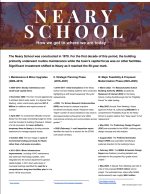
[Editor’s Note: Conklin also provided this pdf version of the information below.]
Building History:
The Neary School was constructed in 1970. For the first decade of this period, the building primarily underwent routine maintenance while the town’s capital focus was on other facilities. Significant investment shifted to Neary as it reached the 50-year mark.
I. Maintenance & Minor Upgrades (2000–2015)
- 2000–2010: Steady maintenance and small-scale capital items.
- November 2000:The town moved aggressively to address district-wide needs. In a Special Town Meeting, voters unanimously approved $21.2 Million for additions and repairs across all schools.
- April 2001: An amendment officially removed Neary from the large remodeling budget so funds could be funneled to building Woodward. Instead of a full renovation, the town shifted to temporary fixes to Neary by funding modular classrooms to manage capacity issues.
- October 2002 The town began a cycle of incremental funding and study for Neary rather than a full-scale renovation.
- 2011–2014: Minor infrastructure improvements, including HVAC maintenance and classroom technology updates, were integrated into the school department’s general capital budget. A 2014 town-wide study of municipal buildings identified the need for a comprehensive long-term facilities plan for the town’s 1970s-era schools.
II. Strategic Planning Phase (2016–2021)
- 2016–2017: Initial evaluations of the Neary School roof and heating systems were conducted, highlighting a shift toward assessing “life-cycle” replacements.
- 2020: The School Research Subcommittee (SRS) was formed to analyze long-term enrollment and facility needs. Research noted, “higher number of school transitions may result in decreased student achievement and ‘affect instructional continuity and communication across grades’”.
- 2020 (February): A roof inspection reportidentified the need for a solution for the EPDM roof section at Neary.
III. Major Feasibility & Proposed Modernization Phase (2022–2025)
- March 2022: The Massachusetts School Building Authority (MSBA) accepted as Statement of Interest (SOI) for the Neary School, inviting Southborough into the “Eligibility Period” for state funding.
- May 2022 (Annual Town Meeting): Voters approved Article 16, authorizing $950,000 for a comprehensive Feasibility Study for the Neary School to explore options from “base repair” to full replacement.
- May 2024: The Preliminary Design Program (PDP) was submitted to the MSBA, outlining early design concepts and site analysis.
- August 2024: The Preferred Schematic Report (PSR) was submitted, identifying a preferred direction for the building’s future.
- February 2025: The MSBA Schematic Design Report was finalized, providing detailed cost estimates for the proposed four-grade school project.
- May 2025: A Special Town Meeting was held to vote on the proposed $108.5 million school project. The estimated town share (after MSBA reimbursement) was roughly $68.2 million
IV: Present Day (2025-Present)
- July 2025: A new committee (Southborough Pre K – 8 Building Research Committee) was formed in response to the failed vote. This committee was tasked with researching and comparing potential projects. The main purpose of this committee was to provide more transparency to the public on all potential configurations.
- August 2025: The Select Board voted not to seek the MSBA extension, effectively relinquishing the state contribution. With the Select Board’s decision to not seek the MSBA extension, the town forfeited the MSBA award of $34,667,306.
- September 2025: After a survey went out to residents during the summer, NO voters cited “high cost” and “lack of alternative options” as the two central reasons why they were opposed to the project.
- October 2025: The Southborough Pre K-8 Building Research Committee concluded its work and presented its findings to the Select Board. The Educational Implications working group found that seven of the ten configuration studies aligned with the district’s educational plan and did not negatively impact the quality of education.
The configurations NOT supported were those that consolidated students into our current blueprint without renovation for additional square footage. Simply put, schools cannot consolidate in this manner without having a devastating impact on school programming that would:
-
- Disportionally affect students with specialized needs (neurodivergent learners, those receiving specialized education services, and English language learners)
- Increase class sizes –ultimately taxes individual teachers as well as the system over all
- Remove Pre-K access to library, music, and art
- Reduce access to Music programming due to scheduling limitations
- Displace Special Ed Program, requiring need for out of district costs
- November 2025: The Southborough School Committee presented findings from a comprehensive environmental study on both Neary and Finn Elementary Schools. The environmental studies at Neary Elementary School were conducted to identify hazardous materials—specifically asbestos, lead, and mold—to ensure occupant safety and prepare for future renovations. High-level findings confirmed the presence of asbestos-containing ceiling tiles and pipe insulation, along with localized mold growth and moisture damage in classrooms and HVAC units. While radon and lead levels were within safe limits, the reports recommended immediate roof repairs and updated asbestos management to prevent further deterioration of indoor air quality.
- December 2025: Following a joint Select Board, Capital Investment Planning Committee, Advisory Committee, and School Committee Meeting, the Select Board proposed three feasibility studies for the town to fund based on the PreK-8 Research Committee’s work as well as funding for urgent repairs.
Later that month the Select Board met to discuss the wording of the Articles to be placed on the town warrant. Select Board member, Al Hamilton, proposed adding a fifth article to the warrant in order to fund a ‘less robust’ renovation of the Neary School that would buy the town roughly fifteen more years before having to make any significant investment. This is now reflected in the current Article 1, Option 2 language. - January 2026: The Southborough School Committee reviewed a critical assessment of the Neary Elementary School roof, which is in active failure after 30 years of use. Experts recommended a full replacement due to widespread insulation displacement and safety risks, rejecting partial repairs as non-viable. The project is estimated to cost between $4 million and $4.5 million, with construction prioritized to prevent membrane failure and ensure code compliance
Upcoming Special Town Meeting
Date: March 2nd, 2026 at 6:00 PM
The choices made at this meeting will shape the future of our schools. Participate in building a consensus that honors both our taxpayers and our children.
- Article 1: Fund a feasibility/schematic design study for Neary School renovation options.
- Article 2: Fund a feasibility/schematic design study for expanding Trottier + Finn.
- Article 3: Fund a feasibility/schematic design study for Finn renovation/expansion.
- Article 4: Fund Neary Roof Repair, ADA updates, and other urgent code-compliant repairs.
What Comes Next: Strategic Long-Range Facility Planning
While 2060 may seem distant, the “end-of-life” cycle for our school infrastructure is rapidly approaching a critical convergence. Like any major asset, our schools require proactive investment to prevent the compounding costs of emergency repairs. However, we must look beyond simple maintenance toward long-term structural efficiency.
Based on current life-span projections, Southborough faces a significant concentrated tax burden as four major facilities reach their expiration dates within a single eight-year window:
Finn Elementary: 2060
Woodward Elementary: 2064
Trottier Middle School: 2064
Algonquin Regional High School: 2068
Simultaneously renovating four schools in less than a decade would create an unprecedented financial strain on future residents. The choices we make in March will begin our next chapter towards finding a solution on how best to address the future of Neary.
Strategic investment today is not just about fixing a roof; it is about ensuring the long-term fiscal health of Southborough and our district for the next century.
Kelly Conklin
17 Sadie Hutt
Updated (2/25/26 9:51 am): Conklin abbreviated the conclusion of the above letter (and original pdf) to remove a personal opinion about questions that should guide decision making. You can view the revised pdf flyer here.
