
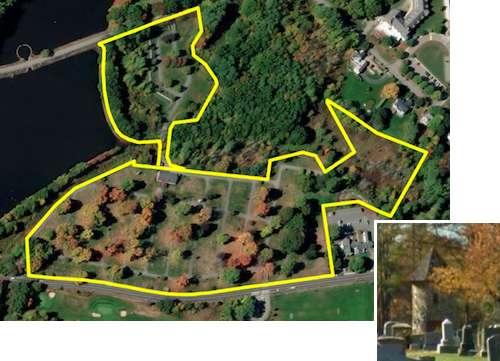
Above: A committee will look at expanding the Rural Cemetery and a new potential use for a unique feature on the existing parcel. (images edited from GIS Maps and Google Street maps)
Last year, Southborough’ DPW chief warned the Select Board that Southborough’s cemetery could run out of space for new graves in about 10 year. He asked for help identifying land for a new site/expansion.
This week, the Select Board approved a charge to create a new ad hoc committee dedicated to exploring his request, along with how to make the most of the current parcel.
The committee’s work will include considering a project suggested by the Historical Commission’s Chair — potentially converting a historic stone water tower into a “Columbarium”.
(For those unfamiliar, a Columbarium is a building or structure with niches to hold urns.)
New Charge
The committee will:
identify and evaluate suitable land parcels for the potential expansion of the Southborough Rural Cemetery. The Committee shall assist and advise the Department of Public Works (DPW) Superintendent and the Select Board regarding the potential acquisition of such parcel(s). The Committee will also identify opportunities to maximize the use of existing Rural Cemetery grounds, including the columbarium.
Within the first month of work, members are expected to develop an “Action Plan” for their work. The deadline for a final report and recommendations is June 30, 2027. That’s also when the committee would dissolve, unless the board extends their work.
Select Board Vice Chair Marguerite Landry worked with Cundiff and others to come up with the draft. That included Historical Chair Kevin Miller. She confirmed to fellow members that the charge is meant to cover exploring Miller’s project concept for using the water tower. (Scroll down for more on that.)
You can read the full charge here.
The Select Board hopes to appoint five residents to the committee. Anyone interested in applying, can fill out the Town’s online form here.
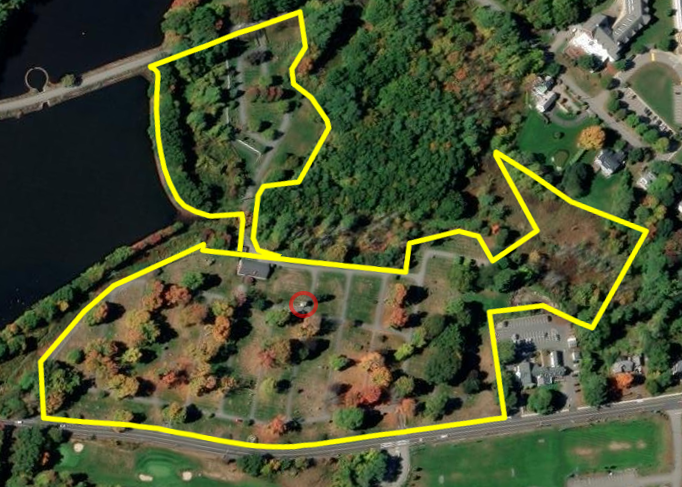
The Rural Cemetery was established in 1842. You can learn more about it on the Town’s website here. (Below is a map image of the cemetery’s parcels, with the location of the water tower circled in red.)
Historic Water Tower
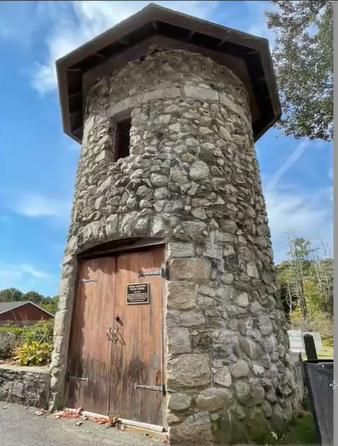 A few years ago, Miller became fascinated by the unique stone tower in the Rural Cemetery. He wanted to understand its origin and function. He learned that it was built in 1903 as part of an irrigation system for the cemetery.
The commission began work on a potential Community Preservation Act project to restore the tower. In a 2024 application, Miller described seeking “funding to restore the roof and wooden elements” of the building that was formerly a holding tank for well water pumped into it using a windmill.
The project was put off for more investigation before bringing a project to voters. To help with the effort, the Select Board approved $5,000 for the Historical Commission to contract a Feasibility Study.
That got put on hold after Miller came up with a new concept last fall. He told his committee he was inspired by thinking about the space constraints the cemetery was dealing with. He did a little informal research into the idea of converting the tower into a Columbarium. He reached out to a nationally known architecture firm about the concept. A principal told him that he wasn’t crazy, and they were interested.
He advocated for holding off on the restoration Feasibility Study to allow time to further investigate the new concept.
Cemetery Commission Background
Initially, DPW Superintendent Bill Cundiff asked for a standing Cemetery Commission. According to Landry, he was seeking help both with an expansion project and other cemetery oversight and upkeep issues.
The Select Board debated creating a new committee. Prior to the Town abolishing the Public Works Planning Board, that board’s work included supporting those kinds of requests from the DPW. But when the Select Board succeeded in getting the PWPB rescinded, they chose not to follow through in creating a previously discussed Public Works Advisory Committee to support the dept.
At one point, they considered creating a new standing Cemetery Committee through a Town Meeting Article (potentially with a petition to the state to again change the language about a DPW advisory committee).
More recently, they opted to focus on a shorter term goal. That allowed the board to create an ad hoc (temporary) committee without a Town Meeting vote.

Any land that is not clean and requires remediation based on state and federal guidelines could be great to use as a burial ground. Those new residents will have no personal health concerns with the poisons in the land. Jack
What about the property about the property directly across from existing cemetery on Middle Rd? It is presently being used by Fay school as athletic field but they don’t own it to my knowledge .
It’s owned by Mass Dept of Conservation & Recreation
Good morning,
Although the parcel belongs to Mass Dept of Conservation & Recreation and leased to Fay School, I’m sure it will be on the list of properties to minimally investigate. Having been on the previous Cemetery Expansion Committee, the most difficult part was finding a suitable piece of property, the build out, Middle Road Cemetery, was the easiest part of the process.
I’m curious. When did that work and expansion take place?
Good Afternoon Beth,
Some initial work was done when I was on the Board of Health, mid 1980’s, investigating the possibility of expanding the Rural Cemetery on Middle Road. Due to the initial opposition from either the MDC or MWRA , not sure which one, it was dropped. During the last year of the Cemetery Commission which I was a member of along with George Killam and John Mauro, we started looking for potential sites for a new cemetery, I believe that was 1990/1991. The Cemetery was dissolved and the DPW was established in 1991. Shortly after that, an ad hoc committee was formed to find a suitable area to expand the Southborough Rural Cemetery, I was selected to be on that committee headed up by Niel Ferris. Over the following year, after reviewing many parcels of land, we decided to approach the State again on the Middle Road parcel. Well it worked, once all the legal hurdles were done, we selected an architectural firm for the design and then went into the construction phase. I believe the Middle Road Cemetery turned out to be a great addition to the Rural Cemetery in many ways. Hoping this answers your question.
So a school which pays minimal taxes can take over the property but we can’t utilize it to expand the cemetery ?
I was clarifying who owns the property.
Robert , Hopefully the state will go along with that parcel . I reside on Middle Rd and will definitely support that location.
Good Morning Mike,
The first hurdle would be to convince Fay School, if that was successful then the State. A bit of work ahead for the new Committee.
Does anyone know when the lease is up for Fay?