
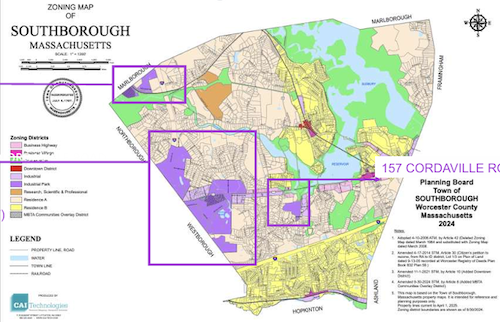
Above: Town Meeting will vote on whether to make proposed “modernized” zoning changes to attract development of properties in the Industrial Park zone. (image cropped from Planning presentation)
For over a year, the Planning Board has been working on zoning updates to attract more business revenue, while still protecting residents and conservation areas from negative impacts.
The result is Annual Town Meeting Article 17. On April 11th, voters will be asked to approve modernized and expanded uses, along with new restrictions, for Southborough’s Industrial Park Zone.
Changes require a 2/3 approval of Town Meeting. That’s a high bar, especially when changes are extensive and can seem complicated. So the board is seeking to educate voters in advance.
Planning member Marnie Hoolahan reached out to ensure I had the details I need to help educate voters about the proposed changes. She also recorded an overview video (plus two bonus videos for voters who want to understand more details about two specific new uses).
Overview of Changes
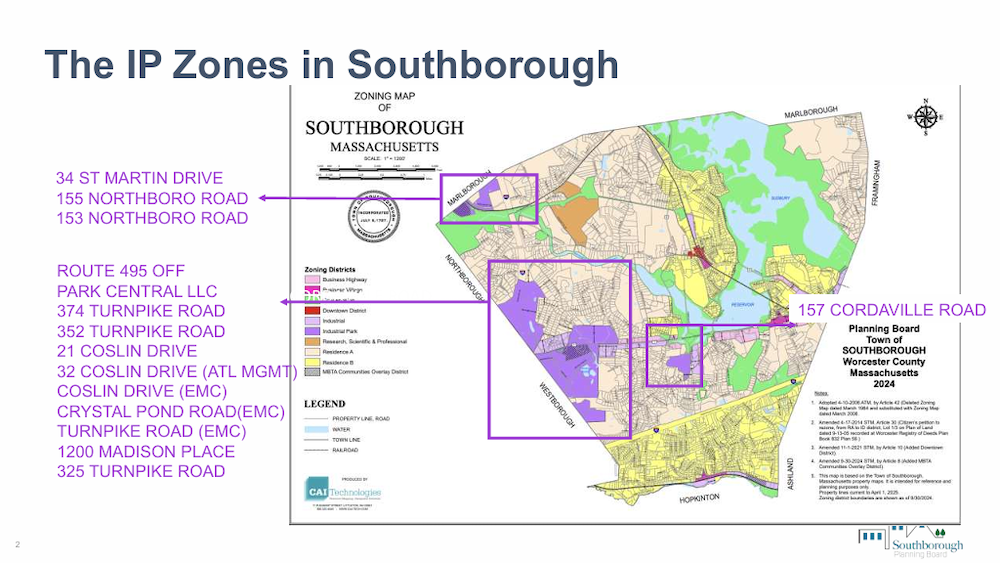 Planning’s presentation on the bylaw highlights the properties (in purple) that would be covered by changes to the Industrial Park (IP) zone.
The initiative to update the attractiveness of the IP zone for development dates back to fall 2024. The work had to be tabled a couple of times while the board focused on more urgent zoning efforts. Most recently, that was to help get zoning passed for a potential future Costco on the old EMC property in the Industrial Park (IP) Zone.
The section of the IP zone (on the western border, south of Rte 9), is the one that the Select Board has had the highest hopes for generating tax revenue. And when urging the public to approve the zoning for Costco, they pitched the retailer as a “magnet” to draw in other business.
But many of viable modern retail uses that might be attracted aren’t allowed in the IP zone under Southborough’s current bylaws.
The proposed changes are to the entire IP zone, so they could also encourage development in other areas of town.
Zoning Use Changes
The zoning Article will amend two sections under the current bylaws for the IP zoning. Most relate to section §174-8.6IP Industrial Park District.
Some outdated uses are eliminated and new uses are added.
A special permit will no longer be required for the following two uses:
- school, childcare nursery, or kindergarten
- assisted living residence, adult day health center, or similar facility providing care, supervision, or support services for elderly or disabled adults
Even for some of the currently allowed uses that will remain, new language highlights and clarifies the type of businesses the Town is willing to accept.
Proposed new by right uses up to 50,000 sq. ft are touted to cover:
- Breweries/distilleries
- Recreation, arts, cultural and fitness facilities
- Creative workplaces, digital services, publishing
- Retail, banks, offices, and consumer services (no manufacturing)
- Medical clinics and outpatient centers
- In compliance with recently updated state laws — Small clean‑energy infrastructure (with safeguards)
- Retail, banks, and consumer services (no manufacturing)
- Light manufacturing with strict environmental controls
Those same uses could also be allowed over 50,000 sq. ft. if a special permit is approved.
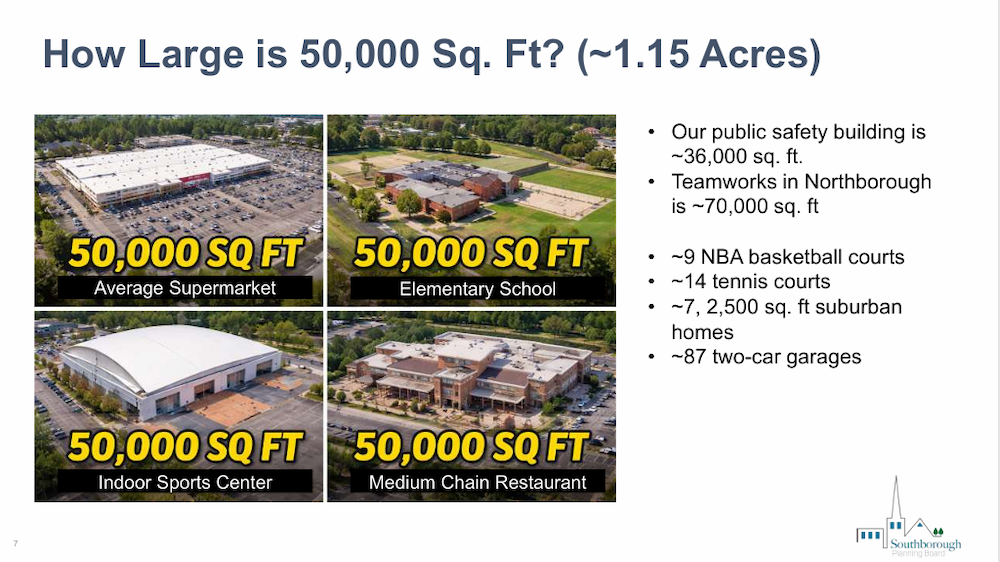 Need some context for what 50,000 sq. ft. represents? Check out Planning’s slide right.
Additional uses that would always require a special permit, no matter the size, include on‑site manufacturing with retail. Notably, it includes special permits for Data Centers, with a maximum size of 50,000 sq. ft. (Scroll down for more details on that new use.)
It also includes restricting a current use that the board apparently decided needs more oversight. Currently “Scientific research and development, including manufacturing, instruction and other activities clearly incidental thereto . . .” is allowed by right up to 50,000 sq. ft.. The new bylaw strikes that language, but adds a Special Permitted use for “Laboratories, Life Science Research and Development Commercial Manufacturing”.
New Protections
The bylaw now specifies requirements to restrict negative impacts beyond businesses’ property lines. As the board’s presentation outlines, those are:
- Noise (must meet MA DEP standards)
- Vibration (no perceptible vibration off-property)
- Odor (no detectable odor beyond property line)
- Emissions (must meet state/federal air-quality rules)
- Prohibits excessively bright lights and refuse issues
For any project that abuts a residential/conservation district, the minimum setbacks double from 50 ft to 100 ft.. That increases to 1,000 feet for “Small Clean Energy Infrastructure” and Data Centers.
A special setback of 1,000 ft from Rte 9 applies to “Indoor Facilities for Wholesale Trade, Distribution, and Storage of Goods and Materials”.
Other dimensional zoning caps remain the same. (For instance, building heights are capped at 45 ft tall and 3 stories.)
Hoolahan created this handout that details everything that is changing and staying the same. She also recorded the video below, walking viewers through the details in that handout.
Data Centers
In public meetings, the board has discussed the growing creation of Data Centers in the country to support AI. They’ve also discussed the growing public backlash over the resources they use.
Members chose to proactively draft bylaws with special restrictions on what the Town will allow for these types of businesses. They capped projects at 50,000 sq ft, and included the 1,000 sq. ft. buffers from residential/conservation properties.
When I asked Hoolahan about the extra restrictions, she explained that she read about noise and vibration complaints related to Data Centers in other areas of the country.
Article 17 includes a change to add Data Centers to the list of projects that require special permits through the Planning Board. (The default authority would otherwise be the Zoning Board of Appeals.)
In Monday night’s hearing, Chair Meme Luttrell justified the Planning Board’s permitting authority for data centers. She described them as “very site intensive”. She advocated that as the board that is responsible for Site Plan Review, it aligns better with Planning’s role. It also allows applicants to streamline the process by going through both the permitting and site plan hearings at once.
For more on that section of the bylaw, see Hoolahan’s focused video:
Clean Energy Systems
Under state laws, the Town is required to allow the by right siting of Clean Energy Systems. Those include:
- Rooftop solar panels
- Small ground‑mounted solar arrays
- Heat pumps or small geothermal systems for heating and cooling
- Small wind turbines designed for individual properties
- Battery/Energy Storage Systems
All projects also have to comply with state laws and regulations. But the Town is also allowed to add some local restrictions. The bylaw would require a 1,000 sq. ft. buffer from residential/conservation properties.
Hoolahan discusses that section of the bylaw in the following video:
For more details on the upcoming Annual Town Meeting and other topics on the Warrant, click here.
