
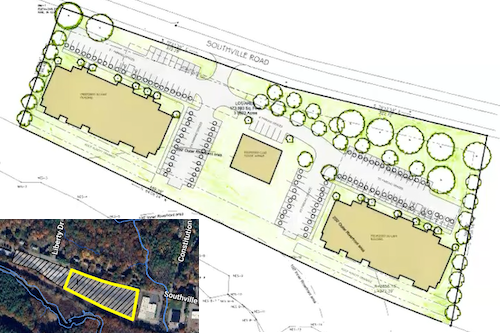
Above: Over a year after the MBTA bylaw was passed, the Planning Board hosted a presentation from developers seeking to make use of it to build a new rental housing project. (images edited from GIS map and meeting video)
In this week’s Planning Board meeting, members heard from developers proposing the first large development under Southborough’s MBTA Communities Zoning bylaw voters passed last fall.
The 60 rental unit project would be built on a currently undeveloped 4 acre lot about 0.8 miles down the road from the MBTA Commuter Rail station. It is the type of project state officials hoped would result from forcing towns with/adjacent to mass transit to adopt denser zoning allowances.
But an abutter who had publicly opposed Southborough’s bylaw highlighted that the project appears to be much larger than what voters were told would be possible on the property. The board’s discussion also raised questions that need answering about the bylaw’s wording and meaning.
The actual number of units, building design, and even a proposed clubhouse could hinge on legal interpretation of Town bylaws. But given the site near a river and wetlands, the scale of the project may be depend on what the Conservation Commission decides.
The Proposal
James Venincasa and Cohen Babcock of SJP Investments presented their preliminary proposal to the Planning Board on Monday night. They introduced their family-owned company, and touted the experience and expertise of the team involved. They also shared images of relevant examples of their work from past projects.


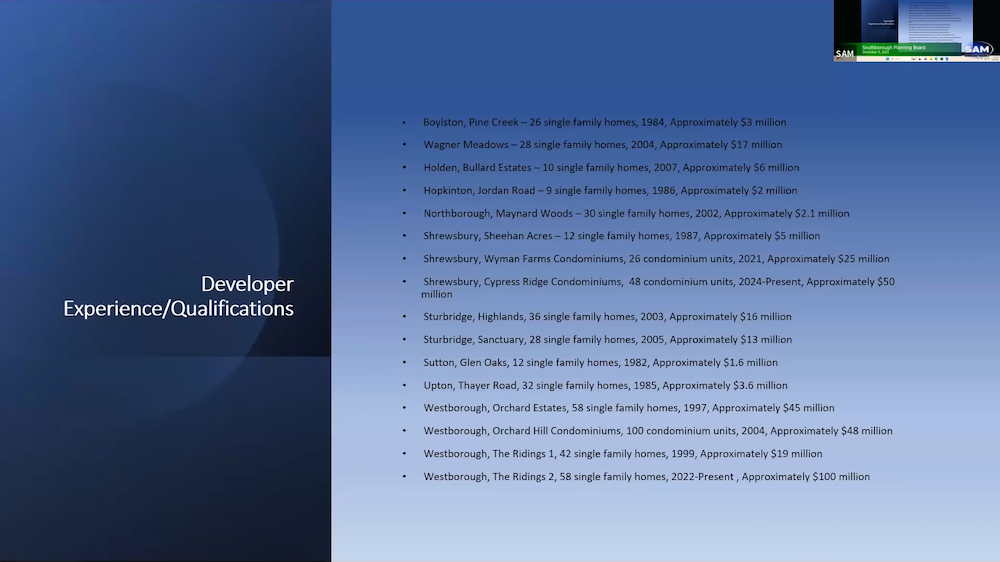
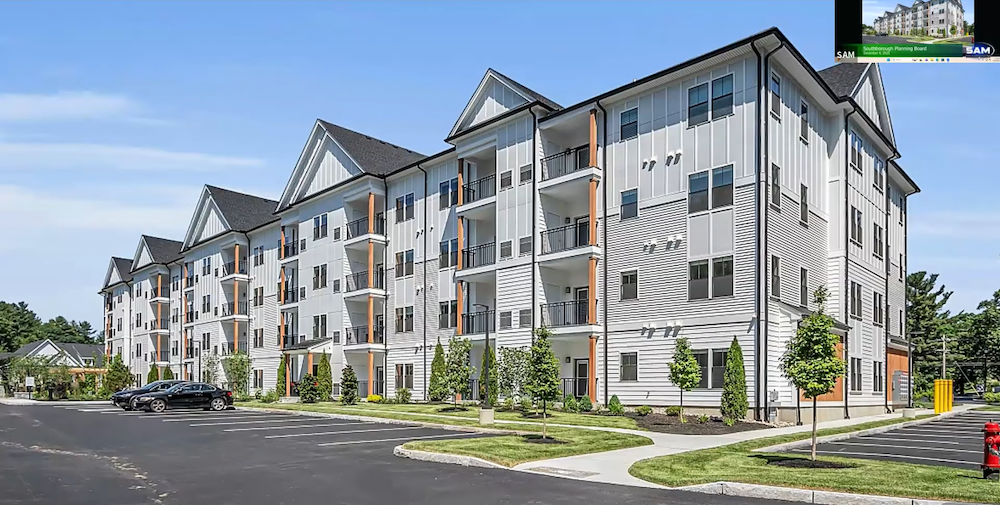
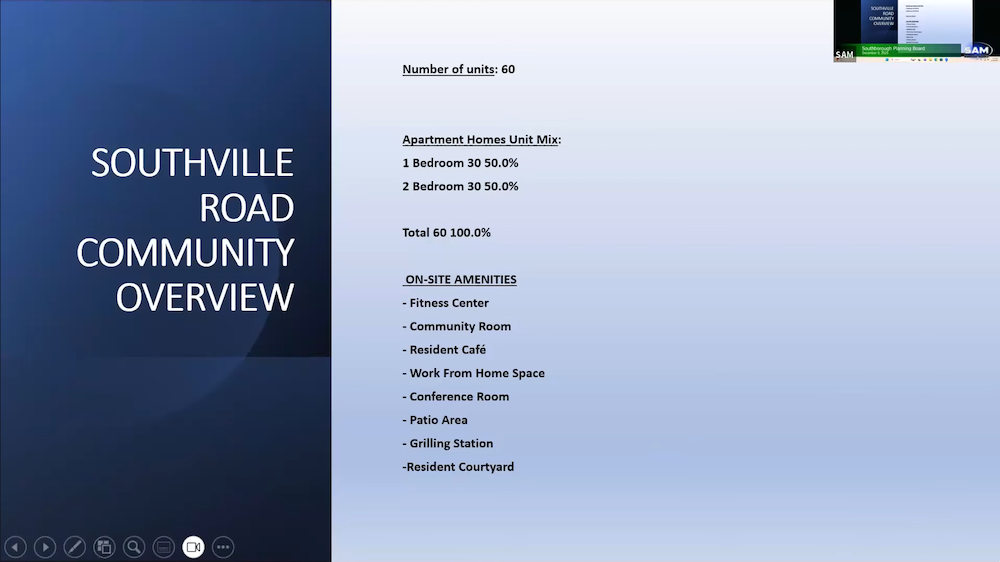
Babcock then walked the board through the rough concept for the Southville development with images.
SJP plans to build two 3 story buildings (capped at 35 ft, and therefore with a flat roof). Each would have 30 residential rental units. A small clubhouse would sit between. As required under the Town’s bylaw, 10% of the units will be affordable housing (at least 6).1
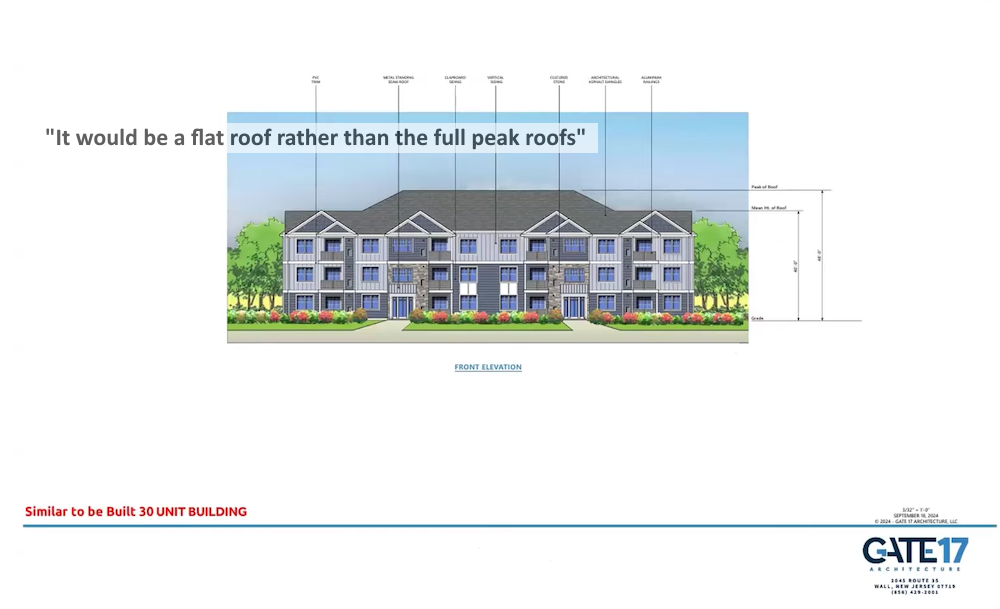
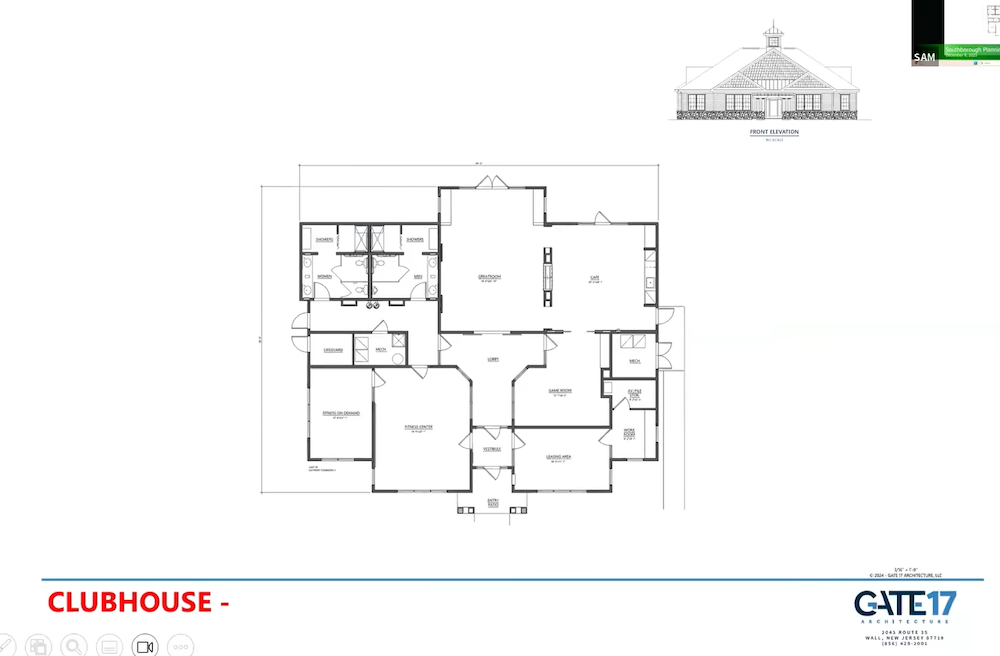
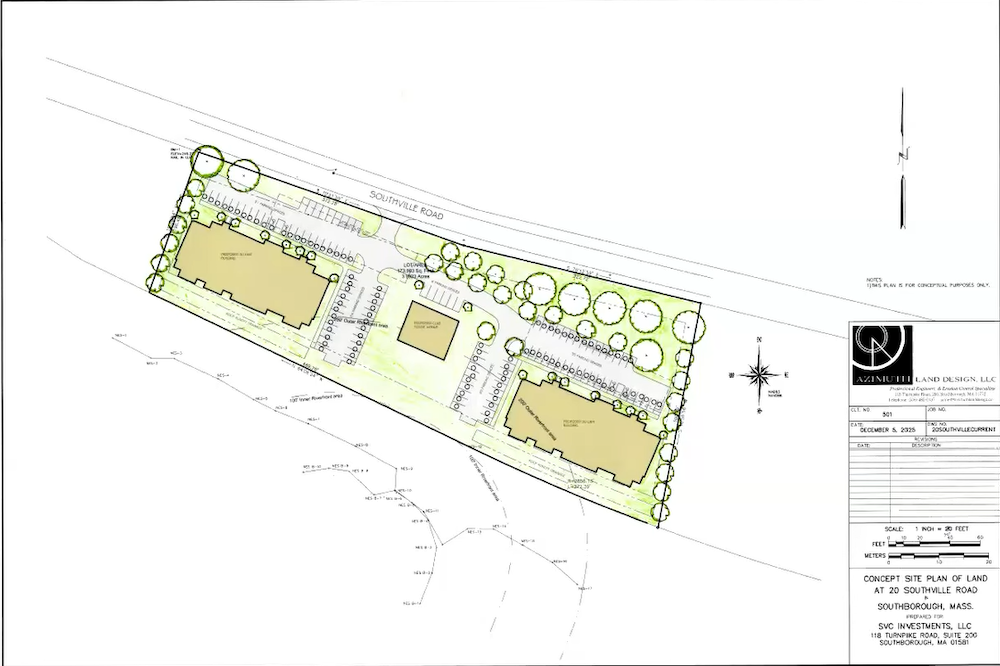
The property owners said that due to septic constraints, they will request a variance to allow the parking lot to be in front of the building rather than the rear. The plan showed the intent to plant trees for screening some of the property from neighbors across the way. Planning Member Marnie Hoolahan said she appreciated that, and agreed the building shouldn’t be set too close to the road.
Upon questioning, they explained that their residents are typically young professionals and aging residents, not much in between. James Venicasa told the board that when families reside in one of the buildings, they are typically from the town, temporarily living there and in the midst of moving or renovating a home.
The buildings will include indoor bicycle storage. (Worth noting, the property is just a 5 minute bike ride from the train station.)
Although it’s not shown on the concept plan, Babcock indicated they plan to include a dog park. The developers detailed that about 25% of their tenants own pets. (They also volunteered that to help keep the property and community “pristine” they take a sample of pets’ blood when they move in. That allows them to track who is responsible if feces isn’t picked up.)
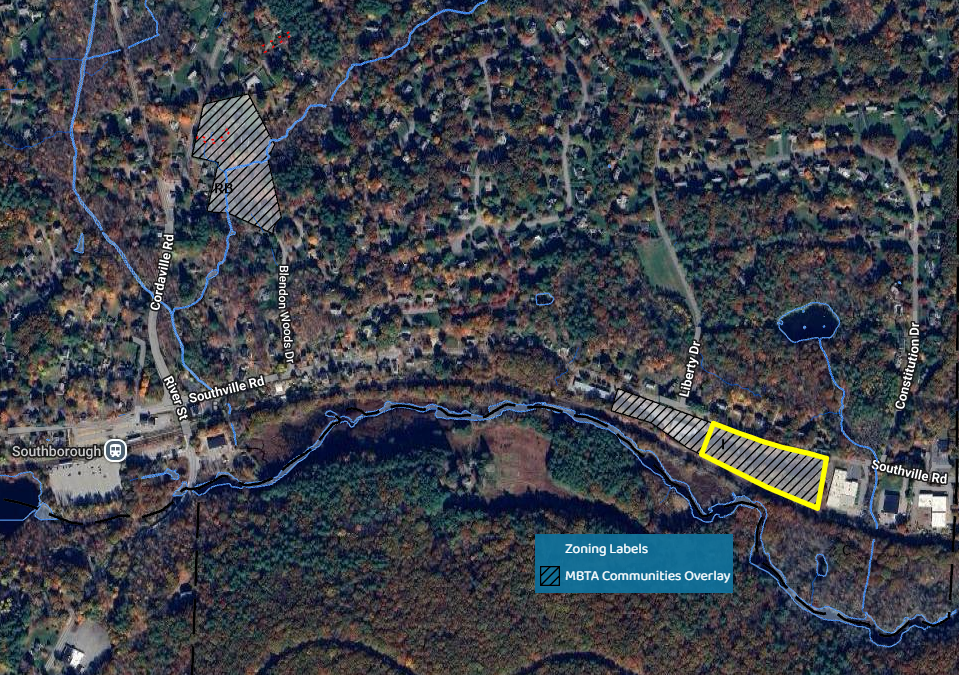 The 4 acre parcel is near the southeastern border of the “Southside” section of town. (It’s literally on the south side of Southville Road, between Liberty Drive and Constitution Drive.) The undeveloped parcel is flanked by an industrial building at 30 Southville and CrossFit Tilt. (See my edited map right.)
The property is one of the parcels that is covered by the MBTA Zoning Overlay bylaw passed in fall of 2024. That bylaw entitles the property owner to develop up to 15 units per acre. As the proponents pointed out, that would mean up to 60 units on the 4 acres. But the state law and local bylaws included a big caveat. The development still has to meet Southborough’s underlying zoning restrictions for height, setback, etc. It also has to comply with conservation laws and bylaws.
The owners clarified that part of the property is within the 200 foot buffer from the Sudbury River, but not the 100 foot “no touch”, and said the wetlands had been delineated. They will soon file a Notice of Intent for the Conservation Commission.
During the discussion, Planning members and a public commenter flagged other potential issues that could limit (or derail) the project.
The Concerns
Freddie Gillespie, who lives a few parcels left of the property, had unsuccessfully urged voters to reject the zoning bylaw last year. This week, she asked the Planning Board about the height restriction for that section of the map.
Last fall, voters were told the bylaw would need to comply with the underlying zoning restrictions. And those zoning restrictions capped buildings at “35 feet, 2 1/2 stories”. Previously, that had been interpreted as needing to meet both limits.
Planning member Lisa Braccio responded that the approved bylaw specifies the height restrictions as “35 feet or 2 1/2 stories”. Member Debbie DeMuria opined that the board needed to dig into that discrepancy. She said it might be an error they need to address or fix.
The bylaw states:
The MCOD is an overlay district superimposed over underlying zoning districts. The regulations for use, dimensions, and all other provisions of the Town of Southborough’ s Zoning Bylaw governing the respective underlying zoning district( s) shall remain in full force except for uses allowed as of right in the MCOD.
Further down, the table is introduced with, “The dimensional requirements applicable in the MCOD are as follows”. (That could be read to mean that it is just recapping them for clarity, or as defining new dimension standards.)
Gillespie also reminded the Planning Board about an important impression the public had been given last fall. She had publicly warned that the 4 acre parcel, combined with the adjacent 2 acre parcel at 30 Southville, could be developed to be 94 units. She pointed out that the Planning Board had publicly stated that she was wrong. The state had only given the town credit for the ability to potentially develop 65 units on the combined parcels.
Gillespie stressed that 30 Southville had previously been developed without any water issues, unlike the property now proposed for development. She opined that it stood to reason that the state had determined 30 Southville could house about 30 units and the 4 acre parcel about another 30 units. She told the board that it would be helpful if they could look back and at why the state hadn’t allowed the town credit for 94 units.
That discrepancy may relate to another issue she highlighted.
According to Gillespie, the builders would need an exemption/permit from the Conservation Commission to build within the 200 ft riverfront section of the parcel. She recommended they learn how densely they can develop the land, before holding more meetings with the neighbors for input.
During the board’s questions, Planning Board Chair Meme Luttrell had been the first to raise concerns about the proposed three story design. But her focus had been on the style of a “flat roof”. She told the applicants the code says the buildings need to look like the surrounding neighborhood. Babcock responded that there are things they can do to make the roof “semiflat” and fit within the height. But Venincasa highlighted that the businesses on either side of the site have flat roofs. Luttrell responded that it was “just something to think about”.
Luttrell also raised a question about the clubhouse. The chair said she loved it, but worried that it may not fall be an allowed accessory use by right. (Which could mean they have to seek a special permit to add it.) Town Planner Karina Quinn said that was a good point that needs to be looked at. She also worried that it might intefere with the FAR (floor area ratio) requirements for the multi-family building.
James Waddell (who had also opposed the bylaw) asked if the owners could share one of a building they’ve done with a flat roof. They agreed to do that in the future. In a polite back and forth, Venincasa confirmed that the financials wouldn’t work for the company if they capped the project at 2 stories.
The owners didn’t directly respond to the issues raised by Gillespie. However, even earlier in the meeting, Venincasa had assured board members that the company listens to local boards and neighbors, and engages in dialogue on needed changes. He followed, “We want to be neighbors. . . We’re not permitting these and leaving. We’re staying.”
