
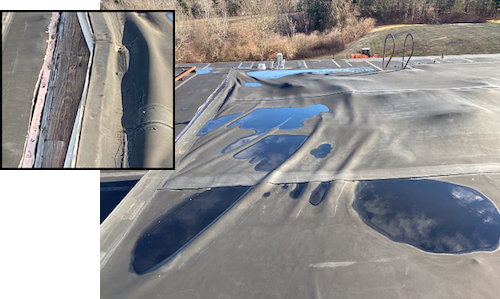
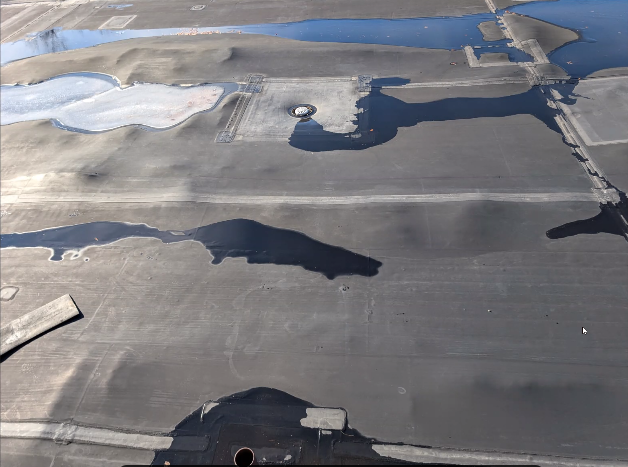
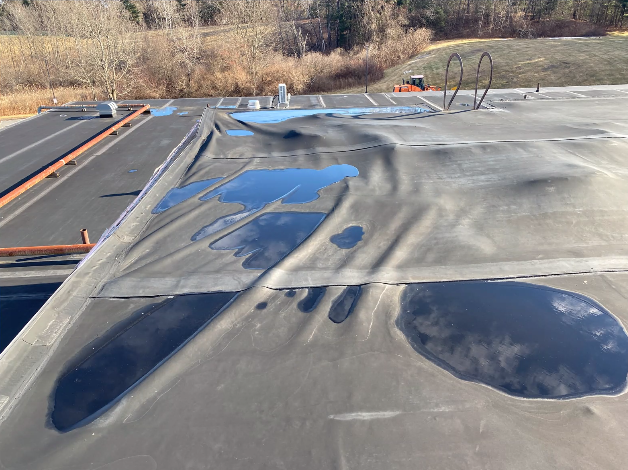
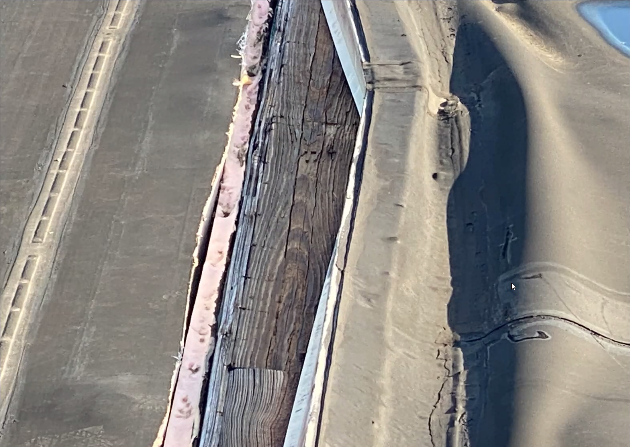
Above: Pictures from consultants who confirmed that Neary’s roof can’t be repaired to last another 3-10 years. (images from screenshots of School Committee Meeting)
Today, the Southborough School Committee heard back from its roof consultant. There was a little bit of good news — but it was mostly, unsurprising bad news about Neary School’s failing roof.
The committee plans to join the Select Board’s meeting this Tuesday night to talk through wording of Special Town Meeting Articles. And based on today’s discussion, they could decide to make significant changes for what options voters are offered on the Warrant for March 2nd.
Brief Recap
Consultants reported that there is no repair solution that could extend the failing roof for a few more years. They did recommend some immediate fixes to try to hold it in place through the summer. Their estimate for the repair is $3.7 – $4.5M. Depending on the final cost, that would also trigger $0.5 – $2M of additional work for ADA Compliance improvements.
So what was it I considered ” little bit of good news”? The consultants confirmed that renovating the school after a roof replacement wouldn’t void the new roof’s 30 year Warrantee (even if they install a new HVAC on the roof). And they reassured that they aren’t worried that the roof could cave in before a replacement could happen in several months. (There were caveats, but scroll down for those details.)
The bigger risk was membrane blowing off. But they believed that sandbags and installation of bars to temporarily hold down the membrane will mitigate that as a short term solution.
And they noted that if the roof is replaced, the ADA fixes don’t have to happen simultaneously. There is a little wiggle room for the Town to work on its plans for addressing the triggered requirements. (Scroll down for more details about the roof situation, and pictures.)
Town Meeting Articles
Recently, the Select Board discussed not including language in the Article for funding the roof replacement (Article 4) that would include study and design work for other repairs to the school. Their intent was to bundle those into Article 1, which asks for funding to study potential Neary renovation and improvement projects.
Today, the School Committee and NSBORO administration worried about that tactic. They noted that even if voters support Article 4, they wouldn’t be able to move ahead if Article 1 is rejected, since building improvements would also be required.
Superintendent Gregory Martineau suggested that the School Committee might want to push for a 5th Article. That would be worded to cover specific work needed to support Article 4, but not the full scope of study currently included in Article 1. If Article 1 passed (or Article 4 failed), they could indefinitely postpone the moot 5th Article. Chair Chelsea Malinowski voiced support for that approach. Other members appeared to agree.
Select Board Chair Andrew Dennington participated in the meeting. During the discussion, Vice Chair Roger Challen asked him if rumors were true that the board planned to withdraw two other Articles to study potential building projects at Finn School or Finn & Trottier.
Dennington said that the board was split with two different views. One view was that the Articles should be withdrawn. He described that opinion as, “We know we can’t afford Article 2 and 3, so don’t even put them on the Warrant.” The other view was that it would cause too much backlash at this late stage to make that change. For “four months”, the board had been telling opponents of the New Neary project who objected to not being given choices that they had a plan to provide them with more chore choices.
He didn’t specify who or how many members voiced support for reducing the number of Feasibility Study Articles.
Dennington clarified that the issue was discussed during the FY27 Budget Forum on Saturday.
For context, he referred to the strong possibility that funding the Town’s regular budget and planned capital expenses could require a Proposition 2½ Override vote this spring. That would require not only a 2/3 majority vote at the Annual Town Meeting in April, but also a majority ballot vote in May. (The board has also discussed potentially using an alternative “debt exclusion vote” to cover bonding for some of the capital expenses. That would have the same voting requirements as an override.)
The Special Town Meeting Articles weren’t on the Budget Forum agenda. It sounds like the topic came up in the context of how much Free Cash they could count on as revenue for the FY27 Budget.
Dennington indicated the board is trying to avoid an override scenario and tapping into the around $3.5M in Free Cash could make that possible. But if Special Town Meeting voters approve using Free Cash to fund all three of Feasibility Study Articles (totalling about $1M), the Town would need to make “substantial reductions elsewhere” in the budget to avoid an override.
He also believed that the cost for the studies appeared to be too small for borrowing to cover the expense to make sense.
There was some back and forth about the potential approach for writing the Warrant Articles. Dennington suggested that instead of a 5th Article, they could use Annual Town Meeting as a backup to get the funding needed for supporting Article 4 if it passes. Malinowski cautioned against that approach. She worried that once a roof Article was passed, voters would think it was done, and not understand that additional funding was needed in order to make that happen.
Committee members and Dennington also talked through the order of Articles and impacts. They imagined potential scenarios with people voting on certain Articles then leaving before other issues are decided.
As I previously covered, this Tuesday, February 3rd is the last regularly scheduled Select Board Meeting before the deadline to sign and publish the Warrant for the March 2nd Special Town Meeting. However, if the board can’t agree on final language, they may decide to schedule an extra meeting on or before February 10th.
Neary Roof’s Failed State
Consultants detailed the state of the roof on Neary School. Jim Russo of SOCOTEC said there was “no denying” the roof is “in failure mode”.
He described the roof and how the layers had been built (top to bottom):
- Rubber membrane cover (EPDM) glued onto underlying layer
- Two layers of polyisocyanurate insulation
- Hot asphalt (to adhere insulation to the hard deck)
- Gypsum roof board/deck
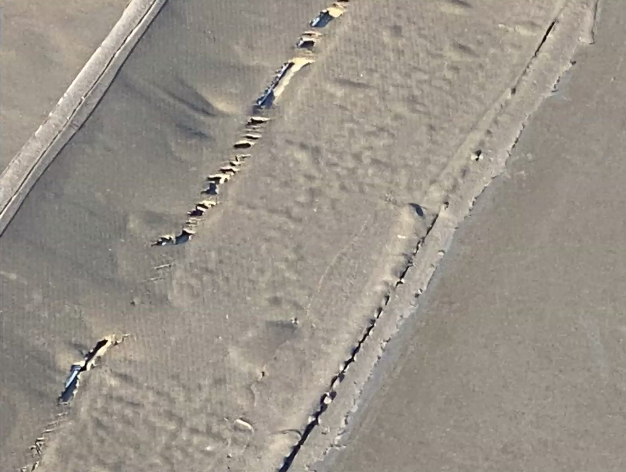
The membrane has lost tensile strength and elongation/elasticity. About 8,000 feet of seams have failed (allowing water to seep in). Instead of stretching during the thermal cycle of heating and cooling, it is ripping and tearing (even in areas between seams).
In areas where the membrane is torn, it flutters in the wind and is in danger of peeling like an onion and blowing off, exposing the roof down to the deck.
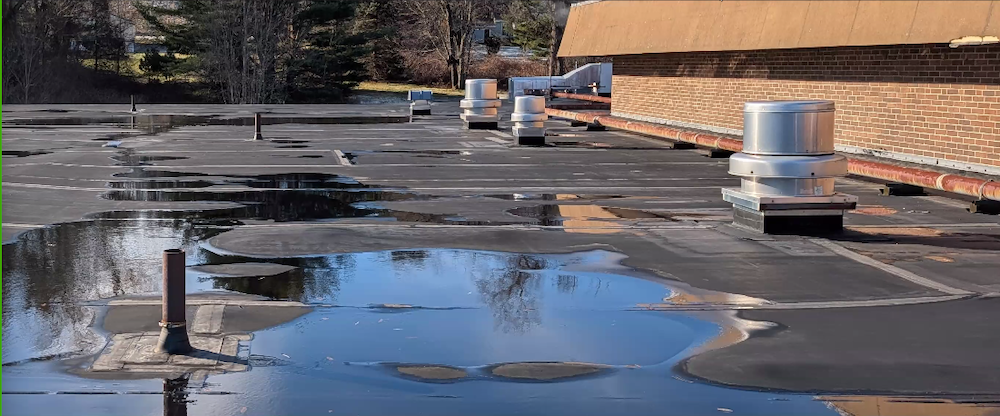
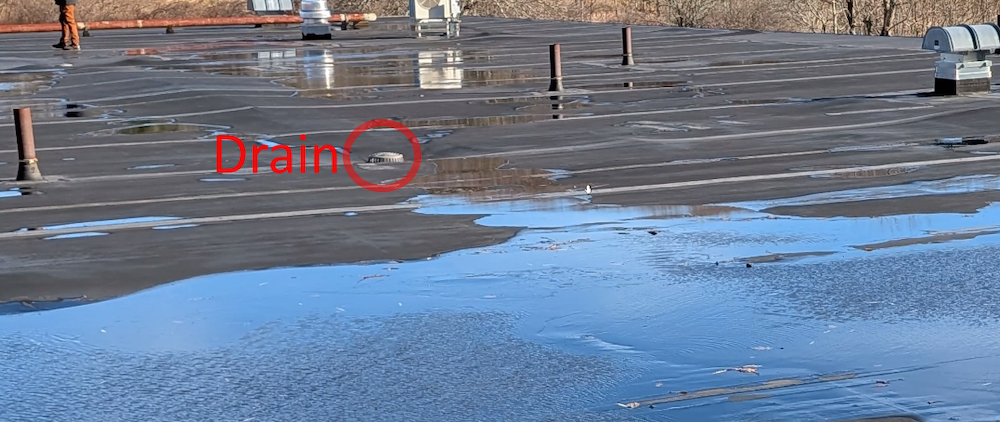
Based on the codes at the time it was built, the flat roof wasn’t designed with slopes that ensure water runs to the installed drains. So water ponds on the roof.
Due to deterioration from the water, about 1/3 of the insulation, is displaced (in various locations, spread out over the roof). That means the roof layers are becoming detached.
And there are likely areas where the deck itself is in need of repair.
The short term recommendation is pinning and weighting down areas of the membrane.
The long term plan is to strip the roof down to the deck layer, make some repairs as needed to that layer, then do a full replacement of the insulation (at current code), and new membrane. (Although they didn’t explain how, I’m assuming based on their analysis, the plan would come with an improved design for drainage.)

Consultants assured that the roof Warrantee wouldn’t be violated if a contractor worked with the roofing company to ensure that a certified expert installs proper flashing around HVAC added to the roof as part of a renovation.
They also explained that when a roof replacement is part of a building renovation that step is conducted first — to stabilize the building and prevent leaks from damaging renovation work.
Cost Variables
Russo explained that if the project comes in at around $3.7M (Less than 30% of the building’s $12M assessed value) that would trigger the need for about $500,000 worth of “minimal” “simple” repairs like entranceways, a bathroom, a bubbler, and a telephone. But if it exceeds $4M:
then you’re faced with at least 2 plus million dollars, because the building itself does not conform to modern-day ADA requirements, as you all know.
Later, responding to a comment by Dennington, Asst Superintendent Keith Lavoie clarified that the estimates were based on a review by an ADA consultant who came in and looked at the prior documentation.
Why they aren’t reasonably concerned about the roof falling down. . .
The consultants didn’t see evidence that the roof deck was in danger of falling down. They agreed that with enough water damage, ceiling tiles can fall down. But they explained that tiles are able to absorb some moisture. They recommended that if tiles are stained, from leaks they should be removed/replaced.
Lavoie assured that the administration is monitoring. He explained that wet tiles are addressed “as soon as possible, and “more saturated” tiles “immediately”, and sometimes removed, causing exposure until a repair is safe to do. He said that it wasn’t safe to be making repairs on the roof in January when there could be ice.
Malinowski wondered if the roof needed to be shoveled to reduce issues caused by the melting and freezing. The consultants recommended against that due to damage the shoveling could cause. And neither they, or Lavoie were worried about the weight from about 24″ of snow.
Lavoie agreed with Challen that while the snow has downsides, the upside is it is currently helping to weigh down the membrane and protect it from the blowing winds.

From where I sit, I do not think we have a choice with respect to the Neary Roof. It has failed and it is not going to get better.
Regardless of set longer term school housing choices Town Meeting and the Voters opt for the roof needs to be replaced. If Town Meeting and the Voters choose one of the options that involves Finn and or Trottier that project will take several years before students can move into a reconfigured system. That means that at a minimum Neary will have to be “On Line” until at least the spring of 2028 and more likely 2029. It will need to have a roof.
While I am in favor of Article 1, Option 2, at least in it’s current form, I support putting the other options before Town Meeting. We owe it to the voters to have a healthy debate about whether we want these more expensive options. We also have to debate the source of the funding for the study of these options.
The funding is currently envisioned to come from “Free Cash”. Free Cash is the excess taxes that were raised in FY 2025 (7/24 to 6/25) that were not spent. If we spend those funds on the study of any of these options those funds will not be available to help offset taxes in FY 2027 (7/26 to 6/27). Given that we are already considering reduction in staffing to keep our tax increase under control If those funds are used to study options, then we will have to have further cuts or higher taxes.