
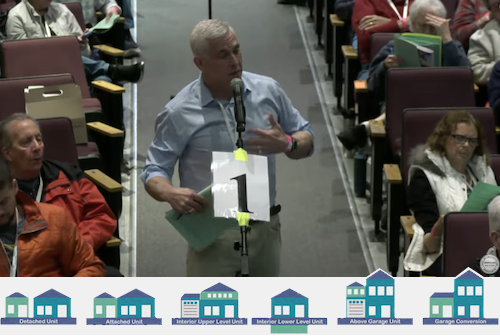
Above: A member of the ZBA helped successfully pitch a zoning change that allows more flexibility to add ADUs, especially for smaller homes. (images cropped from video and edited from past presentation.)
I’m continuing to follow up on debates that took place at Annual Town Meeting earlier this month. Today I’m focusing on a zoning change that should make it much easier for residents to add Accessory Dwelling Units to their homes.1
The previously passed bylaw for ADUs clarified homeowners’ rights under state legislation. That allowed adding one ADU of up to 900 sq ft, but capped at 50% of the “gross floor area” of the principal dwelling. (Worth noting, the Gross Floor area excludes garages, basements, storage areas, and elevators.)
At the time Zoning Board of Appeals members expressed concern that the allowance is unfair to owners of small homes. This month, ZBA member Michael Robbins told Town Meeting:
There’s an inherent issue with that for people like myself with smaller homes. The law allows for single family homes to add an accessory dwelling unit by right up to 900 square ft or 50% of the gross floor area of the home.
He gave the example of his home, which is under 1,600 sq ft and would have its unit capped at about 750 sq ft.
The zoning change proposed by the ZBA under Article 29 increases the by-right allowance cap to 100% of the gross floor area of the primary dwelling, up to 1,200 sq ft. (The change also eliminates the Special Permit option for larger units.)
Robbins touted the improvement for homeowners “aging in place”, arguing that “Smaller homes are more likely in need of an accessory dwelling unit” and the size “really matters”. He noted that the larger footprint will help make units wheelchair accessible.
The Select Board and Planning Board supported the change. But the majority of the Advisory Committee opposed the Article. Member Howard Rose argued that the increase to 1.200 sq ft went too far:
you’re taking half our town with acre zoning and you’re potentially putting a second unit on that lot which drastically changes the character of our town, drastically affects our school systems and our budgets.
Advisory Chair Marci Jones explained that the majority of the committee recognized “the value of expanding housing opportunities for seniors and young families”. But they agreed with Rose’s worries about changing neighborhood densities and character. And they worried about potentially increasing incoming students in schools without increasing tax revenue raised by properties.
No other speakers appeared to agree.
Voter John Gibson questioned another concern raised by Advisory about the zoning change not addressing “septic, parking, and frontage limitations”. He got confirmation that the ADUs would still be subject to current septic requirements.
Later, Paul Carter opined that septic limitations are largely behind the town’s “character” and will definitely “govern” residents’ ability to add ADUs. And Robert Reeder noted that homeowners would still need to adhere to zoning setbacks.
Reeder followed that if he had the money to do it, no one could stop him from tearing down his home and building one 1,200 sq ft larger.
ZBA member Doris Cahill told voters that data from the board’s admin indicated that issues like parking rules, setbacks, and septic would still keep “up to 74% of residents” from being able to add an ADU.
And resident Frank Tipton posited that given high taxes and electric bills residents are grappling with, not many people would be jump at investing in building ADUs. He spoke in favor of equity, to allow residents with smaller homes the same flexibility as those with larger homes.
As for the increased size from 900 to 1,200 sq ft, Planning Chair Meme Luttrell explained that it’s “pretty much” the difference of going from a one bedroom addition to a two bedroom. She referenced hearing from seniors unable to find options for downsizing. She pitched that the ADU could allow them to have a child take over the main house, while they move into the ADU.
Still, Luttrell didn’t believe that the zoning change would prompt a wave of new homes. She noted that special permits had been available since the 80s, and they had only had 34 over the years.
Cahill agreed with Luttrell and followed up to give more detail on the previously approved permits. She noted that “overwhelmingly” most applications were for family members moving in. Plus, there were one or two for medical reasons. She said that 900 would be tight for that purpose.
In addition to allowing families an ADU for an elderly parent, she highlighted that some people might use it to add a caregiver to the home to aid aging relatives.
Luttrell’s and Cahill’s statements about the limited past demand for permits didn’t clarify that those permits had a ratio cap that is now lifted. The zoning change doesn’t just make pursuing ADUs easier, it increases the allowed size for small homes.
Even a Special Permit doesn’t currently allow owners of small homes to add a 900 sq ft unit. Under the zoning bylaw for accessory apartments, the maximum size is capped at:
25% of the habitable floor area of the entire dwelling plus that of any accessory building used for the accessory dwelling.
Under those metrics, only a home that has a “habitable area” of 2,700 sq ft or greater would be allowed to add a 900 sq ft unit. In contrast, owners of many “McMansions” in town can apply for a special permit to add an accessory apartment with more square footage than many small homes in town.
Now, the special permit will no longer be needed for adding a unit up to 1,200 sq ft (as long as it doesn’t exceed the primary gross foot area). But, the option to permit a larger unit is being eliminated.
No one attempted to amend the Article. The bylaw was approved by a majority vote by hand. The ability to pass with a simple majority was based on the state law enforcing lower zoning thresholds for ADUs.
Given the debate over denser zoning, the Town may have a tougher time when it comes to adopting changes to the bylaw for multi-family “over 55” zoning. That’s an initiative that the Planning Board and the Affordable Housing Trust have been working on and still hope to bring to a future Town Meeting. I believe that will need 2/3 support from voters.
As for the zoning changes that were just approved — once the bylaw changes are approved by the Attorney General’s office, the zoning rewrites will be considered effective April 12th. (However, it will take additional time for the Town to get the language updated in the zoning code to reflect the changes. In the meantime, you can find the zoning details here.)
