
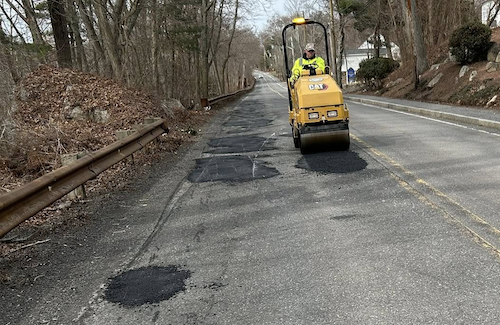
Above: The Select Board is proposing the Town make a big investments in a strategy change to repair and extend the life of more Town roads, beyond simply patching potholes and cracks. (image cropped from DPW Facebook page)
This Saturday, Annual Town Meeting voters will decide on whether to invest $25M in a 5-year plan for road improvements and sidewalks. If it passes, it will be the biggest borrowing expense the Town has ever approved. It will also add to the list of debt exclusions that voters would need to approve on the ballot this May.
Article 13 includes borrowing $2.75M to install four sidewalks. But the biggest expense is $22.26M for road projects based on the DPW’s 5-year Pavement Management Implementation Plan (or Road Maintenance Program). The outlined road projects would cover over 40% of Town roads. (Scroll down for more details on the specific roads and sidewalks.)
Officials support the DPW’s outlined 5-year plan as necessary to address crumbling roads and get back on track. But there are some caveats.
While the road plan is for 5 years, the borrowing is projected as a debt obligation that wouldn’t wind down until 2047-2052.1
Recently, Select Board members disagreed about an aspect of the funding approach. And if the board had thoroughly discussed the Article before the Warrant was finalized, they would likely have moved some of the one-time borrowing costs into the DPW’s regular annual budgeting requests. (Scroll down for more on that.)
Still, none of the members disagreed with DPW Superintendent Bill Cundiff’s recommended 5-year plan for addressing Town roads. Cundiff explained that when minor road problems aren’t addressed, it leads to bigger problems that result in much more expense road projects.
Cundiff’s plan is to shift the Town’s strategy. He hopes to extend the life of roads that are still in fairly decent condition while simultaneously tackling the bigger repairs needed on a long list of failing roads.
Select Board member Al Hamilton suggested that due to cost impacts from the Iran War, it might make sense to delay a lot of the work by a year. Member Kathy Cook rebutted that even though the dollars may not go as far as they hope, the road work is needed. The board’s consensus was that they hope for Cundiff to get started on the work as soon as possible.
Sidewalk Projects
Article 13 would cover four sidewalk projects “in year one”. Those are:
- Parkerville Road (Middle Rd to Finn School)
- Richard’s Road (Cordaville Rd to Woodland Rd)
- Woodland Road (Richards Rd to Oregon Rd)
- Oakhill Road (from existing sidewalk to Walnut St)
Road Improvements
Cundiff presented a 2026 version of a 5 year Planned Pavement Management Plan. His intent is to treat the plan like a “living document” and updated it each year. Cundiff acknowledged that his cost estimates pre-date the Iran War. The impacts of the war are likely to spike the cost of asphalt and diesel. (Hamilton also worried that it could increase the interest rate expense for borrowing.)
Even without inflation and price fluctuations, Cundiff warned of other cost variables that can impact projects listed for 2027-2030. In the coming years, he’ll use the pipe camera tool to inspect the underground infrastructure of roads. If it needs replacing, that will increase the project costs.
The board agreed on making those financial realities clear when presenting the plan to voters this Saturday. (It wasn’t clear if a challenge in tackling all of the roadwork would lead Town officials return to voters sooner than 5 years to ask for extra funding. Or would the DPW just repair fewer roads over the next few years, despite the framed need for all of the work.)
In building the schedule for the road plan, Cundiff said he factored in how heavily travelled the roads are and the roads’ scores from the Pavement Management System that evaluates the road condition. But for “year one” he specifically prioritized tackling roads that don’t have major underground infrastructure problems. They’re ones he considered “fairly low hanging fruit to get the biggest bang for the buck” since he doesn’t expect “many variables” to spike costs.
The 2026 plan shows:
- Major Rehabilitation (Full Depth Reclamation) of:
- in 2026:
- Acre Bridge Rd (Marlboro Rd to Marlboro CL)
- Northboro Rd (Main St to Johnson Rd)
- Pine Hill Rd (#77 Driveway to Nichols St)
- Woodland Rd (Turnpike Rd to Bay Path Ln)
- in 2027 – Woodbury (Southville Rd to Woodland Rd)
- 10 more projects in 2028-2030
- in 2026:
- Minor Rehabilitation (Mill & Overlay, CIP) of:
- in 2026 – Cordavile Rd (Causeway North to Rt 9, Rt 9 to Mt. Vickery, & Rock Point Rd to Richards Rd)
- in 2027:
- Bridge St (Southville Rd to Fay Ct)
- Constitution Dr (Liberty to Southville)
- Independence Dr (Constitution to Cul-de-sac)
- Liberty Dr (Southville to Cul-de-sac)
- Marlboro Rd (St. Marks St to Framingham Rd)
- Vickery Rd (Middle Rd to Breakneck Hill Ln)
- Richards Rd (Parkerville Rd to Woodland Rd)
- Southville Rd (Woodbury Rd to Westborough TL)
- Wentworth Dr ( Liberty to Cul-de-sac)
- Woodland Rd (Old Breakneck Hill Rd to Cordaville Rd)
- 21 more projects in 2028-2030
- Preventative Maintenance (Cape Seal, Chip Seal) – 12 roads in 2026-2030
- Routine Maintenance (Crack Seal, Fog Seal, Patching):
- in 2026:
- Patching – Cordaville Rd, Oak Hill Rd, and Framingham Rd
- Work on isolated sections of 9 other roads
- Additional work on 25 projects in 2027-2030
- in 2026:
The view the full list of road projects, with Cundiff’s memo, click here.
For readers who may be surprised that Cordaville Road and Framingham Road are only on the list for minor road work, there’s a reason for that. According to Cundiff, those are on the Mass Dept of Transportation’s TIP (Transportation Improvement Program) list. That means the state will pay to repair those roads, but not until after 2031/2032. The work in the Town’s road plan is to improve their condition in the meantime, since “they’re in such poor shape”.
Cundiff clarified that the project at least touches 30 miles of the 70.4 miles of Town roads.
Select Board member Marguerite Landry asked if the schedule was meant to avoid roads being dug up again (for new gas lines, etc.) soon after they’re rebuilt/repaved. Cundiff responded that he currently has a five-year moratorium (except in emergencies). But he noted it would be better to have a bylaw in the future. He noted that Spencer charges a road opening fee that goes down as the road gets older.
He also addressed some recently subpar roadwork patches after gas companies replaced/installed gas lines. He told the board that he informed companies that the trench patches are only good for up to a year. Then they’ll need to return to do a “full width overlay”.
Debated Approach to Funding
The Capital Improvement & Planning Committee (CIPC) presented funding options at the Select Board’s March 31st meeting. The Select Board discussed and debated both the right way to fund the road plan, and what approach would be most likely to get the voter approvals needed.
First the board wavered on whether or not to ask voters to fund the full 5 year plan. Chair Andrew Dennington suggested asking for the first two years, then returning to voters with proof of concept. Member Tim Fling preferred asking for 3 years. He believed that a plan covering a longer list of roads, would go over better with more voters. He worried that cutting the list would reduce the chances of getting a 2/3 approval at Town Meeting.
The board eventually agreed on putting all five years before voters. Dennington reasoned that voters who didn’t want to approve the full $25M up front could make a motion to amend the Article. And they worried that bringing smaller requests each year could put the plan on the chopping block each year.
The board’s concern about a phased approach seemed to be just as much about Town officials’ resolve as it was voter reaction. Members discussed the board’s track record of not following through on long term approaches to expensive capital needs.
Dennington recognized that the current state of the roads disrepair was partially a result of officials’ decisions in years when they faced difficult budgets. He recalled that the DPW budget would come in “higher”, but then be cut based on Select Board and Advisory Committee decisions/requests to lower that year’s tax increase.
That pattern was behind the decision to pull roadwork out of the DPW’s annual Operating Budget and craft an Article focused on a long term plan.
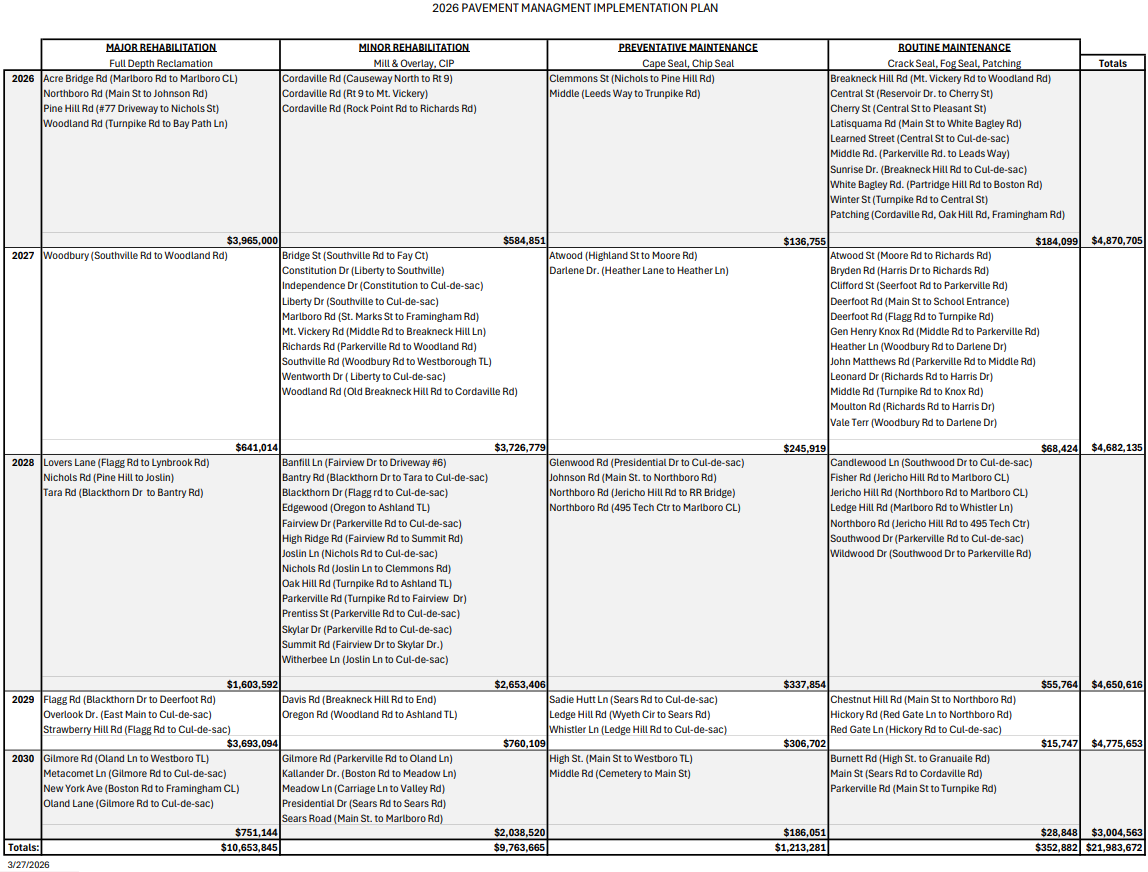 But through the March 31st discussion, Hamilton learned that two columns in the plan table were dedicated to routine annual maintenance work. He argued that borrowing for those costs likely violated the board’s policy on Borrowing (adopted last spring).
Hamilton moved to reduce the borrowing request by about $1.5M, and shift the about $300K of the routine’s cost to the DPW’s FY27 Operating Budget. Cook agreed with the approach. And CIPC member Michael Nute said that an upside to the change would be that voters would continue to expect the routine maintenance as part of the annual budget. (Otherwise, it could be challenging to reintroduce the cost to the budget down the road after skipping it for multiple years.)
But Dennington and Fling worried that it would be too messy and confusing to voters. (It would require increasing the funds under Article 6, before the vote on Article 13.) They worried that it would tank the ability to get the road plan funding passed. Landry agreed.
The Advisory Committee has voted to support Article 13 (and the DPW’s budget). CIPC opted to wait until Town Meeting to vote. Chair Jason Malinowski told the board that they were supportive of the long term road plan. But they believed it was up to the Select Board to decide the best strategy for getting voter support to fund it.
Initially, Hamilton and Kathy Cook voted to not support Article 13 based on the disagreement. In a heated exchange, Hamilton said the board should be ashamed of itself. Dennington responded that he didn’t need to be lectured by Hamilton on what he should be ashamed about.
That dispute was smoothed over at the board’s meeting this Tuesday. Dennington recognized that he had accidentally mishandled a motion (in which Hamilton felt he had been stepped on.)
In between the meetings, Hamilton posted a Letter to the Editor on this blog to raise awareness with voters about the road funding issues. This week, he clarified to fellow members that he wasn’t taking a position to endorse the $25M spend. What he supports is allowing a full throated debate among voters at Town Meeting, so they could decide.
Ultimately, Cook and Hamilton changed their votes to support Article 13. Cook said she didn’t want to see the Article fail, just because she would have preferred handling the funding methods differently. Hamilton said that he decided to “be nice” on his way out. (His term ends in May, and he isn’t running for re-election.)
During Tuesday’s discussion, Fling noted that he agreed that the routine work should be in operating budgets. His position to support Article 13 was based on concerns about changing what was in the Warrant. He followed that in future years, he would like the money to be included in the operating budget. (He didn’t explain how that would work in the next few years if voters are already approving the routine work as part of this year’s borrowing Article.)
Later in Tuesday’s meeting, Fling echoed a concern previously raised by Hamilton about using debt exclusion Articles, including Article 13. He worried that the Town was on a slippery slope and using the exclusions as a way to get around the Proposition 2½ override votes that would otherwise be needed for big year over year tax increases.
Updated (4/9/26 4:58 pm): I corrected the figures for roads which I had accidentally rounded down. The longer figures are $22,255,000 for Road maintenance projects and $2,745,000 for sidewalks.
