
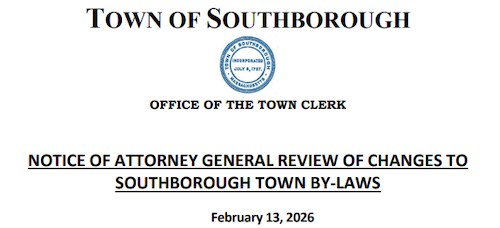
Above: The Town Clerk’s office shared the decision by the state to ratify a zoning Article passed by voters last fall. (image cropped from announcement)
Today, the state Attorney General’s office issued an opinion approving the zoning Article passed by the October Special Town Meeting. Under the new bylaw, Costco will be able to apply for a permit to build and open a new store in Southborough.
An 8 page letter by the AG’s office analyzed and rebutted accusations lodged by a resident that the bylaw adopted overwhelmingly by Town Meeting voters constituted spot zoning.
Last month, the Town learned that the AG’s approval of the bylaw had been held up to review a complaint from resident Carl Guyer. After I covered that news, Guyer followed up with a second email (which he copied me on), recommending the AG to:
not approve the bylaw changes as they presently exist and recommend the town consider broadening the scope of the changes to include a significant part or all of the zoning district being affected by this change.
This would allow the present development proposal to move forward, distance the proposed change from being or similar to the issue of spot zoning, allow the town to pursue the goal of increased commercial and industrial development and keep the Southborough Planning Board from being a gatekeeper of who will be allowed to develop property within the zone.
Today’s decision letter from Assistant AG Nicole Caprioli noted that the role of their office isn’t to opine on policy. It is simply to vet that the bylaw complies with the constitution and state laws.
The letter included the following passages:
The opponent further urges our disapproval of Article 1 because the by-law amendments amount to spot zoning because the zoning changes “may be setting a precedent that may eventually effect the entire community while initially only benefiting the owners of this property…”
As explained below, this assertion does not provide us with grounds to disapprove Article 1 someone challenging a zoning by-law bears a “heavy burden” to show that a by-law amendment lacks a rational basis. . .
The opponent’s assertion of spot zoning appears to be based solely on the definition’s reference to a specific parcel.
But our analysis must go beyond the assertion that only one parcel may benefit from these zoning amendments. Instead, to conclude that a zoning amendment constitutes spot zoning, the singling out of the specific parcel must lack all “rational planning objectives.”. . .
It is clear that the Planning Board extensively discussed all aspects of the proposed zoning changes under Article 1, including the pros and cons of the zoning changes. The minutes reflect a collaborative and thoughtful approach to the zoning amendments that included some Planning Board members who voiced initial concerns, but later supported Article 1, such that Article 1 garnered the unanimous support of all Planning Board members at Town Meeting. Given the thorough analysis by the Planning Board of all aspects of Article 1, and their ultimate conclusion that the zoning changes would benefit the Town, we cannot conclude, based on our standard of review, that Article 1 lacks a legitimate planning purpose
An update from attorneys for the property and the retailer last month previewed that they plan to submit a comprehensive application for the Special Permit and Major Site Plan Review within the next few months. You can read more about the project status and plans here.
An email from Town Clerk Jim Hegarty notes that the AG’s office will be issuing a separate letter on the ADU zoning bylaw also passed by the Town. Stay tuned for that result.
Updated (2/13/26 5:35 pm): I linked documents and added the final paragraph above.

Sorry Carl