
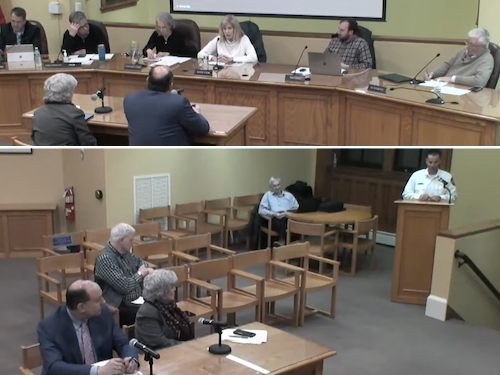
Above: Southborough’s State Senator and Rep spoke with the Select Board and Fire Chief on ways they can support the town. (images cropped from meeting video)
Last week, State Senator Jamie Eldridge and State Representative Kate Donaghue attended a public meeting with the Select Board. The board was looking for an update on the state budget outlook, local aid, and issues affecting our town. But the main purpose was clearly to seek support for short and long term efforts to help reduce Southborough property tax bills.
Select Board members discussed needs for more consistent road maintenance funding, studying regionalization of Fire Departments, stalled legislation to increase tax/PILOT payments from non-profits, and more.
Select Board Chair Andrew Dennington set the tone for the conversation by highlighting the Town’s struggle to fund municipal needs now that they can no longer tap into federal pandemic relief funds.
We were in kind of the ARPA era where we kind of got to cheat a little bit and use federal stimulus money to artificially reduce year-over-year tax increases. And that’s now gone. So, we are kind of fending for ourselves.
Challenging Budgets and Costs All Around
Eldridge told the board that the state is also facing a challenging budget. He noted that many areas of spending are expected to be level. One of the biggest impacts to Southborough in Governor Maura Healey’s proposed budget is the modest increase UGGA (Unrestricted General Government Aid).
Later in the discussion, Select Board member Kathy Cook complained that even small increases are equivalent to cutting support:
A two and a half percent increase in our unrestricted government aid is not even inflation. . .
it would help if you know inflation got factored into that number each year before they decided what it is. . . It’s never been inflation as long as I can remember. So every year we just we we take a cut cut, cut, cut.
Later, echoing her concerns, Donaghue highlighted:
between 2007 and 2023 for the Northborough-Southborough School District state aid grew by $900,000 while district cost grew by $8 million
Cook also stressed the impact over years from insufficient funding of road maintenance through the Chapter 90 program. She claimed the funding levels from the state has been inconsistent. Predictable state funding would help with planning:
Right now our superintendent doesn’t want to rely on the fair share piece because it has been so unreliable.
Eldridge expressed surprise at her narrative, asserting that funding has consistently increased in the past couple years since the passage of the state’s “millionaires tax.” He followed:
I would say that what you’ve gotten over the past couple years, expect that to continue.
Cook insisted that her recent figures showed the funding fluctuating even recently. Eldridge said he would be interested in reviewing the numbers. Cook promised to share them. She said the issue is less about the total amount and more about predictability.
In discussing other budget issues and local burdens, Eldridge noted that lawmakers hear from communities like Southborough about the high costs of special education and transportation. He said that there is legislation to try to “lower the trigger” for “circuit breaker” funding. But it would be very difficult this year. He repeated that caution when Dennington asked about any progress on NSBORO school’s lobbying for out-of-district special ed placements to be funded by the state, rather than local schools.
Donaghue pointed out a major cause of the state’s budget struggle. She explained that $19 Billion of the state’s revenue comes from the federal government. They anticipate that to be cut by $3.7B.
The Representative promoted a “hard fought” bill recently passed by the House that she hopes will help address affordability issues. She said the energy bill passed by the House seeks a balance between affordable and clean energy goals. But that still needs to be reconciled with the Senate:
it’ll be interesting to see how the two the two chambers differ and what comes out of the conference committee.
Potential Revenue/Funding
Eldridge highlighted proposals the Revenue Committee he chairs is looking at to help towns raise revenue. A measure he sponsors would allow communities to increase the local meals tax by 75%. Cook appreciated that, highlighting that many of those taxes come from non-residents. However, she lamented that the town has struggled with restaurant turnover in recent years. She hopes that the pending opening of a Costco in town will help attract new ones.
Later, both Eldridge and Donaghue assured they would support approval of the Town’s future Home Rule Petition to get a new liquor license for Costco. (Town Meeting voters will be asked to authorize the petition to the state at the Annual Town Meeting in April.)
Eldridge touted the Governor’s effort to increase excise tax bills with a 5% surcharge under the pending Municipal Empowerment Act. He noted that all of that would go to local towns. That bill ” to provide more tools in the in the toolkit” is still pending in his committee.
Eldridge also told the board that he expects the Senate to soon pass an Environmental bond bill that could offer opportunities for the town to seek grants for open space protection and Municipal Vulnerability Preparedness related to climate change.
(He also noted his desire, unlikely to happen this year, to see increased wealth taxes. Scroll down for that and the debate it prompted.)
For local “earmarks” in the state’s budget, Donaghue said she hopes she will be able to secure the $35,000 that the Tricentennial Committee is seeking to support next year’s celebrations.
Seeking Support to Study Regionalization of Fire Services
Vice Chair Marguerite Landry asked about any trends the legislators have seen on regionalizing fire and police services. Eldridge said he’d only seen dispatch regionalization. He assumed that for fire and police it would be a “third rail” issue, never supported.
Dennington responded that the board had the Fire Regionalization on their agenda to discuss that night. Member Al Hamilton explained that the problem for “modest size” towns like ours is the “overlap of capital infrastructure”. Hamilton spoke about the Town’s annual tax increases falling “more heavily on the most vulnerable in our community”:
we’ve reached the point where [asking] for a 4 or 5% tax increase is cruel. And so, I think that, we’ve got to start thinking about regional solutions for a variety of things.
Eldridge was surprised to hear that Southborough’s Fire Dept appears to be supportive of the concept. It apparently wasn’t a surprise to Donaghue, who has already been taking steps to help Westborough and Southborough look at a future join Fire District. She sent a letter of support for the towns to get access to the land once the 495/90 interchange project is done. She referred to it as a proposal for a satellite station. She followed:
The 351 communities that we have is the strength of Massachusetts, but that doesn’t mean that we have to have separate fire districts for everybody
But she also noted that they haven’t heard of other communities pursuing it.
Southborough’s Fire Chief Andrew Puntini said that Ashland and Hopkinton looked at adopting one was about ten years ago. He believed they got close before it fell apart, and had a lot of valid research. (Later, Town Administrator Mark Purple described changes in leadership for why that never moved forward.)
Puntini acknowledged the Centerville-Osterville-Marstons Mills (COMM) Fire District. But he said that was different since it’s based off of a water district. He wasn’t aware of other recent research.
He said that he was “really interested in the research of what does a regional system look like and what are the benefits to a community like Southborough”. He said it wasn’t a concept extensively studied in our state. He advocated for funding from the state to help research regionalization.
In the discussion (and in a more in-depth talk later in the meeting), Puntini described his department as supportive of the effort. He pitched the need to eliminate unneeded duplication of equipment, while also looking to “break down silos” to allow the towns to work more “harmoniously” together. He noted that the crews already know each other from their frequent mutual aid work. He referred to the “routine” mutual aid between Westborough, Hopkinton, Ashland, and Marlborough as already working regionally, “but in a muddy fashion”.
Westborough’s chief already made a presentation to their Select Board. Puntini will make a presentation to the Southborough Select Board at their March 17th meeting.
Seeking Longshot Help in Taxing Private Schools
Cook asked if a bill that would require non-profits to pay at least 25% of the property taxes they would “pay otherwise” was “DOA”. Eldridge confirmed that it appeared to be. He pointed out that all the non-profits weigh in an oppose it.
Cook stressed that the full tax exemption for the non-profits is a killer for Southborough:
I believe the last time I calculated, if those four entities were paying full real estate taxes, it’d be $5 million. Our whole budget is 70. So it’s a huge loss of revenue for us. Most towns have one private school. We’ve got three.
She told the legislators that it forces the town to “literally beg” for the voluntary PILOT contributions each year:
with some success but nowhere near the cost of what they they use, and they do use these services: police, fire and roads for sure.
So anything that could be done there. . . it would just help us if we had a state law to back up the begging that we do
Debate over efforts to increase taxes on “the wealthy” or “corporations”
Eldridge noted that he believes in increasing taxes on “the wealthy”, but doesn’t think that will happen this session. Cook was surprised that he was looking to increase that beyond the current 9% Millionaire’s tax. He vaguely described it as other/more wealth taxes.
That last one concerned Cook. She worried that it would reduce state income by pushing more millionaires to move out of state. Eldridge rebutted that it has been successful despite prior worries. He asserted that the original estimate had been collecting $2 Billion and the actual has been $3 Billion.
Cook was surprised given what she heard from people who moved. And she warned:
you want wealthy people in the state because they spend a lot of money. They employ a lot of people. So, we don’t want to have a state that truly encourages wealthy people to go live someplace else for tax purposes, yet come back here when they want to, and not pay taxes here.
Eldridge also later referred to the need to increase taxes on the wealthy or on corporations to lower the burdens on towns. That prompted Hamilton to get on his soap box:
we’ve resisted a split rate because we want to make Southborough a place where people would like to locate a business. . .
you’re running dangerously close to killing the golden goose. And I will make one other pitch that I think the state needs to consider very carefully. . . there is a hidden economic strength in the Commonwealth that is a network of small companies small and medium-sized companies that you find in every commercial development. . .when I had my company I one of the things I realized was you could find an expert in almost anything within 50 miles of where we were. . that that network of small and medium-sized companies needs to be supported, or maybe just left alone. . .strength of the Massachusetts economy is not always the Raytheons of the world
Eldridge responded “Well said”. Donaghue replied with “100%” agreement:
I spent most of my career in private industry working for a small company. . . I saw what it was like to have to try to meet payroll. I saw what it was like have to meet our our phone bill, which we needed to keep the company going. . . one of the things that I’ve seen in my one and a half terms at the state house is how 200 different voices come together with different levels of experience to bring a lot of different perspective into our laws.

Here we go again!! What the heck are you people doing to this town? We have extremely high property taxes with tons of money coming in but never used for what is needed. What are you people thinking want to regionalize Fire departments?? We need more accountability of funds being spent and use common sense when spending the tax dollars. From what I have been seeing the last ten years is various boards and departments totally out of touch with the town’s real needs. And most of all asking for in put from State officials on fixing our problem when they have totally messed up this state. People need to wake up and pay attention to what is going on in the state and our town! Enough is enough!
Mike
I certainly agree that our representatives are not going to help us. The statehouse looks at you and sees a wallet to be tapped.
As to regionalization the fact is that we already have a regional fire system. Like us, most of our neighbors cant fight a fire using only local resources (Framingham might be the exception). Any time there is a fire and or the department has multiple ambulance calls our station is covered by our neighbors and vice versa.
Fire apparatus is expensive, very very expensive. Pumpers are on the order of $500,000 and aerial apparatus run over $1,000,000. Operating a network of small departments like ours and our neighbors means that we are probably over spending on this sort of equipment.
Massachusetts is behind the times in this area. Across the country, fire departments cover much larger areas often crossing town, city or even county lines.
The reality is that our borders were defined, 300 years ago, by how far it was to walk to church on Sunday. They bear no relationship to the cost effective delivery of services and indeed they impede the very same. We should fully evaluate this opportunity. If you like your tax bill then the status quo is your friend.
Al, Jack those prices up. Not realistic. Another problem with fire apparatus is that most of the independent builders have been bought up by conglomerates. Build times have been extended dramatically. Southborough is still waiting for a tanker ordered by Chief Achilles. As for regionalization, as one of your retired firefighters, I’m all for it. It will allow for spreading staff out for more effective responses and NFPA requirements for proper staffing at fire scenes
Mike, we would regionalize to save $ by reducing the % of overhead costs. That $ could go toward other town needs. I’m all for efficiency. I don’t think that we would lose budget transparency by going to a regionalized fire dept — the same rules for budget accounting and transparency would apply.
esRegional Fire station is totally not a very good idea ar way to save dollars by any means. Just like to Regional Dispatch fiasco that is becoming a real cost to all towns. Plus the fact just like what will happen to our devoted dispatchers the will need to reapply and start from scratch with pay levels, benefits and seniority! Will this happen to our great firefighters who put their lives on the line everyday?? I was in management at the former Data General for 18 years and had to layoff a lot of great employees and it was wrong. I don’t want to hear that is part of business when it comes to our firefighters! Want to save tax dollars? Start holding our town to spend correctly and quit wasting our tax dollars. By no means rely on our state officials for any help or direction they have no clue just look what is happening now! Time for the towns folks to wake up and demand changes! Nuff Said!!!!!!