
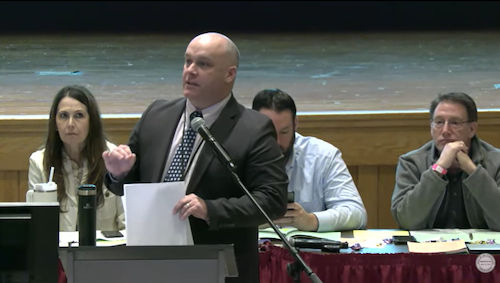
Above: NSBORO Asst. Superintendent of Operation Keith Lavoie tried to carefully make his case to voters on school security system upgrades. (image cropped from meeting video)
As is often the case, a subject that sparked controversy at Annual Town Meeting wasn’t one I was expecting.
A funding request for a $1.4M upgrade to security systems for Southborough’s PreK-8 public schools prompted questions, a motion to amend, and many public comments.
The funding request turned out to be the topic that prompted the most engagement from public commenters at Saturday’s meeting.
At the heart of the issue was school administrators’ reluctance to publicly share details about why they believe the system needs upgrading and what improvements the upgrades would provide.
In the end, voters did approve the funding in full. (Even the voter who originally moved to block the spending came around.)
I don’t want to be responsible for accidentally highlighting any security gaps, so I’m not going to get into too much detail here. But below is my overview of the debate.
Article 12 proposed funding for:
A. $810,000 – Finn Classroom Floor Replacement
B. $1,400,00 – PreK-8 Security System Upgrades
C. $365,000 – PreK-8 Technology Equipment (classroom projection & presentation systems)
Assistant Superintendent Keith Lavoie said that item B had been discussed in Executive Sessions with the School Committee and the fire and police departments, who all support the project. He described the funded work as intended to:
build continuity between the schools and municipal departments as well. Typically we are doing these types of projects piecemeal, but this would be a holistic approach to really get us to where we want to be with safer schools.
That led to questions from residents Rob Lorenson and Jim Waddell. The answers led to more questions and their apparent perception that the investment was a high cost for insignificant or unnecessary improvements.
During the discussion, Lavoie and Superintendent Gregory Martineau noted that their explanations were limited by what they could safely reveal in public.
Rob Lorenson moved to strike item B from the budget.
That prompted several residents to comment in strong support of the spending. Sprinkled in were also comments from those who believed that more clear answers were needed on what the $1.4M covered.
Among the commenters in support were Police Chief Newell who supported the school’s planned upgrade. He described it as a good system that would make it easier and faster for the police to respond to a situation. It would also make the schools safer for the people inside them.
One resident, Margaret Sangiorgi responded to an earlier comment questioning if improvements for easier radio and video inter-school connections are really needed. She told the hall that there was a school shooting in her elementary school (in another state) when she was a child. She stated:
And the first person they shot was the secretaries who were in charge of the phones. So, when somebody asked, “Are the phones still going to work?” Yeah, they are. But that doesn’t mean people are going to have access to them.
She warned that if voters rejected the spending and someone got hurt in the future, they would regret it.
Then, Sangiorgi asked for clarification if Algonquin would be included in the project. Martineau said that the entire project would link all of the NSBORO Schools. The ARHS piece is included in their FY28 spending plan.
During the back and forth with voters, Lavoie clarified that the investment is for a 10 year contract and a long term, comprehensive plan for the systems and updates.
Some voters noted the need to address new cybersecurity concerns the schools’ hadn’t needed to worry about in the past. Based on his professional experience, Robert Reeder said he appreciated the answers the administration was giving:
I now have a clearer understanding of what they’re doing and understand why it’s 1.4 million. . .
I can tell you as a security officer, we’re not worried about hackers anymore. We’re worried about AI hacking into our system because it’s so much faster. And I don’t know the details of what they’re doing specifically because the first rule of security is you don’t give the details because then that tells somebody how to get through it. But I can say what he listed and what they’re trying to do is spot on for where technologies going and what we have to do.
Regional School Committee member (and former Southborough School Committee member) Paul Desmond said that security is something the schools had been looking at for 15 years. The students have been doing their part, participating in safety drills the whole time:
We have to deal with the threat that some guy with a gun is going to come into one of our schools and we need to be able to react in time.
Then referring to the immediately preceding Article for a $1M looping the water mains between Presidential Drive and Fisher Road.1, he followed:
We just passed a million dollars to make water flow a little bit better. We’re asking for a little more than that to protect our kids. That’s it.
In the end, Lorenson told the hall that based on what he learned through the additional back and forth, he had changed his position. He planned to vote against his own motion to strike the spending.
The motion to amend failed. And the motion to support all of Article 12 got the 2/3 support needed to authorize borrowing all of the funds.
Prior to the debate on the security spending, there had been one voice of opposition to a smaller item under the Article.
Advisory member Howard Rose questioned why the spending on classroom technology was pulled out of the regular operating budget. He argued that it should have been included under the school’s budget for technology, and spread out over multiple years. He advocated tackling 20 classrooms per year.
Despite his criticism, Rose didn’t make a motion to amend the Article.
Later, Mike Szczepanski of the Capital Improvement & Planning Committee responded:
We were going back and forth whether or not to push it back to the school budget. But we decided taxpayers are going to pay for it. It’s here. Let’s just get it moved forward.
It’s worth noting that pulling the spending out of the regular budgets allows departments to communicate a lower year over year budget increase, without highlighting the growing debt burden for taxpayers.

I was happy to see this get the discussion that it did during town meeting. I had the same concerns during our CIPC discussions and ultimately had to call Keith Lavoie personally to figure out just what this $1.4m was actually going to buy, which is obviously not an option for everyone in the town and speaks to the completely lack of transparency about this. What I especially resent about the unwillingness to discuss it is that because it falls under “security”, people immediately get freaked out about the horrific but ultimately quite rare school shootings and are willing to spend anything in the name of that, although in practice this spending has nothing to do with that. This is about modernizing the school’s software and tech infrastructure related to access control and surveillance and making administrators lives much easier. Now that kind of investment is necessary and worthwhile, but is that really so mission critical that the people paying for it can’t be told what it’s for? Are we worried about Hans Greuber finding a back door from a public meeting? That’s absurd! So I was glad to see it get that level of discussion and frankly I was glad that Greg and Keith actually answered the questions. That wasn’t so hard, was it?