
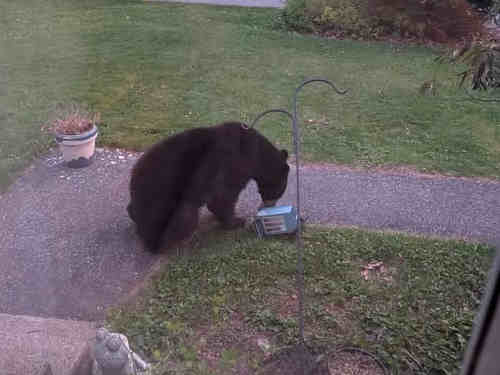
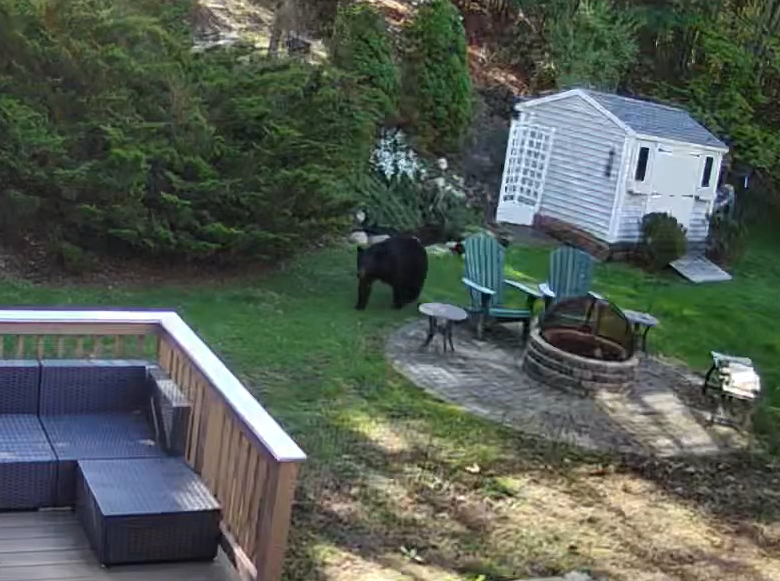
Above: Reminding that birdfeeders in town are one reason that a bear has been wandering through yards this spring. (image cropped from photo by Kathryn McKee)
A reader reached out with a video of a black bear in their yard last night. Posts on a private community Facebook group show that the bear has been making its way around town for well over a week now, with more frequent sighting in recent days.
The details also serve as a reminder and warning that it’s time to take down your birdfeeders and secure other attractive food sources.
I’m sharing more images, videos, safety information, and information on who you can contact if you spot one in your neighborhood.
In Town Sightings
Where has it been most recently sighted?
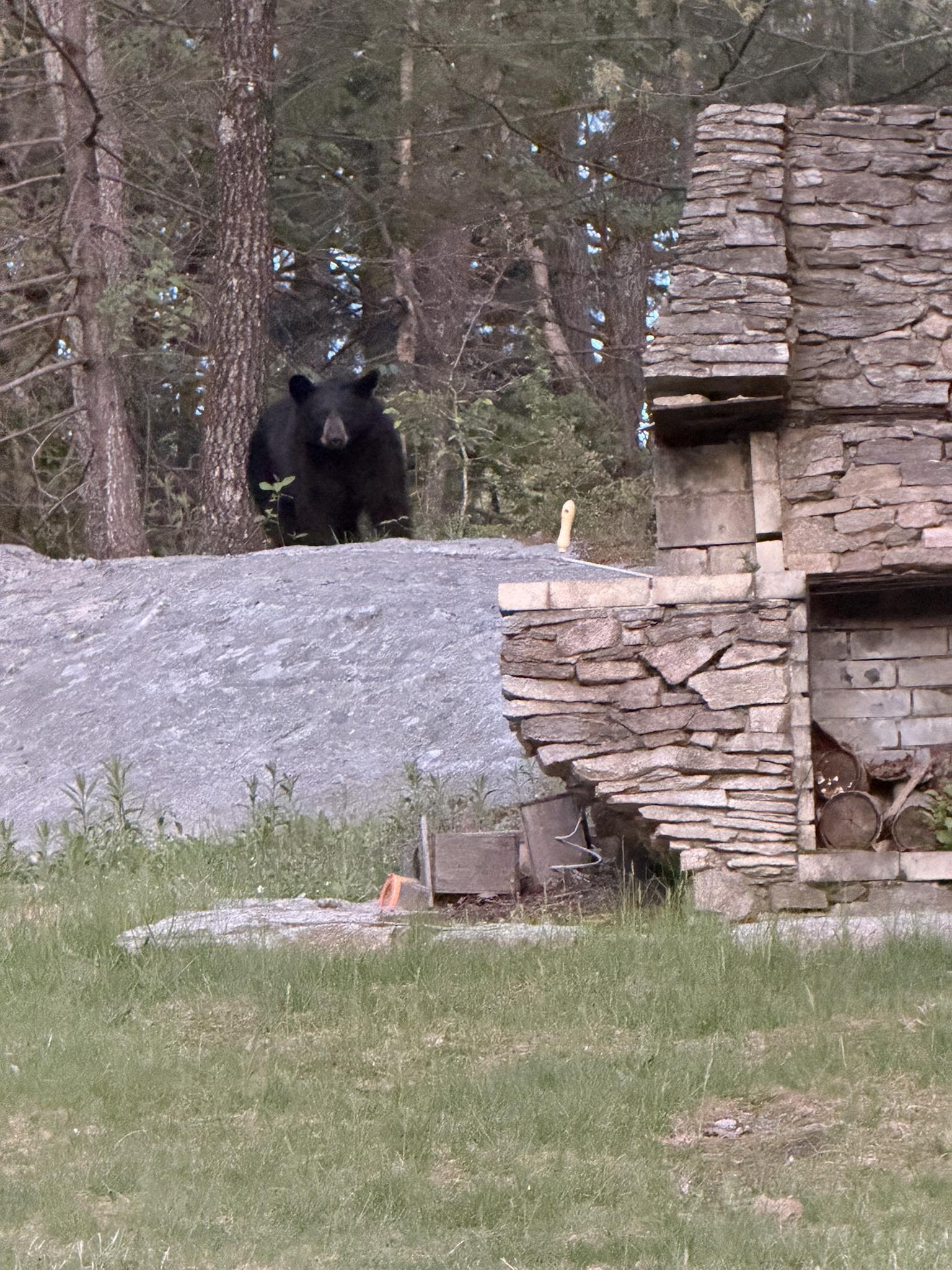 Last night, multiple residents spotted the bear on Mount Vickery Road (image right), where he knocked down some beehives.
The most recent comment I found had him spotted on Woodland early this morning, and moving “northwest” in the woods.
Scroll to the bottom of this post for videos and more photos.
Where else has it been seen?
One Main Street resident reported their birdfeeder was destroyed last month. If that was the same bear, it bear either got bolder or hungrier. There have been frequent reports of the bear in yards even during the day over the past several days.
A Meadow Road resident posted that a large animal bent their birdfeeder 90° on the night of May 3rd. Someone reported a large black bear destroyed their birdfeeder on the night of May 5th. The morning of May 6th, he was photographed in a Granuaile Road yard.
On Friday, a bear reportedly caused damage in a Middle Rd yard by Rte 9. Then on Saturday night, something large broke a birdfeeder on Middle Road by the reservoir.
This Monday morning, one was spotted on Oak Hill Rd and Walnut drive. Posters noted that he roamed into the forest from Walnut Drive on Monday evening. He was then spotted on Cordaville Road late Monday night. Yesterday morning, reports had him moving through Middle Road yards towards Mount Vickery Road.
Some posters were frightened by the sightings, others thrilled, and many seemed to feel some combination of the two.
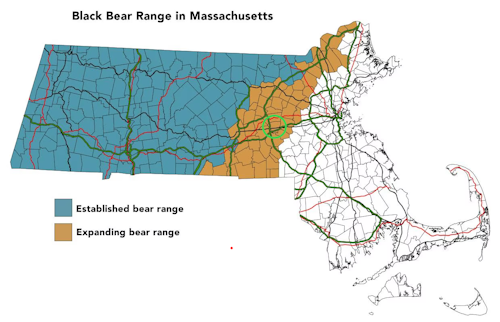 This is hardly the first time Southborough yards have attracted a hungry bear. And the state’s Division of Fisheries and Wildlife promotes that bears’ range has been expanding over the years to include Central Mass towns like ours that used to be out of range.
How to respond in a Bear Sighting
Reporting Bear Sightings
The public should reported to the Environmental Police at 508-366-6537, (or the Animal Control Officer, Jennifer Condon at 508-485-7817). (Unless there is a worrying incident, they will probably just keep track of its behavior at this point and not actually come out.)
Reacting to Bear Encounters
With a dog — MassWildlife warns:
The presence of a dog could trigger a bear to be aggressive. . . If you encounter a bear while with your dog, keep your dog leashed, back away slowly, and leave the area.
In nature, towns, and yards — MassWildlife’s recommended actions depend on whether the bear is in your yard, or you are in theirs.
If you’re out in the woods when you come across a black bear, MassWildlife recommends:
talk in a calm voice and slowly back away. Do not approach bears or intrude between a female bear and her cubs. Do not run. Fight back if a black bear makes contact with you.
Bears spotted in towns are generally left alone. The state website says that in most cases authorities will determine that a Large Animal Response Team (LART) isn’t necessary. The bear will eventually leave the area on its own.
If the bear is in your yard, wait until it leaves, then remove/secure food sources.
Take Precautions to Reduce Interactions
Birdfeeders are a Hazard
Many of us grew up learning that birdfeeders are a wonderful way to interact with local nature. But every time a bear is spotted in town, I’ve been reminded that authorities warn about them as a hazard.
Many posts in the Facebook group confirmed that birdfeeders in their yards were recently destroyed by a large animal.
In past police warnings, residents had been asked to take them down for at least a few weeks when a bear was spotted in town.
MassWildlife warns against putting them out at any time of year. They warn that food sources in yards can lead to unnecessary conflicts between people and bears. And it can cause bears to become habituated (lose fear of humans), leading to the need to euthanize them to protect communities.
To support local songbirds and attract hem to your yard, the public is instead encouraged to grow native plants, shrubs, and trees and/or add a water feature to create a bird-friendly area.* You can learn more about that here.
Securing/eliminating other food sources (including pets and domesticated wildlife)
Trash & Compost — MassWildlife warns to secure garbage, compost, and other attractants. They encourage keeping garbage cans in garages or outbuildings. (They also provide a link to instructions for building a “Bear Resistant Trash Can Caddy“.) If your cans are exposed, not only should they be latched, but double bagged. And you may want to use “drops of ammonia” to offset the attracting odors, even when cans are empty.
For compost, the public is warned to not include “meat scraps, greasy, oily or sweet materials”.
Grilling — MassWildlife also warns about cleaning grills after each use and not to leave grease containers or spilled grease in your yard.
Pets and other wildlife — Pet owners should feed pets indoors instead of leaving out food bowls. And obviously, it’s a good idea to keep an eye on dogs outdoors:
Keep dogs leashed whenever they’re outside and never let dogs chase or interact with bears. Check your yard before going outside with your dog.
For beekeepers and owners of chickens/livestock — MassWildlife recommends surrounding hives, coops, and livestock (like goats) with electric fencing:
Electric fences are most effective when put up and continuously charged before the first damage occurs. Keep open, mowed areas on all sides of hives and coops and do not locate hives or coops in abandoned areas or close to brushy, overgrown areas.
Do not place fences next to trees. They also include an interesting tip to bait the fence:
Teach bears about electric fences by placing bacon strips or foil strips with peanut butter or honey on the hot wires of the fence. This delivers a shock to the most sensitive part of a bear, it’s nose. An unpleasant shock to the nose is the most effective way to teach the bear to avoid the area.
(That does seem to be a bit contradictory about not attracting them into your yard with food smells. But, maybe the animals themselves are also considered food smells!)
For livestock owners, they also warn to avoid field-birthing or cleanup the smells afterwards.
They also shared on Facebook a link to learning more about black bears in our state.
Crops and orchards — I assume that this advice also applies to fruitful gardens. Electric fencing is also recommended here. (See above for the tip on placement and baiting it.
They also recommend picking tree fruit as soon as it is ripe (or even before) and to pick up fallen fruit.
Seeing is Believing
One reader (Kevin) sent me the following video:
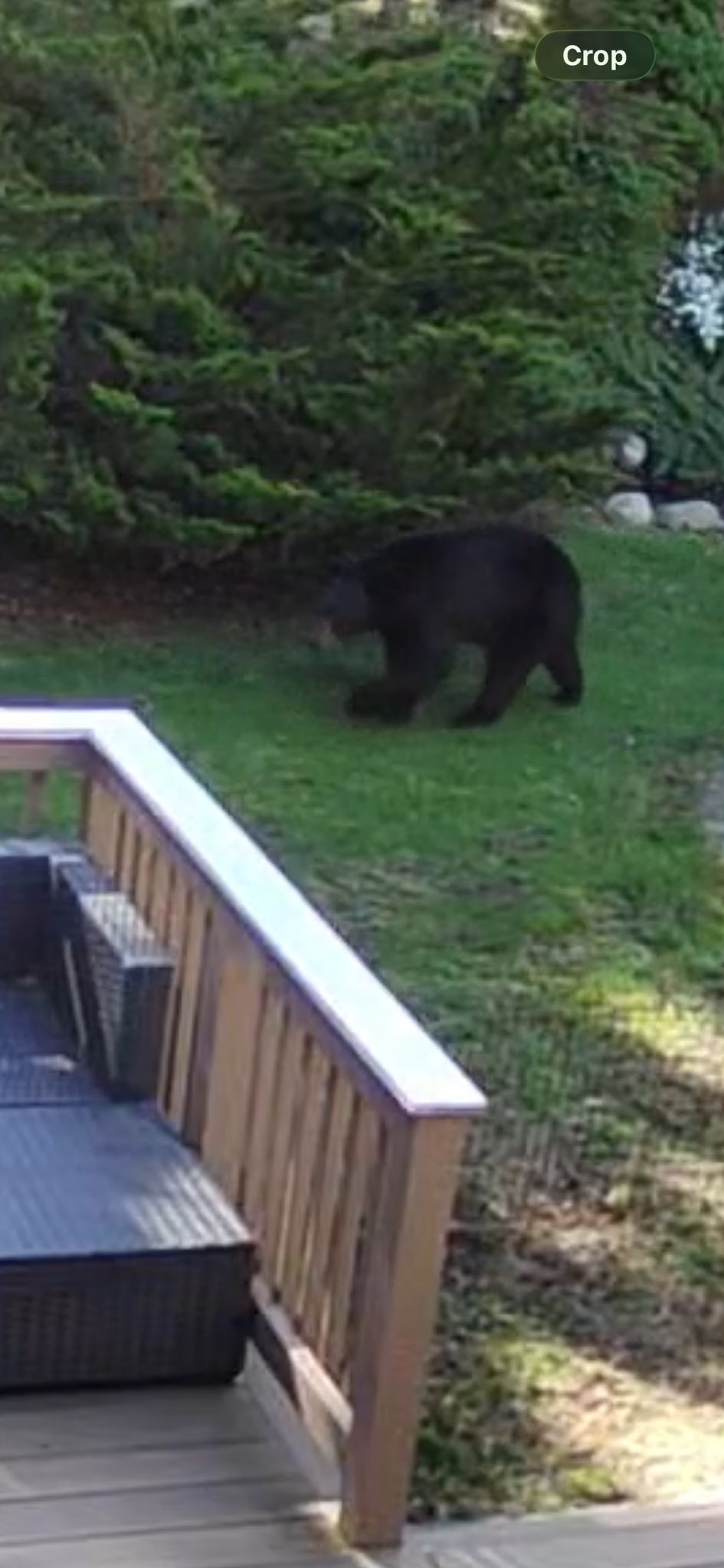
After finding more sightings in the closed Facebook group, I reached out to some of those posters to get permission to share their images, including the ones below:
*I’m sure the advice about native plants is music to the ears of volunteers involved in the Open Space Commission’s Native Plants – Native Pollinators initiative and members of the Native Plant Gardens Of Southborough.

It came through Mt.Vickery Road as it knocked over my beehive.
Yes, my beehive, which died over the winter, still with some honey, was knocked off my back terrace again 2 feet from my back door last night. We never had to take these kind of precautions in my thirty years here in Southborough, so this is a whole new level.
On Facebook, some have pointed out that National Grid’s big project in the woods may be disrupting the bear’s usual annual activities, pushing him out towards yards.