
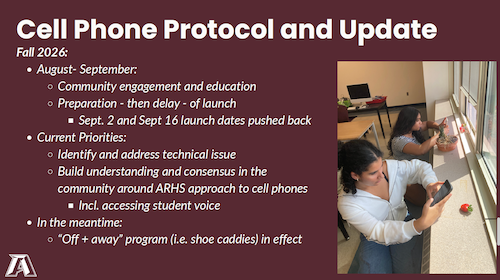
Above: Although the school’s latest online update shows that rollout of the Doorman should be in process, an update at last week’s Regional School Committee clarified that it’s now in limbo. (image cropped from meeting packet)
At the start of school, I shared news that Algonquin was launching a big technology change for the year. Any student who wanted to keep their cell phones on them would have to install the “Doorman” app that disables use of most functions during school hours. At the bottom of the story, I also referred to, but didn’t directly specify, that personal computing devices were initially also to be banned during school hours.
After pushback from many students and families, both of those plans have changed.
As of an update made to the Regional School Committee last week, the use of the Doorman app is indefinitely postponed to allow for more community discussion. And while the school did go ahead with the change requiring students to use school provided chromebooks when working on computers in classes — they are allowed to also bring in their personal devices for use outside of class.
Cell Phone Restrictions & the App Linked to School Attendance
Over the summer, Algonquin announced to students and families that the Doorman app would be used to restrict students’ use of phones during school hours. Students who had the app installed could keep their phones but would activate Doorman at the start of school to mark their attendance. In the case of an emergency or problem, they could deactivate the app to access their phone’s full functions. The school would be notified when that happens, and students would have to justify the activation.
Any students who didn’t want to comply could check in at the school office at the start of the day and leave their phones there (or leave them at home).
As the school year approached, ARHS students and parents began pushing back, raising concerns, and demanding answers and/or changes to the protocol.
The school posted that the implementation date for using the app wouldn’t begin until last Wednesday, September 16th. And they scheduled a Parent/Guardian Info Session for August 27th.
On September 4th, ARHS posted news on their website that stated while students should begin using the app on the 16th, the school wouldn’t begin using it to marking attendance would begin this Friday, September 25th. But, on the evening of the 16th, ARHS Principal Sean Bevan updated the Regional School Committee that the launch had been cancelled.
During his presentation “Cell Phone Protocol and Update”, Bevan told the committee that the delayed was based on two issues. One was a technical issue he experienced when testing on his own phone again soon before implementation was to begin. The second was the upset feedback the school was getting and concerns being raised. He described:
a desire in the community to talk more about this and understand more about it and to be educated more on it and to build consensus on its need. . . I reached out to our Steering Committees to find. to meet with students and get student voice. . . about what their concerns are. And then in the meantime, as we start to look at what are our needs to meet those larger goals, which is to protect the learning environment and address student social emotional health as it relates to cell phones, we are keeping with the “off and away” program
That “off and away” program requires students to put their phones in “phone caddies” which Bevan referred to as canvas shoe holders hung on the back of classroom doors. He said they were currently working great. But earlier in the presentation, he had stated that the system had worked really well at the start of last year, but:
is very difficult to sustain over time and it takes a great deal of energy for teachers and it does invite a bit of conflict with students as those as teachers continue to have to employ those systems.
And in answering committee members’ questions, he said that cell phones “is the one of the top issues, maybe the top issue, faculty bring to our attention to ask for help in managing”.
In a closed Facebook group, parents who were concerned about the planned implementation raised a variety of concerns. Those included one that Bevan said was the top priority in a parent survey — the ability to reach kids in case of a school emergency. (Some parents specifically pointed to their fears about kids’ ability to call/text if there is a school shooting.)
Given that, the technical issue that Bevan reported running into prior to rollout was one that would have raised alarm with parents. He told the committee that when testing it again, his phone didn’t come out of restricted mode “quickly enough for my preferences”.
Some parents have worried about the app’s ability to allow student access to apps needed on their phones and allowed under their IEPs (Individualized Education Plans). That wasn’t specifically discussed during last week’s meeting.
Parents have also raised concerns about whether the phone app could cause an issue in protecting students’ privacy. And in public comments at the start of the meeting, Southborough parent Oded Biran criticized pushing kids to install an app on their phone when he wasn’t sure the company behind it could be trusted:
they have done no external security audits. their risk profile, this specific company, their risk profile is what I would call dangerous at best when I would be doing due diligence on a company like this. and I have done a lot of due diligence on companies like these. and also the fact that it is not clear to me on whether or not they are actually using VPN or not using VPN and I don’t think it’s clear to them either.
At the end of the meeting, his son, Jonathan Biran, weighed in as an ARHS junior. He said he was concerned not just for our community but other school systems. He worried that if Doorman had a data breach, it could impact tens of thousands of students.
Another criticism parents have voiced is that the school’s protocol should have been decided by the Regional School Committee as part of their policy role. Both Birdan and Northborough parent Mitch Cohen remarked on that in their comments. Cohen told the committee:
You have very well thought out policies on student responsible use, technology, medication administration, safety, security, and attendance. the use of school purchased apps on family-owned phones to track use and attendance impacts them all. I hope that tonight you will recognize the importance of school committee decision-making before anything like this is considered again.
Later in the meeting, Jen Primack, a Southborough member of the committee, said that she had looked into that complaint. She found that in other communities whether the committee creates a policy or not has been mixed. She asked school and district leadership, whether the committee should have a role. Superintendent Gregory Martineau said that he could bring it to the joint policy subcommittees to do some research.
Member Kathleen Howard worried about the school simply removing kids access to phones without doing the work to deal with the “neurotransmission addiction”, mental health impacts and the “cognitive itch” the devices have caused kids (and adults) to constantly want to “scratch”. She wondered if DESE (Mass Dept. of Elementary and Secondary Education) offered any resources.
Bevan said that they had applied for a grant from for support of cell phone management programming in schools, but didn’t get it, and that “they’re not prescribing a singular way to do that.” Martineau followed that they are:
working with our students and educating them around, you know, why is it addictive? You know, what are what is the research around the impact it’s having on your brain? How does it impact your brain? I think the portrait of the graduate and what we’re trying to move forward in terms of digital wellness is the larger conversation around cell phone use.
And Wellness Coordinator Mary Ellen Duggan confirmed that the Digital Wellness Subcommittee is working on educational resources for families, for staff, and for students.
When the school first started pursuing a change for handling cell phones this year, the administration believed that the state would pass legislation to ban phone use during the day. As noted in public comments, the house and senate didn’t reach agreement on details for a bill this year.
Computers/Personal Devices
Last June, Bevan indicated to the committee that students wouldn’t be able to use their personal computing devices during the school day. He said that if they were, they’d be able to use them as a workaround of the cell phone ban. Upon questioning last week, he updated that he changed that based on feedback from students:
There was a sense of loss. There were students who spent their own money. There’s a sense of agency. so trying to so listening to that feedback is important.
He decided on a compromise between that feedback and the tension that teachers prefer having one device in a room “to keep the learning environment highly predictable”. So students can use their own computers in the library, “and we’re not going to be policing what device they’re using”.
