
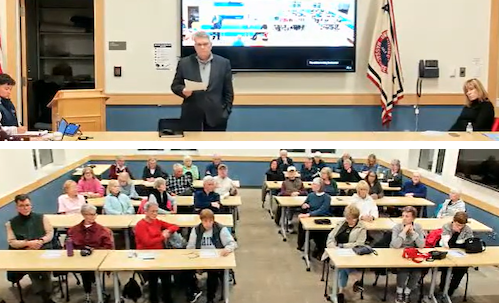
Above: A number of actively involved seniors showed up in person to the Town Governance Study “Listening Session”. They were the only ones. (images cropped from meeting video)
Last week, a consultant for the Select Board led a “Listening Session” to help inform the Governances Study he was contracted to conduct. Rather than a wide cross-section of residents showing up, the room was filled with Southborough seniors who argued for preserving the Senior Center’s independence. And rather than simply gathering their feedback, the consultant increasingly challenged attendees’ concerns.
His approach made me wonder whether feedback was sought to help shape recommendations or the consultant was “listening” for chances to pitch the changes he planned to recommend.
[For those who missed participating, the consultant previewed that he plans to hold another session in early December. Stay tuned for those details.]
The meeting was led by Bill Keegan of Capital Strategic Solutions (CSS). His consulting firm was hired by the Select Board to study Southborough’s government structure and recommend ways to improve efficiency. The session was promoted as an opportunity for residents to share their perspectives and identify priorities for improving municipal governance.
A couple of years ago, seniors succeeded on pushing back when some Select Board members looked into combining the Senior Center with other departments, like Youth and Family Services. Members of the Council on Aging were concerned that the study would revisit that possibility. They and other active participants from the Senior Center showed up to advocate for the continued autonomy of the committee and department.
Based on the interest of the attendees in the room, much of the meeting focused on that topic. There was also discussion about the Town’s communication challenges, fiscal issues (especially related to the schools) and other concerns.
According to Keegan, the study is examining potential restructuring of Town departments and committees. He didn’t consider leaving the Senior Center unchanged to be an option. To make a case for consolidating it with other departments, Keegan tapped into his personal experience (which included serving as a Town Manager for 26 years — for Seekonk, then Dedham, then Foxborough.) He told the room:
I used to have dept staff meetings with 16-18 people and they were very unproductive. … I shrunk that organization to a point where there were 8 people reporting to me. . . Those 8 depts became much more functional, they related to each other much better and the work got done a lot more efficiently
Asked about how he handled the staff changes (adding or deleting 8 people), he explained that it was neither. The jobs were just restructured, and some functions eventually eliminated “through attrition”. The potential “attrition” worried Council on Aging member Mary Ann Anderson:
Each person in our department has a specific job. And it’s very specific. We cannot lose any one of those people in those positions because they’re important to how our senior center works.
She argued that the Senior Center is a Town leader in performing well to meet the needs of the population they serve:
We are growing every single year. We are moving forward. We are looking at the future. We never stand still.
COA Chair Doug Peck worried about the impact of the center with its “unique mission” being consolidated with other departments. He argued that seniors would lose their voice:
now you have somebody who’s got two or three budgets and the pot is only so big. Where’s their loyalty lie? . . .it’s really, really hard to manage and because we have different missions than of any other department in this town. Our mission is to build a community of seniors. . . seniors that need this community that offers a incredibly wide variety of services from mental health issues to you know where do I get a handyman to fix my door when it breaks it goes the gamut.
There appeared to be some disparities in the arguments that Keegan made to the room. He agreed with attendees that the senior population is growing. To him, that was all the more reason that the current structure was untenable and would become more unaffordable over time. He highlighted that the Town (and many municipalities) are facing Proposition 2½ override issues.
But, when asked if the study would provide a quantitative analysis of savings that could be realized, Keegan responded “Probably not”. At one point, he claimed that administrative costs are always saved when departments are combined. But when repeatedly questioned on the idea of trying to trim taxes by focusing on changes to departments with small budgets, he stated that it wasn’t just about cost. The most important priority was “efficiency” — providing better services, improving communication and making government more responsive.
Peck stressed that he had repeatedly asked the Town for examples on what it would look like to consolidate the departments and what would be gained. He hasn’t gotten any answers. Keegan didn’t provide any insight on that in the meeting.
Peck didn’t argue that the Town government should remain exactly the same. But he opined that Keegan’s way of thinking about the traditional “hierarchical” organizational chart was antiquated. He said he’d studied and taught organizational design, He advocated for an alternative, “network” structure as allowing more collaboration and innovation. In keeping with that concept, Peck said he had previously suggested that a member from COA sit on some other committees and vice versa. He acknowledged that was a type of “restructuring” but, without making major changes. “It’s just a willingness for people to talk together,” he said.
On the cost savings front, seniors rebutted that their department and other departments focused on for consolidation each make up only about 1% of the Town’s budget. Anderson said the center had already been asked to bring its budget back to its FY25 level and had done what it could to control spending. Peck suggested that broader use of artificial intelligence across Town government and the school system might offer other opportunities to reduce costs.
Several attendees pointed to the costs of running the schools (and school buildings) as being the true source of fiscal strain for the Town. They wanted to see more pushback from the Town on the budgets. They indicated that they felt no one was saying “No” to the School Committee. Keegan pointed out that Town Meeting gives residents a say on the budgets. But some felt the push for restraint needed to come from the Select Board and Advisory Committee before budgets get to Town Meeting.
Keegan stressed that his look at making changes wasn’t just about the Senior Center but involved the Town’s overall organizational structure. At one point he indicated that would include the schools. But earlier in the meeting, he acknowledged that his study wouldn’t cover the structure of school staff or the School Committees. He was hired by the Select Board, not the School Committee which (under state statutes) has authority over the schools.
Ironically, in the meeting Keegan also made suggestions that would seemingly add to the Town’s budgets. In response to residents’ opinion that the Town is ineffective at communicating with the public, the consultant advocated appointing a Communications Director. And given seniors’ stated satisfaction with the Senior Center’s printed and mailed newsletters, he suggested their newsletter be mailed to wider populations in town. Questioned on why others would want the information on the senior center, he responded, “why not know about that information before you become a senior?” (I found the concept notable, since, over the Years, the Select Board has pushed to limit and reduce Town mailings to reduce costs.)
Stewardship Committee Chair Joyce Greenleaf, participating remotely, asked for the report to provide full context and a compelling rationale for any proposed changes, including clearly defining the problems each recommendation is intended to solve. Keegan assured it would.
The meeting also included broader concerns about Town communication, public access to information, long-term planning and budget oversight. Attendees suggested improvements ranging from a monthly Town newsletter to more opportunities to interact with department heads and elected officials. One of the suggestions was for the Select Board to hold office hours. Chair Kathy Cook told them that the board had been holding those, but people rarely attended. Anderson suggested that the Town better advertise them, perhaps using the DPW’s electronic sign at the downtown intersection.
Others suggested that department heads (like Police, Fire, and DPW), rather than the politicians they work for, should hold monthly hours with the public at a coffee shop.
Both Peck and former Select Board member Bonnie Phaneuf voiced disappointed that more board and committee members were not present for the discussion, given that the study could lead to changes affecting their responsibilities. Keegan said he had already gathered input from department heads and members of boards and committees, and that he had additional meetings planned. And attendees were told that 15 people were logged into zoom. (Though only two raised their hands to make comments. Notably, although their comments weren’t about the Senior Center, both were over the age of 60.)
Keegan told attendees he still intended to present his final recommendations to the Select Board on December 15. He said the recommendations would include the reasoning behind them and would be presented as a blueprint for future change.
He also stated that he planned to hold another listening session opportunity in early December. (And he did assure that he was using the sessions to “listen” for solutions.) That meeting could be more productive in getting public responses to the Town’s current organizational structure. Due to the MS Outlook outage, Asst. Town Administrator Vanessa Hale was unable to pull up the current org chart to show meeting participants.
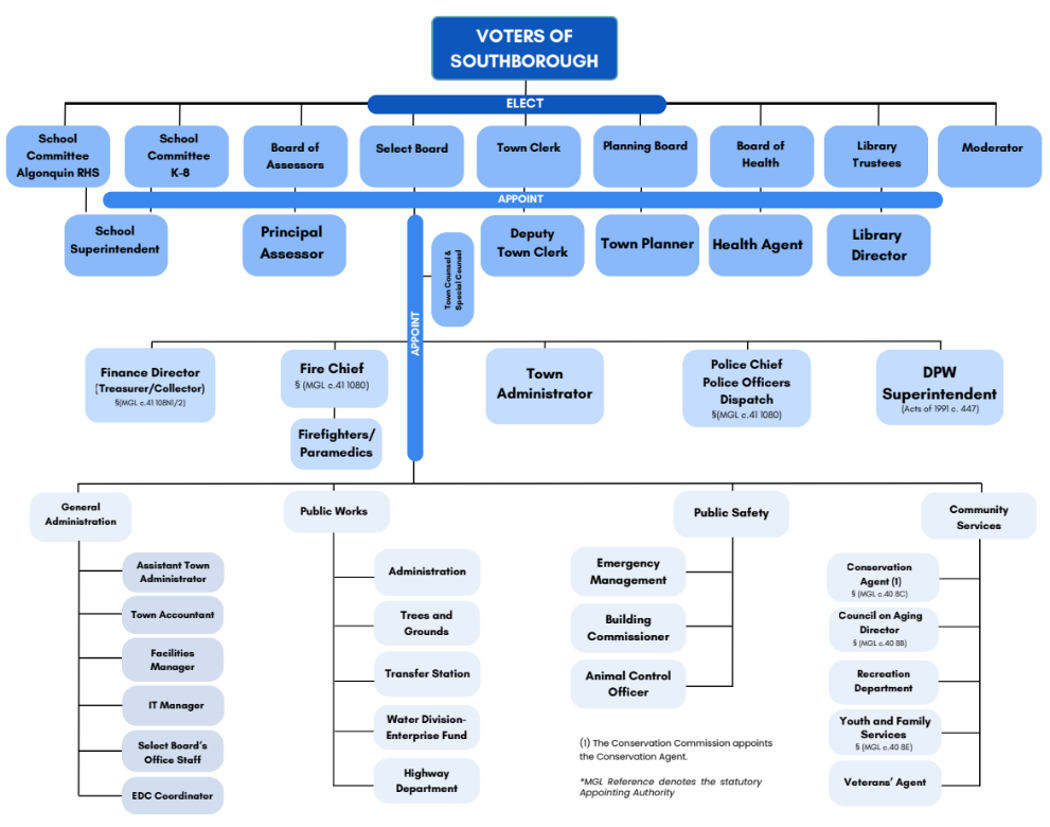 Zooming in from home, Claire Reynolds pointed out that the org chart from the Town’s Annual Report didn’t match the description that Keegan gave for the current structure. (See image right.) It doesn’t show 16 people reporting to the Town Administrator as he had claimed.
Keegan responded that it was a functional chart and didn’t show the actual reporting. He presumed that all of the department heads in the chart report to TA Mark Purple. Hale clarified that under state statutes, some report to their committees. Keegan commented that makes it even more challenging for the Select Board to deal with.
Phaneuf recommended that if the Town is going to share an org chart, it should identify who is under contract “with who”. She also believed people need to understand what powers the Select Board has for eliminating or reorganizing departments without a Town Meeting vote.
At the end of the meeting, Select Board Chair Kathy Cook responded to some of the criticisms of the Select Board’s budget management that came up during the discussion. She told attendees that much of the budgets are dictated by Collective Bargaining Agreements with unions, indicating they don’t control those salary increases.1 And she stated the board works very hard, looking at each budget to try to reign them in.
For the coming year, Cook warned that the Town was planning on bringing two budgets to Town Meeting. One would represent the headcount cuts that would be needed if a Proposition 2½ override isn’t passed. The other “really tight” budget would be essentially for level services. That will require an override vote.
Cook told them that if they really care about the budgets, there were three important meetings to pay attention to. One was this week (November 17th). The other two are on December 2nd and December 15th. The board will vote on the budget to approve to send to the Advisory Committee in early January, Advisory will work on that for a month. Then the two groups will talk through any issues to try to come to a consensus to recommend to Town Meeting.
