
On Saturday morning, a member of the Zoning Board of Appeals, with support from the Planning Board, tried to convince Special Town Meeting voters to rewrite residential zoning bylaws. The zoning change would have added a special permitted use for new development of two-family homes.
Only 51% of participating Special Town Meeting voters approved the measure that required a super majority to pass it.
Here’s my recap of the debate that led to the Article’s failure.
The proposal, sponsored by the Zoning Board of Appeals (ZBA), was described as aimed to increase housing diversity in Southborough in line with the Town’s 2021 Master Plan and 2025–2030 Housing Production Plan.
But the proposal drew criticism from voters worried that removing an existing two-year waiting period would create unwanted change in neighborhoods and encourage demolition of lower priced homes to be replaced with expensive duplex condos.
Voters debated whether the proposal was sufficiently developed and whether special permit safeguards would adequately protect neighborhood character.
What the Article proposed
Doris Cahill of the ZBA presented the proposal to amend the Town’s 1955 bylaw governing two-family dwellings.
Under the existing bylaws for special permits, converting a single-family home into a two-family dwelling requires the building to have been in existence for at least two years. It also specified a minimum lot size of 15,000 sq ft.
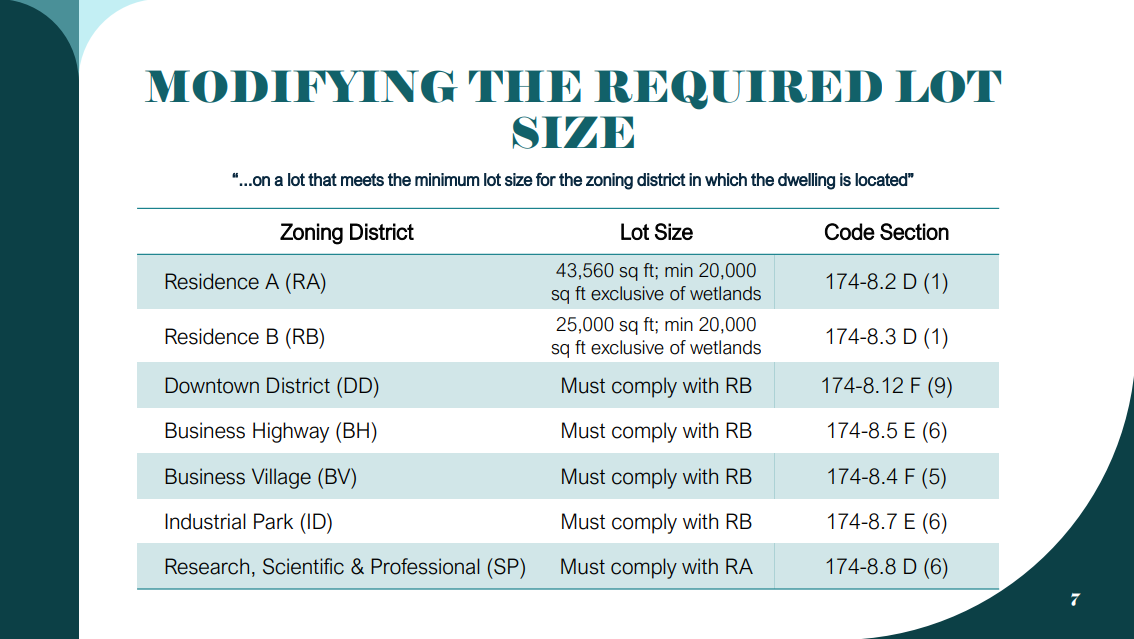 The proposed changes would have removed the two-year waiting period, allowing immediate conversion or new construction of two-family dwellings. Lot size minimums would default to the current (more restrictive) residential standards for zoning districts. (See image right.)
It also would have added a formal definition of a two-family dwelling as two units arranged side-by-side or one above the other, excluding accessory dwelling units (ADUs).
The proposal would not have eliminated the other existing requirements. Projects would need to meet Title V septic requirements for two family homes and go through the Special Permit process with the ZBA. Cahill’s presentation described:
Special Permit process allows for abutter input, conditions to ensure public health, safety & welfare and the character of the neighborhood
Planning Board supports a floor amendment
Prior to the presentation, the Planning Board reported that they supported Article 2 in a 3-0 vote, with the condition that language referring to lots meeting the minimum lot size for the zoning district be removed.
Immediately following the presentation, Meme Luttrell (former Chair of Planning who had participated in the public hearings as a resident) moved to remove the phrasing throughout the bylaw that specified the projects need to be:
on a lot that meets the minimum lot size for the zoning district in which the dwelling is located.
She explained that the edit would not change the zoning restrictions. It was intended to simplify it to remove “ambiguity and misinterpretation” the phrase might cause. (Some zoning districts that have different specified minimum lot sizes that aren’t applied to residential dwellings in those zones.)
After brief discussion, the amendment passed by a majority vote.
Debates over readiness, affordability, and developer incentives
The need to revise the language became part of an opponent’s argument. Howard Rose said the amendment demonstrated the proposal was “not ready for prime time” and shouldn’t be “rushed”. He argued that other aspects of the Town’s code should have been addressed before bringing it forward.
Voter Kathleen Barry, who works in the Building Dept, rebutted the idea that the zoning rewrite was rushed. As a Building Dept employee, she had witnessed the ZBA’s administrator and Building Commissioner “working on it endlessly for at least nine months”.
Rose was one of the four Advisory Committee members that had voted to Not Support the Article in their report to Town Meeting.
Al Hamilton spoke on behalf of the three Advisory Committee members that voted to support the bylaw change:
As you know, we have a housing crisis in and an affordability crisis in the Commonwealth and the only way that we are going to ever resolve that crisis is by building more housing.
John Butler objected to what he believed was a deceptive framing of the bylaw by the ZBA in past public presentations. The board had stated that the only direct neighbor to Southborough that has a time limit for the two-family homes is Framingham. But he asserted that some other towns, like Northborough, don’t allow any development of two-family homes in residential districts. That’s why there isn’t a time limit.
Butler also argued that it didn’t make sense that 55+ housing was still capped, not allowing more developments, while this new rule would open the door to new condo projects in every zoning district and neighborhood. He highlighted that this was different than ADUs, which must remain under single ownership. :
State law prohibits the ZBA from even considering whether a proposed new duplex is a condominium with two owners, or a single. So if this passes we should expect condominiums because that increases the value. We should not romanticize the ZBA proposal as somehow bringing affordable housing.
Opponents argued that the proposal did not include any requirement for affordable housing units. And some worried that removing the waiting period could encourage developers to buy modest single-family homes, demolish them and replace them with expensive duplexes that could be sold as separate condos.
Allison Pedraza believed that the existing time requirement helps ensure buyers invest their time and money in the community instead of purchasing properties for quick redevelopment. She argued that the change could encourage real estate speculation:
By removing the two-year waiting period you’re really creating a real estate investor’s dream.
Freddie Gillespie cited issues in other communities after they passed similar zoning changes:
in Res B, you’re going to see massive teardowns replaced with large condos on the same lot . .. You don’t get affordable housing if you don’t require it.”
Later, Ellen Marya, vice chair of the Affordable Housing Trust, claimed that the issue some commenters worried about is already allowed under current bylaws:
There is nothing in our bylaw now that says someone cannot buy a house that has been in existence for two years and tear it down and turn it into a two-family house. This is not a two-year waiting period on ownership. It’s a two-year waiting period on how long the building has been in existence. That is currently allowed, and that is not what we have seen in town.
No one directly addressed Marya’s comment.
[Editor’s Note: If Marya is correct in her interpretation, the removal of a wait period would only have impacted lots that don’t currently have a house on the property. That means it wouldn’t have added a new use to most neighborhood properties. (In fact, by requiring greater minimum lot sizes, it could reduce some opportunities.) But it still could have opened up new development on empty lots or larger lots that qualify to be split].1
Earlier, Paul Desmond, chair of the Affordable Housing Trust, argued that even without an affordability component, increasing housing supply could help moderate prices. He pointed to the limited stock of housing as the cause of high prices. Marya echoed that sentiment, saying more housing choices could help seniors downsize while remaining in Southborough and allow people who grew up or work in town to continue living there. She also told voters that the Trust is working on updating the bylaw for 55+ Housing.
Andrea Hamilton noted that a duplex unit priced at $700,000 could represent a more attainable option in a town where single-family homes routinely cost well over $1 million. Both Luttrell and Barry asserted that owning one side of a duplex is less expensive than a single family home.
Multiple opponents worried that adding duplexes would change the character of neighborhoods. In their rebut of that concern, supporters Al Hamilton, Andrea Hamilton, and Desmond all focused on the physical appearance of buildings. They argued that there are multi-family homes and new duplexes in town that look just like single family homes.
Developer John Bartolini Jr. pointed to duplexes he built in town, stating that they had not disrupted neighborhoods:
I built four houses with a garage. I rented them and then I came back and I turned the garage into a duplex. They’re n Flagg Road. Nobody says a word. Nobody says a peep. Nobody even came to the special permit when I notified the neighbors that I was going to do it.
Barry tapped into her personal experience growing up in a duplex in another Town, to rebut concerns about the impact of new duplexes on the Town’s quaint character:
We could barely afford the duplex that we had, but the duplex allowed us to come into town. My family is “quaint” . . . and we were really great for that town.
She shared that her father had worked his entire career in Southborough, wanting to move his family here for his kids to enjoy the benefits. He couldn’t afford that until his promotion to police chief, after she was already in college.2 She followed:
If we want families to come here, we need to have a variety of housing. If we want to age here, we need a variety. . .
So, we need to think about what we want here and who we are. Are we elitists who want we don’t want this in our backyard or are we people who want people to come to Southborough and make this place the great place that it is?
At the start, Advisory Committee Chair Marci Jones briefly stated their majority’s concerns, which included impacts on neighborhood character and potential municipal costs. They also questioned whether special permits would be an effective safeguard against unwanted development. Jones stated:
Special permitting while it’s presented often as a guardrail and a preventative measure in fact in reality does not prevent and is not a safeguard. And the ZBA confirmed that in a meeting, that they have never in fact stopped a developer on a special permit.
I later asked Cahill to clarify if the ZBA can and would consider complaints of abutters who worry that a project to allow condos would change the character of their neighborhood. She responded:
We’re definitely going to look and hear the abutters. it needs to meet the character of the neighborhood. And if you look at prior decisions, you’ll see that explicitly cited. We deny a permits. . . It needs to meet the character of the neighborhood. . . So yes we can say no.
Cahill highlighted that there had only been one two-family application to the ZBA and it was prior to her joining the board about six years ago. Luttrell also noted that as part of the special permit process, the Planning Board submits a report to the ZBA.
Kevin Miller asked how many ZBA members were in attendance. Cahill explained that the five-member board had voted unanimously to propose the Article after months of public meetings. But she confirmed that she was the only member present at the meeting.
The vote to approve Article 2 was 85-80. (By the close of the meeting, a total of 182 voters had checked in. But some voters had clearly turned out to support Articles 3 and/or 4 to fund Community Preservation Act projects.)
- The current special permit language applies the time requirement to “conversion of a one-family house. . . to a two-family dwelling”. I sought the ZBA’s administrator Laura Davis and the Building Commissioner’s confirmation of Marya’s interpretation of that language.
I asked whether “conversion” includes demolishing to build a new two-family, or just renovating a house. Davis agreed with Marya’s point on ownership, but said she would defer to the Commissioner on what the threshold is for a “conversion”. Commissioner Mark Robidoux is out of the office until late this week.
At this stage, the point may be moot. But if most residents objections were based on a misunderstanding, then the bylaw change may be revisited at a future meeting with a plan to improve communication around it. (I’ll update this post after I hear back.)
- Barry is the daughter of late Southborough Police Chief William Webber.
