
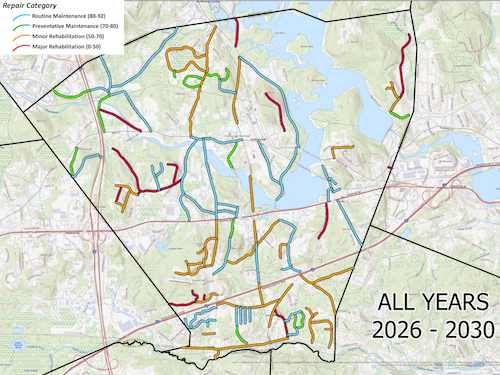
Above: Town Meeting voted to borrow for a 5-year plan to improve many heavily travelled roads across town. But it will still need support at the ballot to move forward. (image edited from presentation)
Only 207 voters checked in to participate in Saturday’s Town Meeting. Based on the timing of who left mid-meeting, it seemed many of them were there to weigh in on the request to borrow up to $25M to invest in improving roads and sidewalks.1
The funding Article is the largest single borrowing bill ever passed by Town Meeting. But while an attempted amendment was made on one detail, and multiple voters asked questions, no one spoke against borrowing the funds.
(There were votes in opposition. But enough voters supported the borrowing that the Moderator didn’t need to use the clickers to call the 2/3 approval.)
The funding will still need to pass muster with the majority of voters in the Town Election. The May 12th ballot will include a question asking to exclude all future debt payments on the borrowing from the annual cap on the Town’s tax levy. (Otherwise, it would be included in the calculation for capping taxes under proposition 2½.)
For voters who want to better understand what the borrowing would pay for, here’s my recap of the Town Meeting discussion.
On Saturday, DPW Superintendent Bill Cundiff walked voters through the Town’s proposed sidewalk projects, and the 5 year Pavement Management Plan. The Treasurer followed to explain the financial picture.
Road Management Program presentation
The majority of the presentation focused on the $22,255,000 for roads. Cundiff explained that the borrowing is intendent to allow the Town to invest in simultaneously fixing roads that are in terrible shape, while also conducting work to extend the life of other roads to keep them from deteriorating.
Historically, the town has taken the approach of worst first. We would basically focus on the failing portions of roads which is a large capital investment. So they would draw that capital improvement out of the operating budget and that would not allow us to put any kind of protection mechanisms into the other roads that aren’t in that bad condition.
He likened some of the work to the sealing residents do to extend the life of their driveways.
The work is broken into four categories. The “Routine Maintenance” deals with sealing cracks to avoid the cycle of freezing and thawing in cracks that leads to bigger cracks and potholes. The “Preventative Maintenance” is a full width overlay, similar to sealing a driveway. “Minor Rehabilitiation” is “typically milling and overlay or cold in place concrete”. That’s still just surface work.
“Major Rehabilitation” is the full depth reconstruction needed to fix the roads in the worst shape. It’s the most expensive. And, as noted later in the discussion, there can be additional costs not estimated in the budget if the DPW discovers there are bigger infrastructure issues under the road. (Failing drainage, etc.)
The intent of the Town’s plan is to include enough work under the first two categories that, eventually, the list of roads that need minor or major rehab shrinks over time.
He used tables and graphs to demonstrate how much more expensive it is to deal with failing roads. He also shared details about the number of roads that are in need of work. (See images below.)
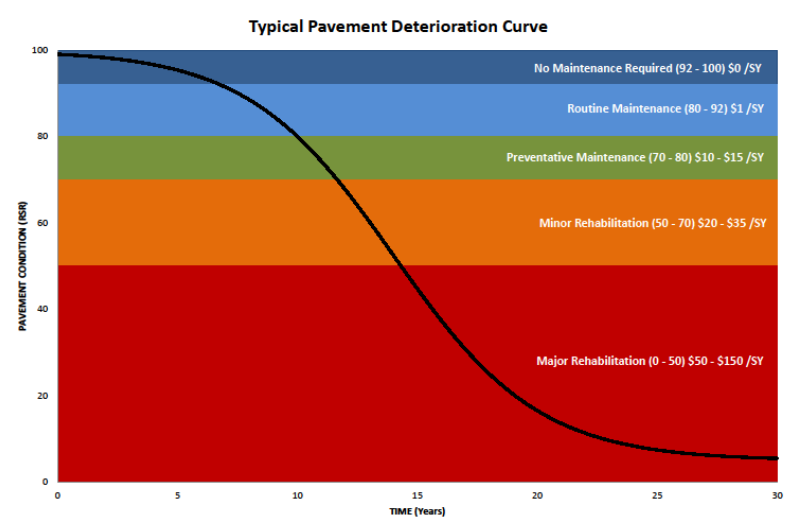
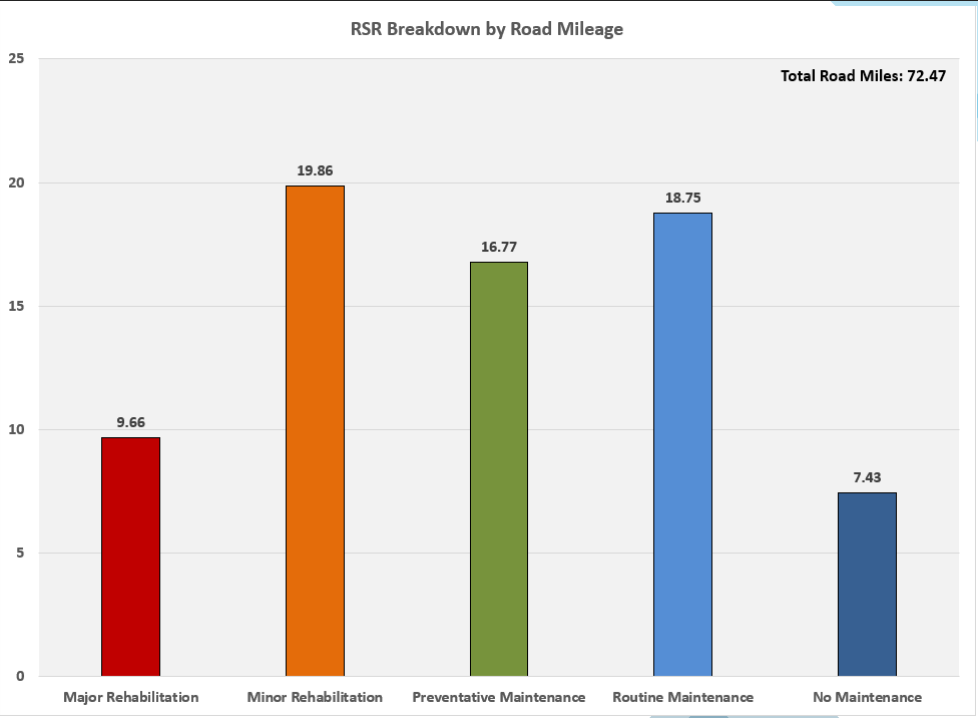
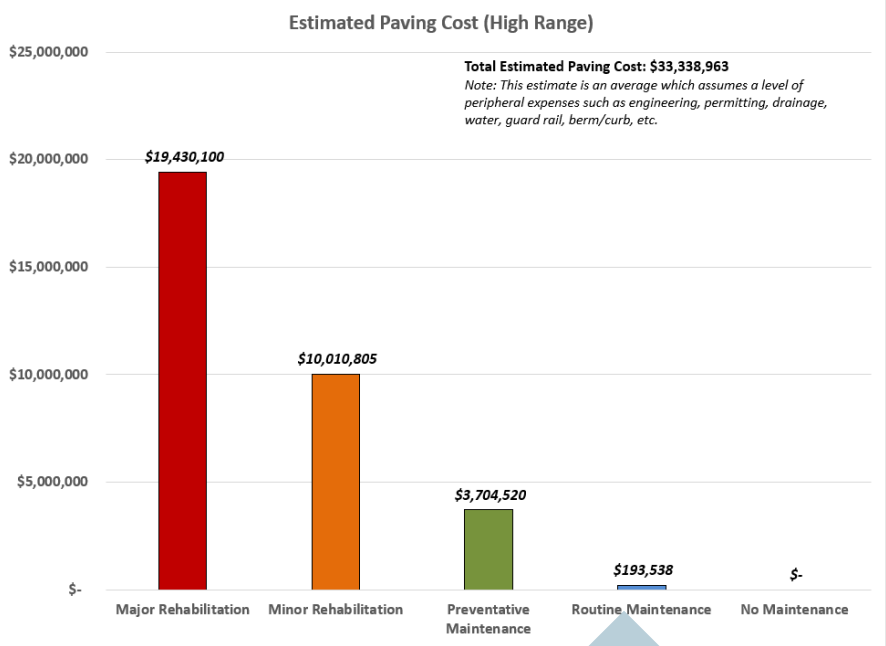
In his presentation, Cundiff described work done by the Town’s contractor Beta, to score the road conditions. (For readers who want more details on how that was done, I’m including two slides below from the consultant’s presentation to the Select Board in 2024. You can read their full presentation and report here.)
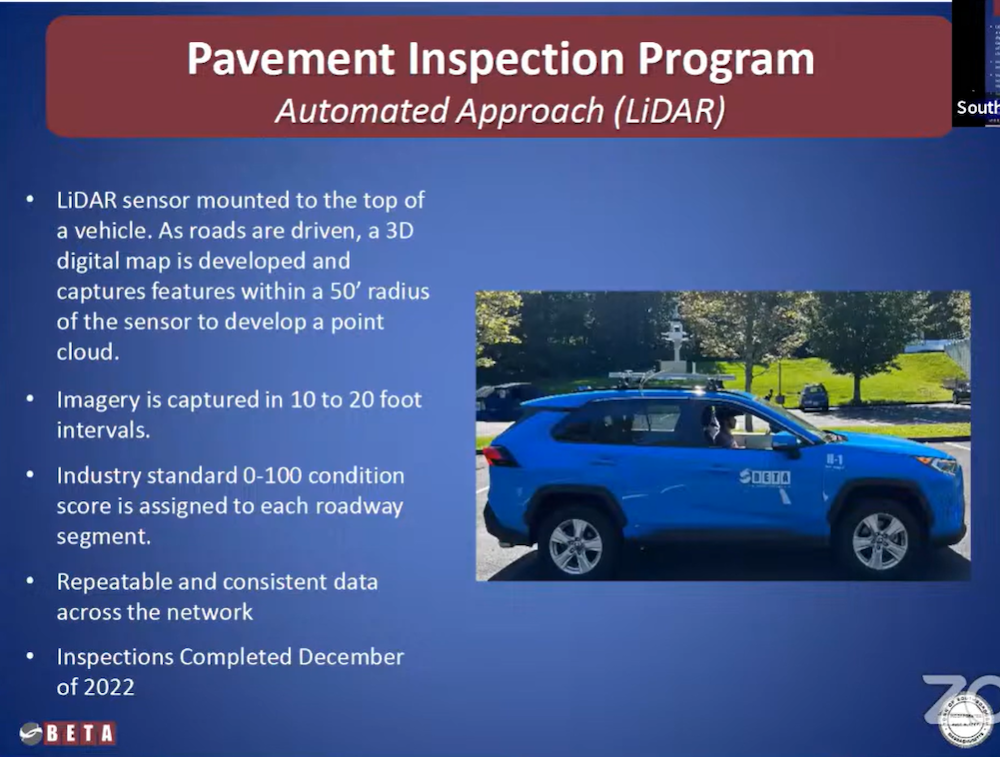
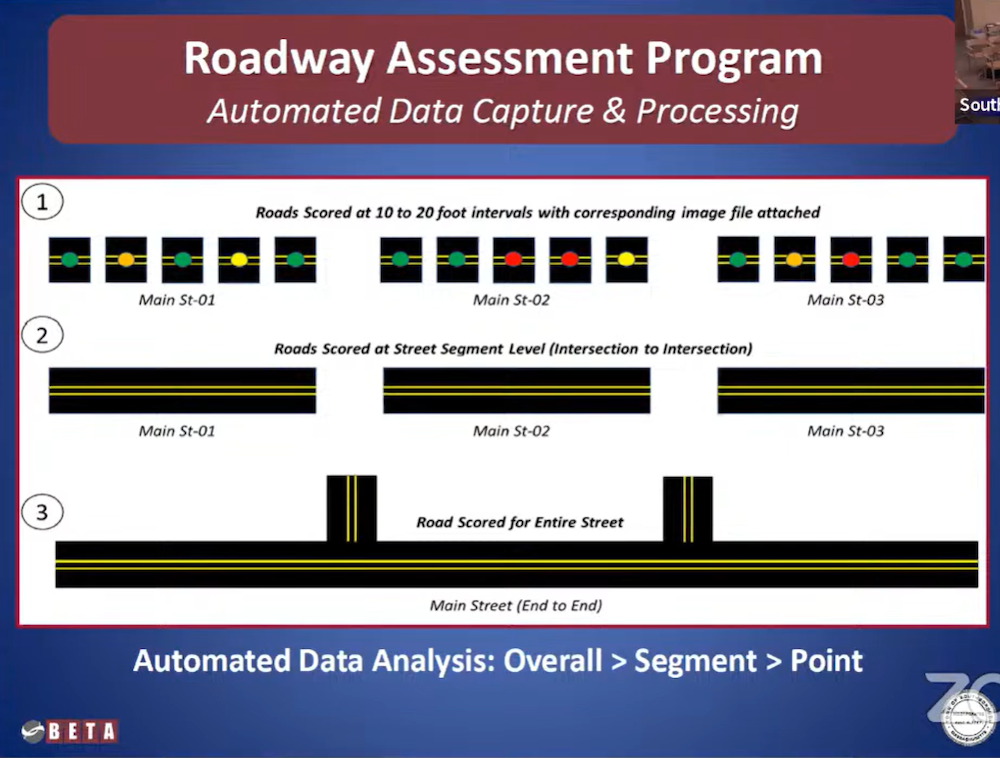
Cundiff used the road scores to create a 5-year road plan, but it wasn’t the only factor. He prioritized highly travelled roads. And, to get started quickly, the first year only includes Major Rehab of roads that don’t have underlying drainage issues. By pushing more complicated jobs to years 2 to 5, it gives the DPW time to do the advance prep work to be ready in those project years.
During the presentation, Cundiff noted that if an agreement moves forward for Hopkinton to interconnect to the MWRA water system through Southborough, Hopkinton will be expected to pay for repairs to the roads being dug up. That would change the timeline for impacted roads, which could be moved off the current road plan.
Given unknown costs for projects, especially with rising oil prices that impact asphalt and diesel costs, the Town may not be able to tackle all of the projects on the plan. Each year, Cundiff will return to the Select Board with an updated road plan.
Currently, the planned schedule is:
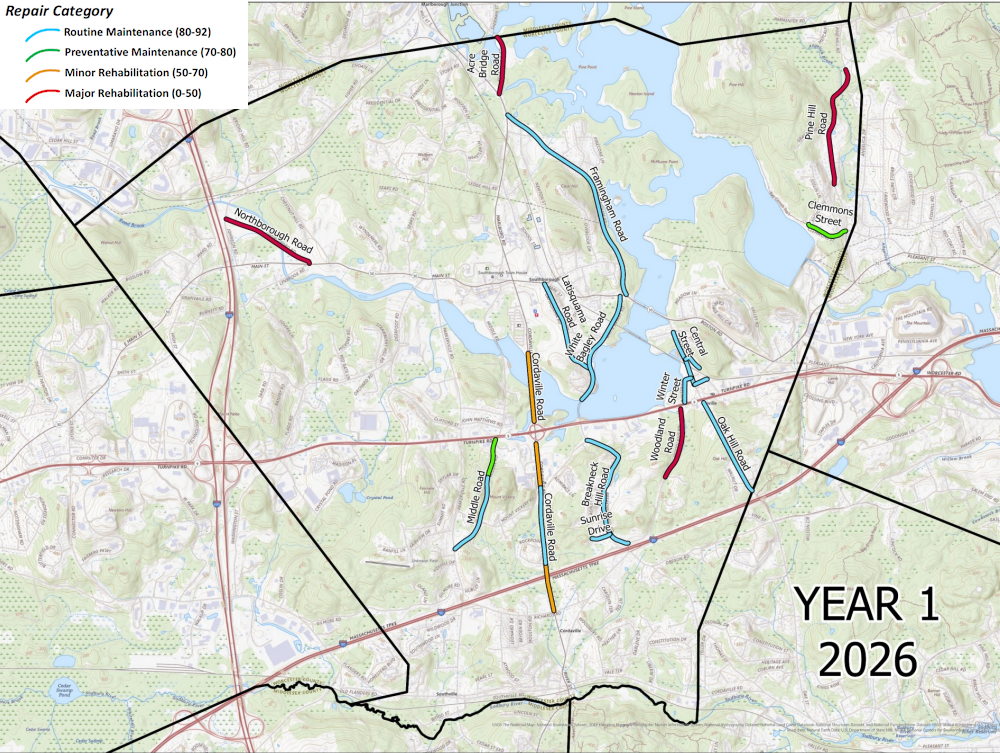
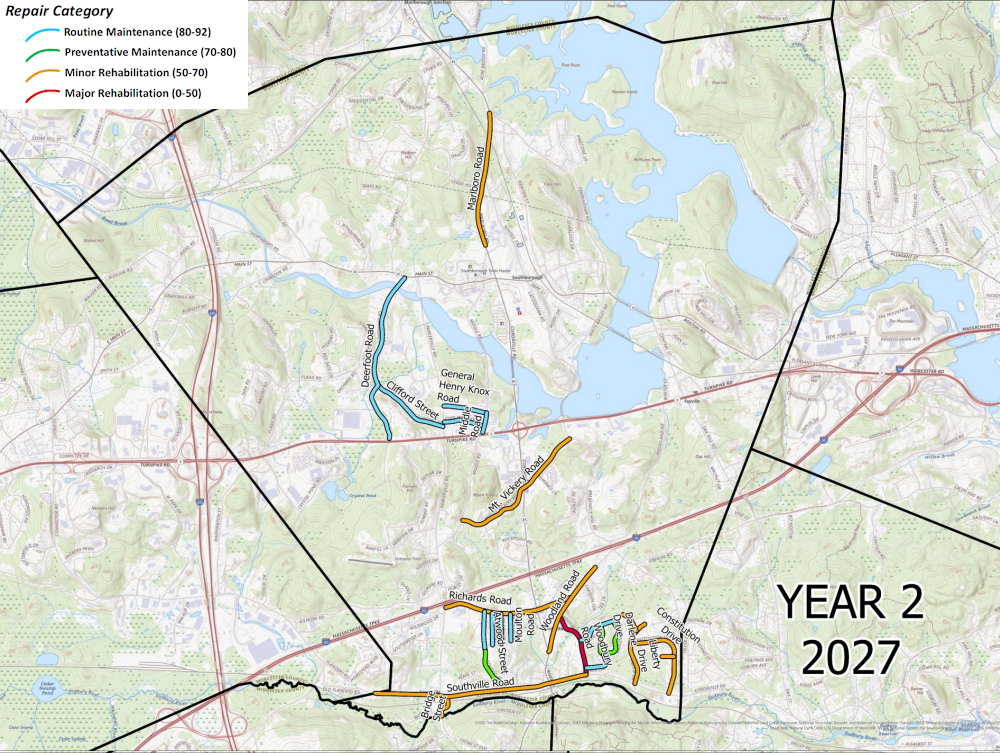
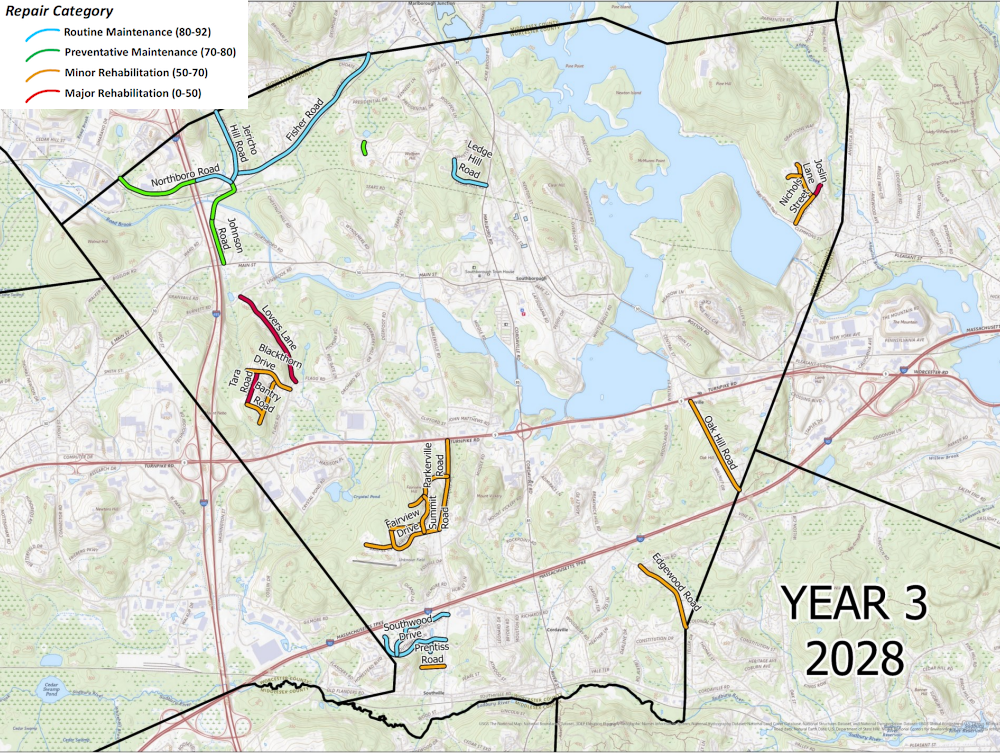
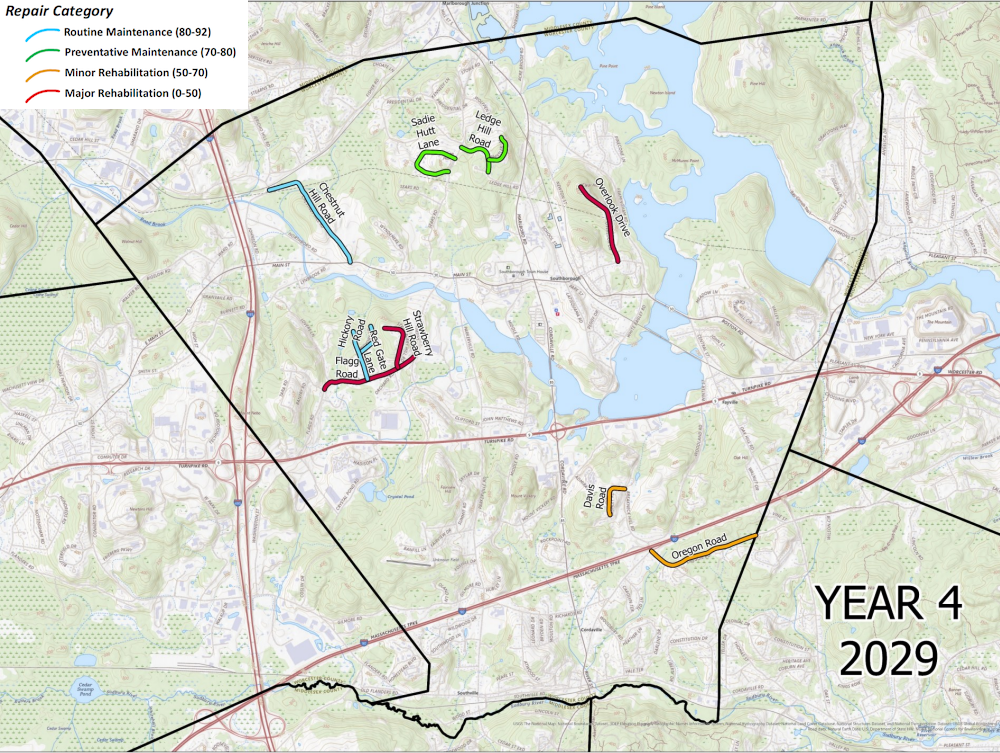
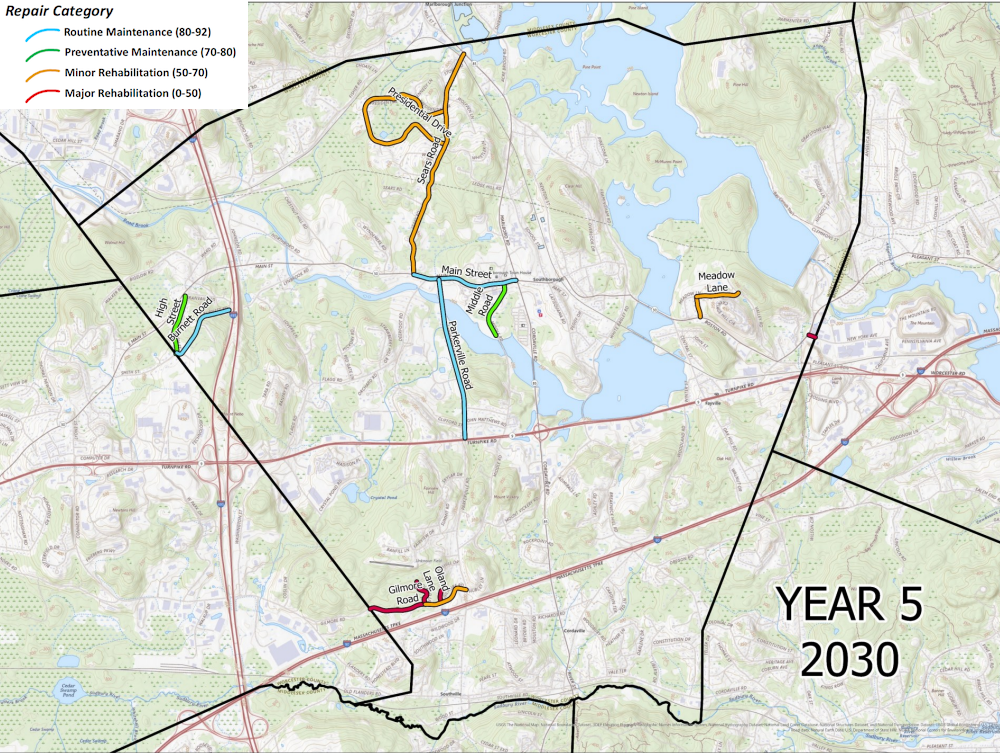
You can read Cundiff’s full presentation here and my prior coverage with more details here.
Sidewalks
Only 11% of Article’s 13 funds are dedicated to sidewalk projects — $2,745,000 But all 4 of those sidewalks would be tackled in the first year.
While it wasn’t highlighted, three of the sidewalks will connect far more neighborhoods to walkable access to Finn School, it’s playground and adjacent recreational facilities.) The following new sections will connect to the existing sidewalks in front of the School.
 Parkerville Road (Middle Rd to Finn School)
- Richard’s Road (Cordaville Rd to Woodland Rd)
- Woodland Road (Richards Rd to Oregon Rd)
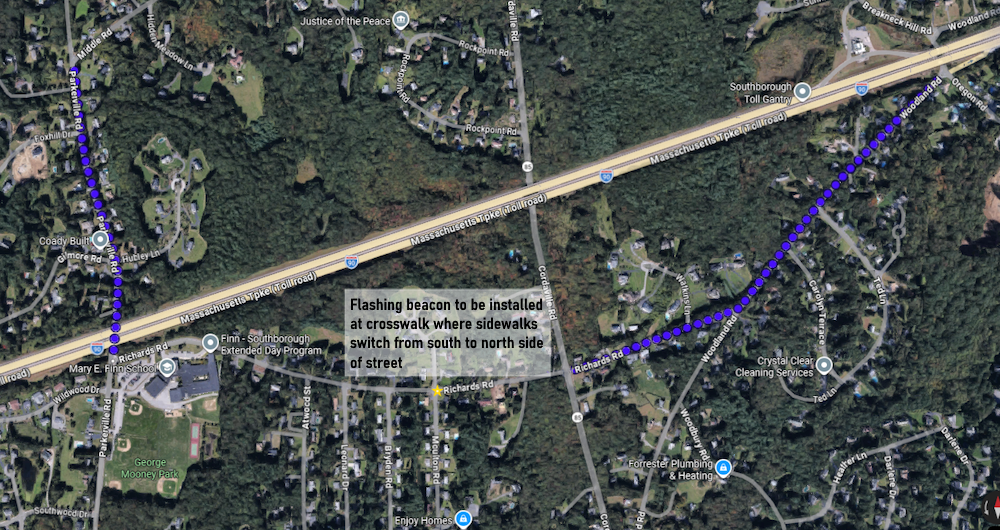
Cundiff specified that those sidewalks will be concrete with curbs. And he noted that a crosswalk on Richards Road will include a flashing beacon. (From prior communications, one is planned for the area where sidewalks switch from the south side of the street to north side of the street, at Moulton St & Killam Farm Rd.)
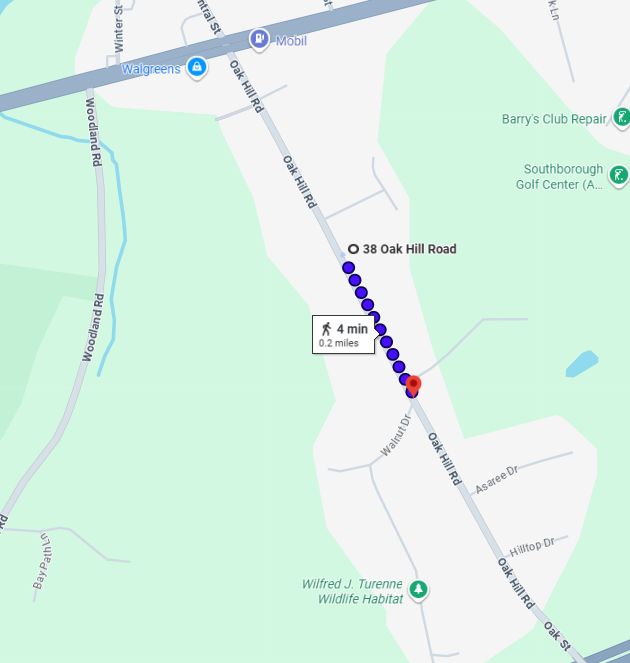 In his overview of the projects, Cundiff corrected an error in the Warrant (and presentation). A sidewalk planned for Oak Hill Road should have been described as running from the existing sidewalk to Walnut Drive. (Not to Woodland Rd, which is nowhere near there!) The project will extend the existing sidewalk using “basically asphalt” with no curb or berm.
The Financials
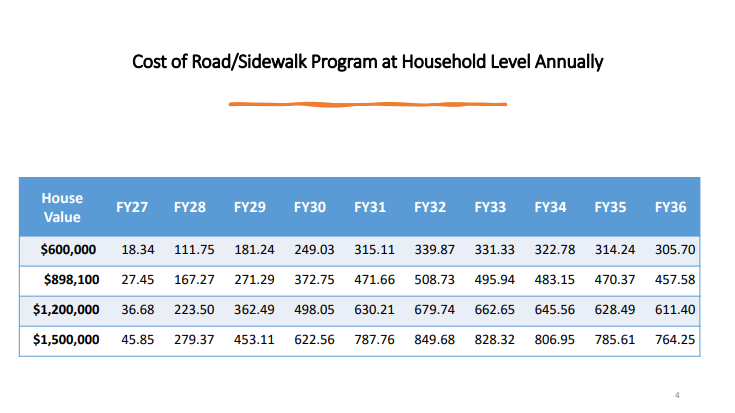 Town Treasurer Brian Ballentine acknowledged that his role in the meeting was to share the bad news. He focused on the Town’s debt landscape. He noted that debt is currently low. If approved, the road and sidewalk projects are forecast to add debt payments that peak in 2032. He presented (right) the impact for homeowners with varying house values.
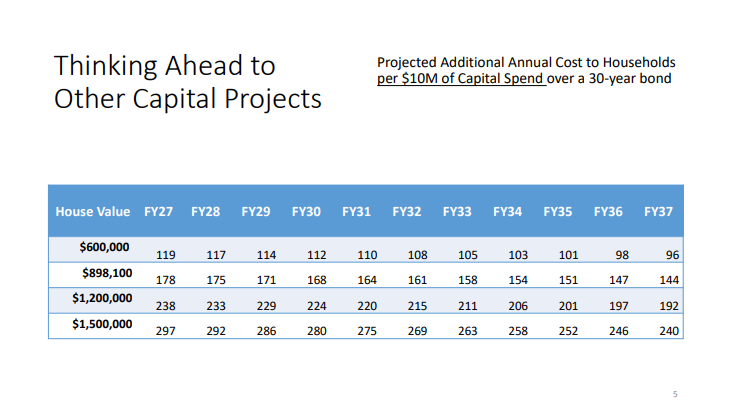 Ballentine also shared the cost that would be added for every additional $10M of borrowing if other capital projects are approved in the future. (Like a big Neary renovation project.) The table is the cost per household for every $10M of borrowing. (So multiply it by 5 for a $50M project, etc.)
You can view the full fiscal presentation here.
An Unsuccessful Motion
On behalf of the Open Space Preservation Commission that she chairs, Freddie Gillespie made a motion to insert the following language:
and that all work on these road and sidewalk maintenance, construction and improvement projects be done in in compliance with Mass DOT general recommendations for invasive plant management and that imported soils and material for backfill and site stabilization or any use related to these projects shall be certified weed-free and meet minimum standards provided by the North American Invasive Species Management Association (NISMA) and that any required seeding or planting shall adhere to Mass DOT landscape design and roadside maintenance guidance and shall use a seed mix recommended by Mass DOT.
She spoke to the hall about the problems and expenses caused by Japanese Knotweed. She explained how easily an infestation can spread:
You break off a little bit. It spreads. It creates new plants all the way down the road
She shared photos of giant infestations. She told voters that knotweed spreads under pavement, comes up through cracks and is strong enough to break through walls. She said the OSPC is worried about the large expense the Town could incur if they don’t take steps to avoid the project causing new infestations.
Cundiff responded that they don’t currently have a standard for the request. He said that when he asked Gillespie who would certify that soils were weed free, she didn’t have an answer. He was reluctant to support the proposed restriction without understanding what it entails. But he was willing to work with the OSPC and other committees on best practices.
Select Board Chair Andrew Dennington objected to the last minute proposal to the OSPC, after the Select Board and Cundiff spent a long time preparing to present the Article. He also raised a potential Open Meeting Law issue. He noted that while the OSPC had purportedly voted on the motion, the item wasn’t included on any of their posted agendas.
In contrast, Joyce Greenleaf supported the request. She told the hall about an infestation in her yard that forced her to spend $5,000 to hire a licensed specialist to get rid of. And she highlighted that residents are prohibited from spraying the edge of the road in front of their homes, which are in the right of way owned by the Town.
Marnie Hoolahan also supported the motion, noting that it called for abiding by Mass Dept of Transportation Rules and Regulations. Cundiff responded that local roads aren’t required to follow their rules. And he clarified that the motion is actually about following MassDOT’s “best standards” which even their agency doesn’t always follow. He also reiterated that he was willing to work with Town boards and committees.
Andrea Hamilton suggested that voting against the motion doesn’t mean that it can’t be addressed or adopted later. It could be brought to a future Town Meeting when more is known. And Advisory member Andrew Pfaff noted that the issue could be better addressed through a DPW or Select Board policy.
The Select Board voted 5-0 and Advisory Committee 6-1 to Not Support the amendment.
In a vote by hand, the motion was shot down. (That doesn’t mean the issue is dead. This could come up for discussion at a future Select Board meeting, especially as the board seeks to ensure voters support the debt exclusion on the ballot.)
Discussion of the Original Article
No one urged voting the Article down. But even among voters who spoke in general favor of the Article, there were some embedded critiques.
Answering voters’ questions, Cundiff explained that even roads that aren’t on the list will still receive the normal routine maintenance – filling potholes and dealing with drainage issues.
As for roads shown in red (in need of major rehab) that aren’t on the plan, they weren’t travelled enough to make the cut for the first five year plan. They might be added to a future round.
Mike Dillon expressed upset that the sidewalk projects linked to the roads project. As a 23 yr resident of Ted Lane, he described the danger for families walking down Woodland and Richards Rd. He worried that if the road borrowing failed, that the ability to address the “imminent” need for sidewalks would fail with it.
As a resident of Lovers Lane, Jamie Mieth supported the Article that would eventually fix her road (in 2028). She pointed out that for her street, the road is their sidewalk. She worried about a pedestrian getting killed when a car hits a pothole.
Still she wasn’t thrilled with the financial situation:
I’ve lived at Lovers Lane for almost 20 years, pay excise taxes for five cars and over $20,000 a year in property taxes. And I, you know, I will say I’m shocked we’re here having to ask for more money to do all these roads. I mean, I would ask the people in charge of the budget to make some hard choices going forward. And I did just approved the budget we had. And it would be very hard to make choices. I admit that. But we have to get these roads in shape.
Paul Carter strongly advocated for investing in the road plan. But his comment also noted that:
The sidewalk plan is old. The important thing is we’ve inventoried our sidewalks and we’ve located our accessibility handicap ramps locations and this is not specified in the plan but an important part of the overall plan to do sidewalks in town.
Next Steps
For details on voting in the Town’s Election, see my related post.
- As I’ve previously posted, I was unable to attend the meeting (for the first time in 13 years). So, I didn’t personally observe it. But, the Town Clerk tells me that he saw “quite a few people” leave after the vote on Article 13. While, only a few after the subsequent vote on the Trottier school roof.
