
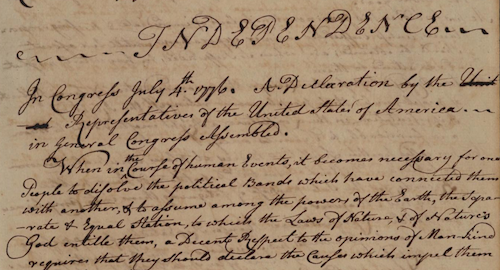
Above: In 1776, Southborough Town Meeting Minutes recorded the Declaration of Independence (image from Town’s digitized archives)
I’m correcting and updating on a recent post about the Town’s Declaration of Independence. I learned that at some point, the Town located the handwritten copy from 1776. The historic document is also part of the Town’s historical records that have been digitized and uploaded for the public to access.
I’m also sharing some more interesting history from the period that was captured in the records.
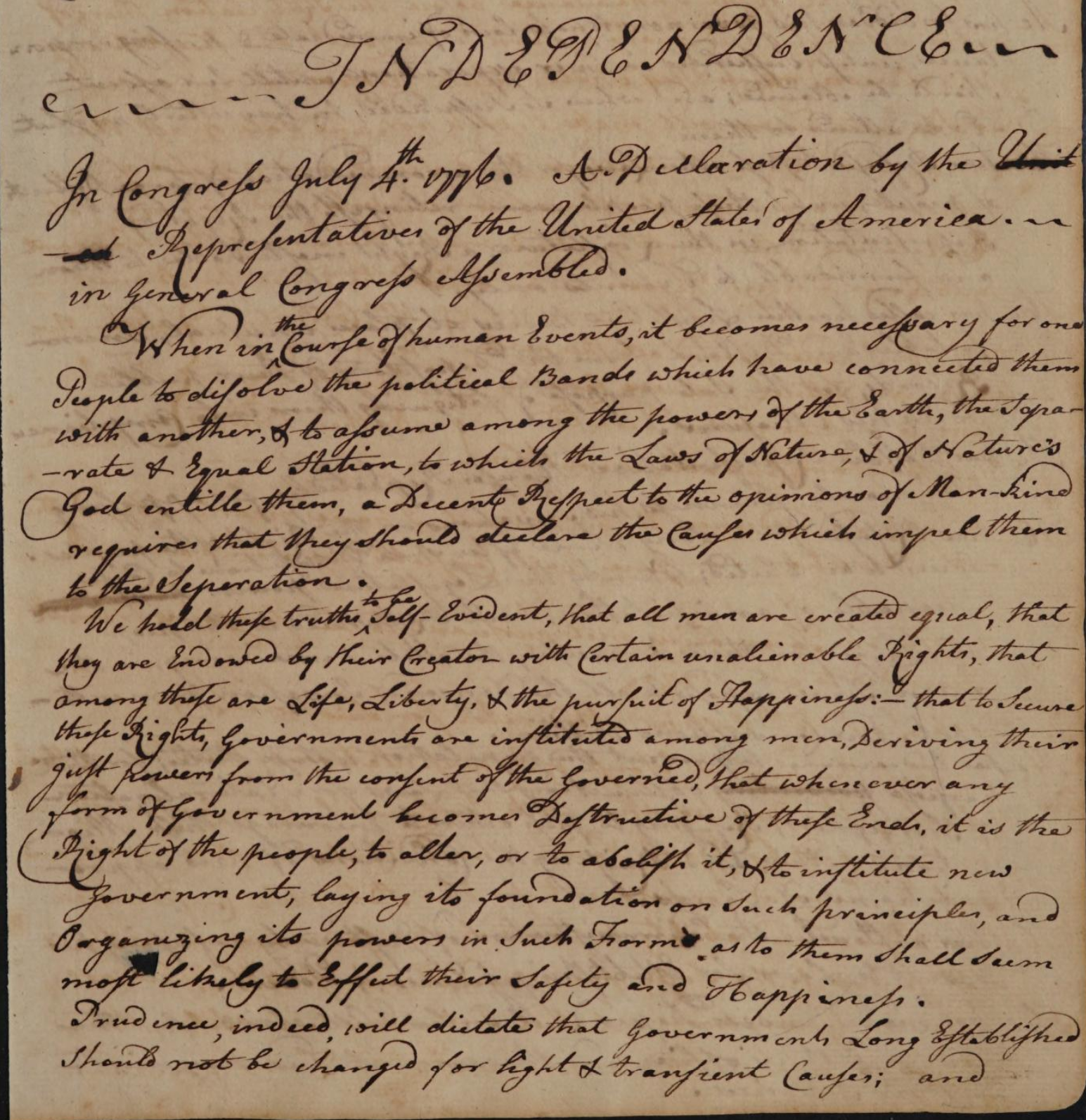 The record was in the Town Meeting Minutes. (It can be viewed here, on page 43 of the 1774-17799 minutes.) I also cobbled together screenshots to show the opening section of the document (image right).
In my prior post related to the Town’s documents, I also shared some history about the Town’s early commitment to support the cause for Independence. That was based on the Town’s vote on June 10th, 1776.
In looking at the minutes, I found that the Town resisted a push to take a stance a few months two years prior. In March of 1774, Town Meeting voted to not act on Article 12 to support the movement.*
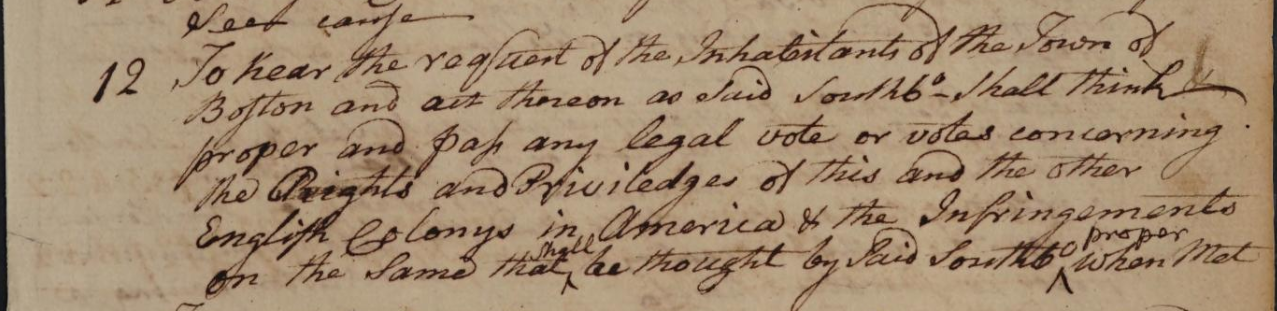
The old fashioned handwriting in the minutes was a bit of a challenge for me. But, you can get the gist from the words in the Article I was fairly confident of. [Note: Since writing this originally, Town Moderator Paul Cimino contributed his reading of the text, helping to fill in the blanks. It included fixing a transcribing error of mine. (I had accidentally typed “Town of Southborough” in one spot where I meant to type Boston!)] :
To hear the request of the Inhabitants of the Town of Boston and act thereon as said Southborough shall think proper and pass any legal vote or votes concerning the Rights and Privileges of this and the other English Colonys in America & the Infringements on the same that shall be thought by said Southborough proper when met.
*Updated (7/16/26 8:41 am): A comment by Moderator Paul Cimino not only filled in gaps in my reading of “Article 12” (and corrected a transcribing error I made), but also corrected that I misread the old fashioned script in the date. The vote was in March of 1774, not 1776. (Scroll down to read his full comments with other details below.)

Needless to say, this kind of history fascinates me.
After reading this Post, I set out to see if I could assist Beth in completing the transcription of Article 12 at Town Meeting, and I think I have done so (see below). But first, one significant correction: the Town Meeting from which this Article 12 comes was held on March 7, 1774, not 1776 as noted in the Post. There is no shame in this clerical error; quite the contrary, the script writing style of the era can stump anybody, and 4s often look like 6s. (Plus, all of the surrounding documentation in the Town archives places the Town Meeting on that date in 1774.)
In terms of the actual transcription of Article 12, below is what I see. I especially note with interest that the opening “request” is made of Southborough by “the Inhabitants of the Town of Boston”:
12. To hear the request of the Inhabitants of the Town of Boston and act thereon as said Southborough shall think proper and pass any legal vote or votes concerning the Rights and Privileges of this and the other English Colonys in America & the Infringements on the same that shall be thought by said Southborough proper when met.
Two more contextual notes:
The references to “said Southborough” may seem confusing, coming as they do after the reference to Boston. But remember that the entire Warrant of the Town Meeting is predicated on it being addressed to the people of Southorough; the preamble to the Warrant makes that reference, and “said Southborough” is a reference back to that preamble.
So, was Boston already drumming up support for recognizing royal “Infringements” on the colonies as far back as 1774? It certainly appears so.
P.S. If you read this entire Comment, you have my utmost respect ;)
Paul, the pushback in 1774 was in response to the Coercive Acts (aka the Intolerable Acts) passed by the British Parliament to punish Massachusetts for the Boston Tea Party of December 1773. I much appreciate having the input and perspective of the Town Moderator here!
Thank you, Kevin, we are all educating each other to be sure, so I appreciate it. So, to close the loop I went back and looked up the actual outcome of Article 12 from that Town Meeting in 1774, and the record of the Meeting lists only 4 words: “passed over at present”
A bit anti-climactic to be sure, but history is history.