
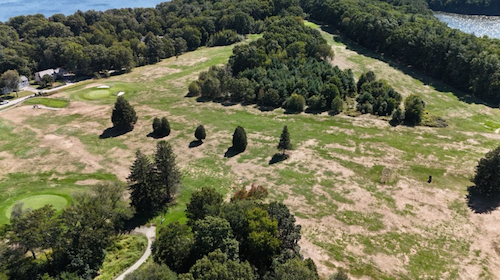
Above: Southborough voters agreed to invest close to $1M in CPA funding to replace the failing irrigation system at the Town-owned 9 hole golf course. (image from Article 3 presentation)
I’m continuing to cover significant votes at last Saturday’s Special Town Meeting. Today, I’m recapping the approval of Article 3 — to increase Community Preservation Act funding for an irrigation project at the Town-owned 9 hole golf course.
The vote to approve the funding was aided by golfing voters who showed up specifically to support the Article at a meeting with low attendance. But supporters also swayed most of the other attendees — despite strong criticism from some voters and opposition by the Advisory Committee.
Critics of the Article focused on the cost and “optics” given the Town’s strained finances. Proponents successfully countered many of the critiques and advocated for the recreational community asset.
Article 3 Presentation
Article 3 requested up to an additional $433,546 in CPA funding (beyond the funds approved in 2024), raising the total CPA contribution limit to $987,296. The Golf Course Revolving Fund will contribute an additional $100K to the project.
Knowing the arguments that would be coming, Community Preservation Committee Vice Chair Kristen LaVault briefly explained to voters that the CPA funds are raised through a local surcharge on taxes and a match by the state. They are restricted to use for open space, historic preservation, outdoor recreation, and community housing projects — not general municipal operations like police salaries.
Before detailing the Article’s request, Golf Course Committee Chair Tony Schoener talked up the importance and popularity of the 120-year-old, 57-acre municipal course. He reported the rounds played at the Southborough Golf Club increased from over 18K in 2019 to over 28K in 2025.
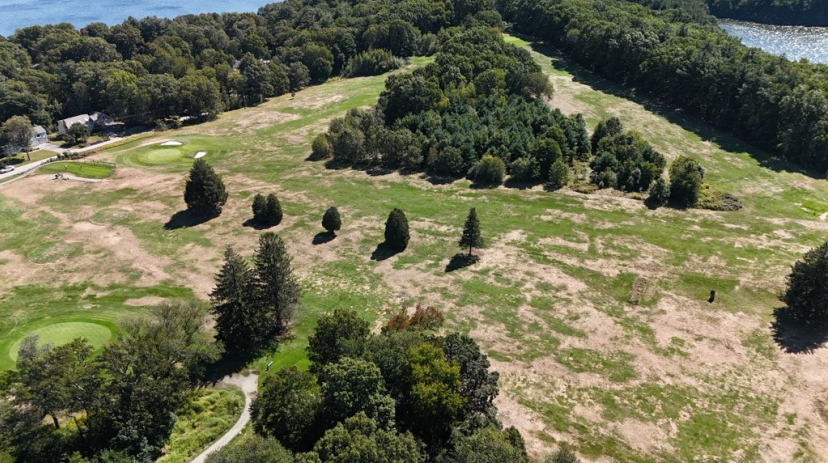 He then explained that the 50+ year-old system for watering the greens is leaky (wasting water), prone to frequent breakage, too manually intensive, and leaves fairways dry and less playable during summer months. (See image right from the presentation.) Summing up the pitch for funding replacing the failing irrigation system, he told the hall:
If you vote yes today to make this once in a generation investment in the golf course, your taxes don’t go up.
The hall was informed that the Select Board voted unanimously to support the article but the Advisory Committee had voted unanimously against it.
The financial arguments
Advisory Committee member Al Hamilton argued that the golf course was meant to be self-supporting. He objected to spending taxpayer funds to reduce labor costs for a private management company, and proposed a $1.50 per-round surcharge to cover municipal borrowing costs instead.
Select Board Chair Kathy Cook rebutted that the current course operator is retiring, and the town must bid out a new management contract next spring. Without a functional irrigation system, the town will fail to attract a new contractor and negotiate a financially beneficial agreement.
Cook also pointed out that current green fees are competitive with nearby municipal courses. Under the current contract, the Town would only receive a cut of a surcharge. She didn’t believe they could jack up the fees enough to generate sufficient revenue for the project.
In his comments, Hamilton also argued that CPA funds could theoretically free up general funds by funding qualifying town building repairs. He didn’t provide any specifics on future projects the Town should reserve the funds for. But he cited the past use of CPA funds to restore and preserve the Town House façade as an example of the type of project he was talking about.
Following up on that, Andrea Hamilton pointed to the timing of the Article at a Special Town Meeting this fall as a concern. She didn’t like voters funding the project without seeing the Town’s overall budget priorities and capital expense needs, including upcoming school construction.
Advisory Member Erik Glaser asked if they had sought other funding sources. (The answer was no.) Referring to earlier comments made under Article 2 about the importance of affordable housing in town, he said that dedicating $1M of CPA funds spent on the Golf Course instead of buying land to put affordable housing on seemed to smack those arguments in the face.
And John Butler argued that the optics of spending a lot of money on this type of project could have political blowback if voters are asked to pass a Proposition 2½ override in the spring.
LaVault highlighted that CPA’s project eligibility rules are strict, limiting the ability to apply them to most capital projects. As the Recreation Commission’s rep on the CPC, she countered claims that funding the project would prevent funding other recreational projects:
From a recreation perspective we have a capital plan… We don’t view this as in competition with any of that… there is not this long list of projects out there that we’re waiting to fund with CPA funding.
Arguments about the importance of the course and investment
Among those who advocated for the project, was one who valued the Town’s asset for non-golfing reasons. Freddie Gillespie reminded voters that part of the reason they invested in purchasing the property with a Conservation Restriction was to protect 57 acres that offers scenic views to everyone who passes by, sledding/snowshoeing in the winter, and areas with a natural habitat.
Lynne McKay, who runs the Southborough Women’s Golf League, promoted the community benefit of a well maintained municipal course. McKay highlighted that her group has 56 active members ages mid 50s to 91 years old. She also has a long waiting list that Southborough residents go to the head of. She touted:
Playing golf gets women outside, keeps them active, lets them socialize with other women, and having the course right here in town makes it easy for them to get there. . . women can continue playing and enjoying golf as they get older. If the walking gets more difficult, they have the opportunity to ride in a cart. What other activities do we have in town that people can do a sport from the time they’re children until they’re in their 90s?
She stressed the need for Southborough’s course to have better irrigation:
It’s not a cosmetic thing. It’s fundamental infrastructure to maintain the course. We’re tired of having our balls landing on hard dirt. You hit the hard dirt with your golf club, it hurts your wrist. We’re tired of losing balls going into the woods because there’s not enough grass to keep them from rolling. . . voting yes for article three is preserving a town owned recreational asset and protecting Southborough’s investment in that property for the long term.
Jim Colleary supported investing in the “historic” property long used by citizens, and argued against continuing to let the Town “deteriorate”.
Doris Cahill described herself as a regular golfer at the course who doesn’t play there when it is in poor condition in the peak summertime. She reasoned that investing in fixing the problem would result in a lot more use in the summer and more greens fees. She described the course as a great recreational asset and “the only real cash flow item in town that I can identify.”
Sean McCarthy agreed with Cahill. He also pointed out that by attracting out-of-town golfers, the course supports our economy. McCarthy acknowledged his bias as someone who had played about 150 rounds this year. He advocated
I’ve been playing that course since I was a kid. . .It’s busier now than I’ve ever seen it. It’s improved a lot, and the people who work there really care about the course and the residents and non-residents who play there. . . . people come from all over the state to play here in Southborough. . . Even if only half of them stop at Mauro’s or Dunkin’, or Fitzies that’s a lot of money going to our local businesses
Voter Dick Cruciani spoke as a 20-year employee at the golf course. He shared firsthand knowledge of how difficult it is to manually water the course and for the course to compete with neighboring municipal courses in Holliston and Westborough. He’s witnessed how play is reduced in the summer but comes back when the greens are restored in the fall. He finished:
I’m going to be celebrating my 85th birthday I would like the town to put the irrigation system in and relieve me from my responsibilities.
The Article passed by enough of a margin for the Moderator to decide by a quick vote by hand.
