
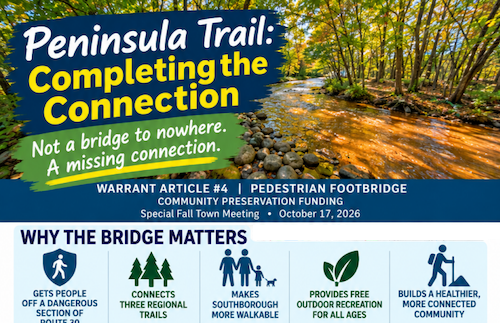
Above: The CPC and Trails Committee are bringing a funding request to Special Town Meeting for a footbridge help safely close a gap in Town and regional trails. (images cropped from flyer)
In March 2024, Annual Town Meeting voters approved using CPA (Community Preservation Act) funds to continue the effort to bridge the gap in regional and town trails. After an unsuccessful bid that proved the budget was far too low, the Trails Committee is now asking to double it, while also shrinking the scope of work.
It’s a funding request that faces stiff opposition from the Advisory Committee and Select Board. But they don’t have the final word. That lies with voters who participate in this Saturday morning’s Special Town Meeting.
The Trails Committee is hoping residents who support the trails will show up and vote in favor of “Completing the Connection” through the Peninsula Trail Project. Responding directly to a criticism by an Advisory Committee member, the committee’s flyer on the article promotes that it is “Not a bridge to nowhere.” It’s “A missing connection” in the network of town and regional trails.
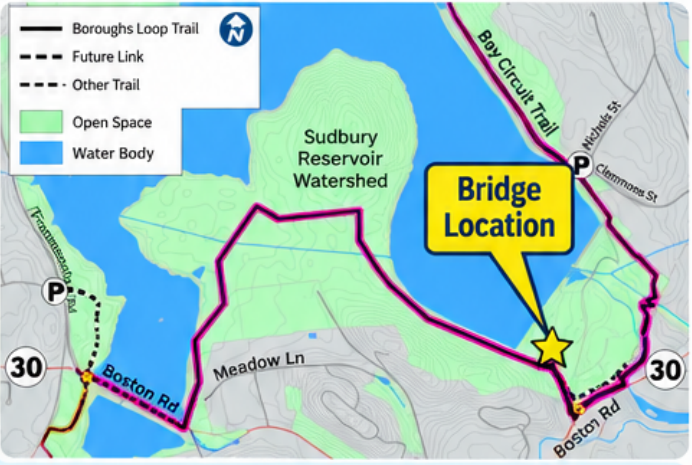 Article 4 is asks $217,318 to the previously approved $211,232 for the trail project. The budget would be dedicated to installing a pedestrian footbridge over water. Without the bridge, the only way that hikers can get from one section of the trail to the other is by walking on a section of Route 30 that is hazardous for pedestrians.
Originally, the smaller budget was intended to also cover a boardwalk and paving/striping/signage for parking spaces. The committee was able to tap into other funding for the paving.1 The boardwalk idea had to be scrapped when the costs for the footbridge came back as much higher than the committee had expected.
If approved, the total project budget will now be up to $428,550. The Trails Committee hopes that the actual spend will be much lower – just $265,300. That figure could be possible if the committee succeeds at getting a $100K grant from the state. (The Town won’t be eligible for the grant if voters don’t increase the CPA funding.) The total funding ask is also padded to include $104,500 in “contingency funds” for unforeseen costs that the committee hopes won’t be needed.
At the heart of the debate over Article 4 is how CPA funds can/should be used. The issue is heightened by Select Board and Advisory members’ concerns about the potential need to convince voters to pass a proposition 2½ override in the spring just to fund the Town government and schools at current service levels.
The Select Board initially supported the project before the cost shot up. In their September 15th meeting, the majority of the board felt that the project wasn’t worth dedicating that much in CPA funding. Members of the Select Board and Advisory opined that the money might be put to better uses given the Town’s financial situation. But they were unable to specify any projects/expenses in the Town’s project/capital pipeline that the money should be reserved for. (Scroll down for more details on that debate.)
More Project Details and Background
The Peninsula Trail project closes a 1.9 mile gap in the 33 mile Boroughs Loop trail, plus overlapping regional trails for the Aqueduct and Bay Circuit Trail systems. The Article is to fund the next stage of a project the committee has been working on for over 9 years. (It’s a project that received widespread community support six years ago, when the committee asked residents to sign a statement asking the state to grant access for a trail through Mass DCR property.)
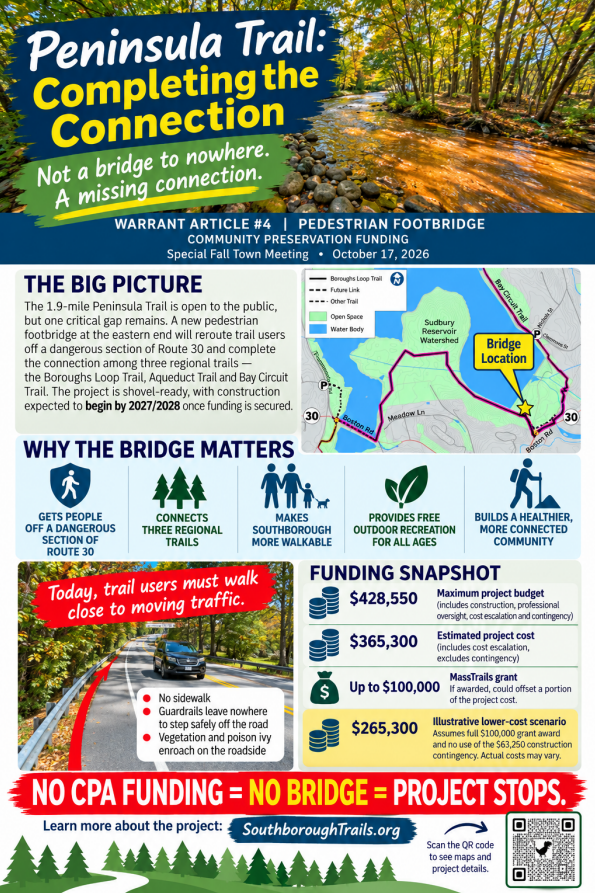 In a flyer, the committee emphasizes that if the project doesn’t get funded that would put a “Stop” to the uncompleted project. The attached handout explains that there are no other funding sources available for the work.
Pitching the project merits, the handout explains:
The pedestrian bridge closes the missing link in a larger trail network and reroutes trail users off a dangerous section of Route 30. Trails are another part of Southborough’s walkability network. Just as sidewalks create safer pedestrian connections along our roads, trails create off-road connections that help make Southborough more walkable. Southborough has long committed to completing its part of the 33-mile Boroughs Loop Trail . .
ONE CRITICAL GAP REMAINS: ROUTE 30
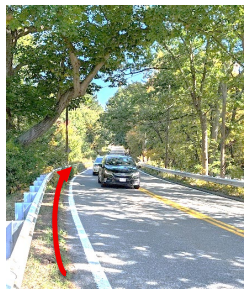
Today, trail users must navigate a section of Route 30 with:
- No sidewalk
- Little to no usable shoulder
- Guardrails leave pedestrians with nowhere to step safely off the roadway
- Poison ivy and vegetation encroach on the roadside, pushing pedestrians farther into the road
THE RESULT: PEDESTRIANS ARE FORCED TO WALK DANGEROUSLY CLOSE TO MOVING TRAFFIC.
A “bridge to nowhere”? Quite the opposite. The proposed bridge addresses this known safety concern by getting trail users off the unsafe section of Route 30, closing the gap, and connecting communities through trails.
In a presentation to the Select Board and Advisory, Trails Committee Chair Kathryn McKee highlighted that major portions of the Peninsula Trail have already been completed while spending only $2,400 in total CPA funds to date. The committee returned $44,600 from Phase I back to the town’s CPA account. It’s a project the committee and Town have been working on for 9 years.
I asked McKee about where hikers would be redirected once the footbridge was built and why the boardwalk was no longer needed. She responded:
To reduce project costs, we eliminated the boardwalk and built out a natural surface trail around the wetland area where the proposed boardwalk would have been installed. Appalachian Mountain Club / Bay Circuit Trail volunteers (led by Amber Sterns – the Bay Circuit Trail Coordinator) helped the Trails Committee build this section of trail.
She also described We’ve had about 4 volunteer workdays over the last 2 years to build this section. One workday earlier this year was dedicated to rerouting around the wetland area, the other workdays built out the other section of the natural surface trail.
McKee also asked me to share another update, which appeared to be based on questions the committee heard at their booth on Heritage Day:
we have confirmation that the gate at the Rt.30/Central street access road will be removed in the near term.
Select Board and Advisory Opposition
For those unfamiliar, the CPA is funded by a surcharge on Town property tax bills. The funds are set aside to be used only for qualifying projects under the umbrellas of open space preservation, historical preservation, recreation, and affordable housing. Each year, the state provides a partial match on the amount collected that is contributed to the Town’s CPA funds.
Advisory member Al Hamilton objected to putting so much money to the project he called “a bridge to nowhere”, when the Town is having trouble paying for police, etc. Trails Committee Chair Kathryn McKee and Community Preservation Commission member Kristen LaVault pushed back that the restricted CPA funds can’t be used on those kinds of regular budget items.
But Hamilton took the stance that if the CPA is wasted, there is a cascading effect when the Town needs to pay for future projects that voters want/need through taxes/borrowing. Select Board Chair and Vice Chair Kathy Cook and Andrew Paff reiterated their long stance that the CPA should be treated as a potential funding source for items in the Town’s capital expense plan.
Pressed to give a concrete example, Hamilton said that the CPA could be used for Recreation field projects. LaVault, who is also a member of the Recreation Commission, responded that field projects are currently on hold while the Town decides what to do about the Neary School building project. (She didn’t specify in the meeting, but there is concern that a school building project have its own cascading effects on other municipal properties and fields on or abutting school campuses.)
LaVault also advocated that there are many residents who don’t use the athletic fields and “really do value the trails”.
While four Select Board members voted against supporting the Article, member Sam Stivers supported it. He told the board
we have a public asset here in terms of a trail people use, are going to continue using it, and frankly it’s not safe at that point… I think we have an obligation to make it safe as we reasonably can.
The Advisory Committee unanimously voted to not support the project. Member Larry Samberg calculated the bridge cost at roughly $5,000 per foot ($320,000 for 65 feet). He asserted that is higher than construction costs for major highways. They believed the cost was just too high for the value/priority of the project.
CPC’s Support
Given the pushback from municipal leaders, CPC (Community Preservation Commission) members recently debated whether the Article should be delayed. The members were unanimous in supporting the project, but two were concerned that asking for support at this fall’s meeting might “tank” the project.
At their October 8th meeting, they discussed a suggestion by the Trails Committee to amend the Article on Town Meeting floor to reduce $8K of the contingency funding. CPC members worried that the last minute change would add confusion, and make it harder to get the votes needed. (Especially since voters who have experienced projects being more expensive than initially estimated could be cynical about the reduction.)
CPC Chair Lisa Braccio worried that the CPA Article wasn’t “ready”. And LaVault believed that more time was needed to educate the public. That wasn’t just about the project merits, but also on how CPA funding can (and can’t) be used.
Grant Farrington wholeheartedly disagreed with hitting pause. He described the project application as having been in process for a year and a half. He noted that prior CPC Articles had passed even when they didn’t have full support from the Select Board and Advisory. The committee voted 4-2 to support presenting it to voters this Saturday.
The Special Town Meeting is scheduled to open at 10:00 am on October 17th at Trottier Middle School. For more details, see my dedicated post.
For more details on the Peninsula Trails Project and Article click here for the 4 page, updated handout.
