
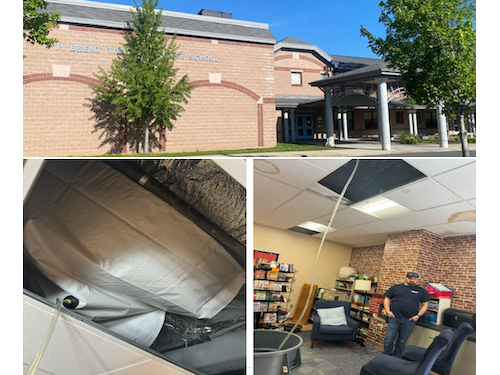
Above: Trottier is one our our district’s more recently built, modern schools. But it has been plagued with roof issues and leaks for decades. In a few weeks, voters will be asked to approve a project to replace it. (images cropped from district website and presentation)
Last month, Town Meeting voters approved spending millions to replace a failing school roof. In less than three weeks, voters will be asked to approve even more funding to replace another school roof at another Town Meeting.
Even after significant assistance from the state, Southborough’s share of the Trottier Middle School roof replacement project is estimated at $5.4M (with built-in contingencies).1
According to Assistant Superintendent of Operations, Keith Lavoie, issues with the roof began within years of its sub-standard installation nearly 30 years ago. But by the time the issues were discovered, the contractor had already gone out of business.
As a former Trottier teacher, then principal, Lavoie was very familiar with the leaks the building has experienced for decades. He described the problem as based on structural flaws.
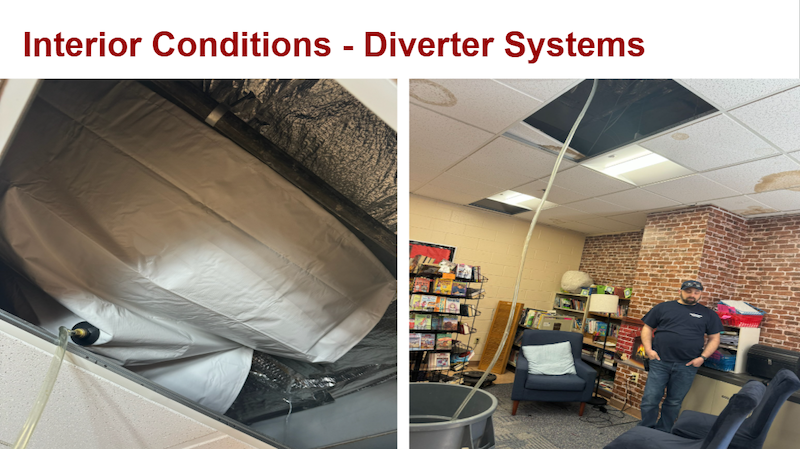
Lavoie’s presentation featured images and details of the roof problems and indoor impacts, including leaking and mold. It also demonstrated an example of the building staff’s creative work to grapple with the problems using a “diverter system” of tarps to drain leaks:
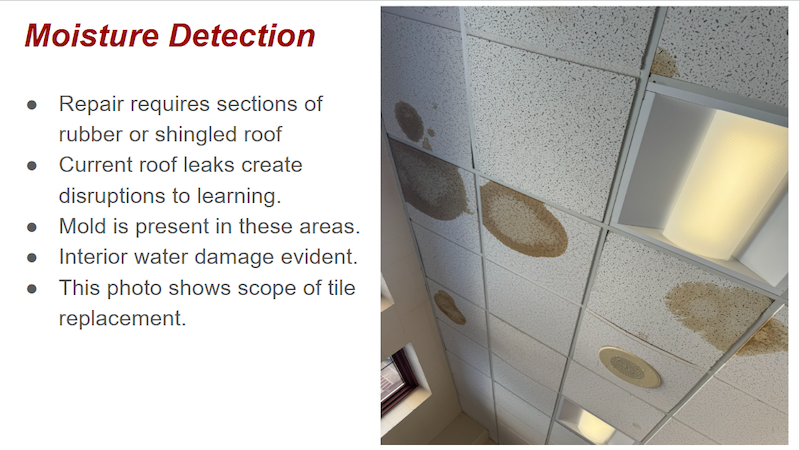
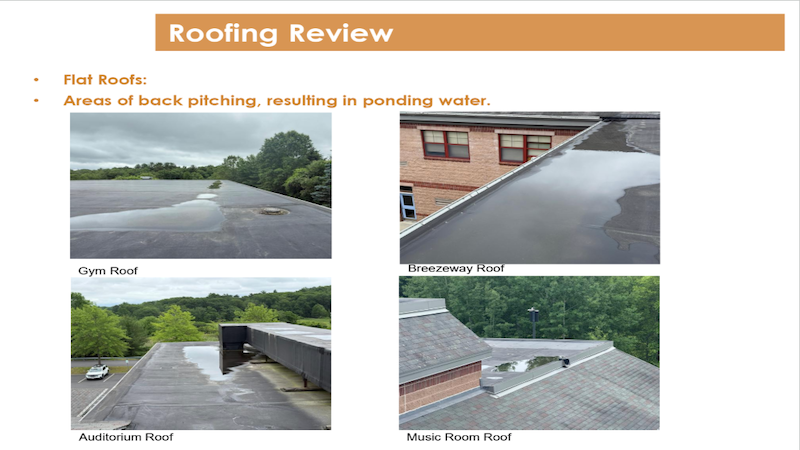
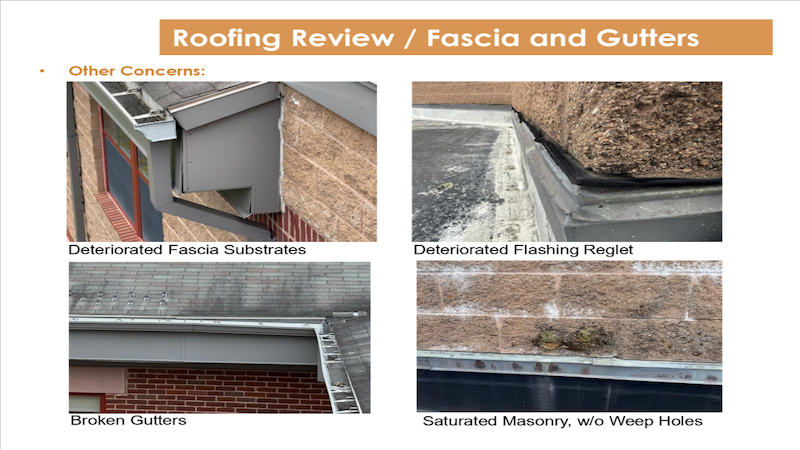
(You can view the full set of slides Lavoie presented to the Select Board last week here and the 2025 Existing Conditions Report here.)
Starting in 2019, the school applied for for financial assistance through the Mass School Building Authority’s grant program for “Accelerated Repairs”. That was rejected three time. When the roof became 25 years old in 2024, it was finally accepted into the pipeline as an eligible project.
The project costs include replacing damaged areas of decking, but also adjusting how existing decking is fastened to correct the structural issues. That’s in addition to replacing all of the insulation and the outer membrane (over flat areas) and shingles (on the pitched areas).
The project is currently estimated as costing over $8.8M (with contingencies). MSBA will reimburse Southborough for “41.32% of the total eligible costs”.
The Warrant for the Annual Town Meeting on Saturday, April 11th will include an Article to authorize borrowing for the full project cost. (The Article wording is dictated by MSBA. The actual motion, which is also dictated by MSBA, will make that borrowing contingent on a successful ballot question.)
If voters reject the funding, the future replacement cost is expected to rise 5-7% per year. The Town would also lose its place in the MSBA grant cycle and either need to potentially wait a few more years, or fund the project without state support.
If borrowing is approved at Town Meeting, a ballot question will be added to the Annual Town Election for exempting the debt payments from the proposition 2½ override cap.
That’s in addition to the debt exemption question for replacing Neary School’s failing roof — a $4.5M project that voters approved at the March 2nd Special Town Meeting.
And stay tuned for news on a potential third debt exemption question for infrastructure funding that dwarfs the school requests. The Annual Town Meeting Warrant will also include close to $25M borrowing Article for road and sidewalk improvement projects.
Updated (3/26/26 1:59 pm): Lavoie got back to me about a question I had asked. I wanted to understand how much fixing the underlying problems from the prior substandard roof is adding to the project cost (beyond what a normal roof replacement would have been). He responded:
I was able to connect with the architect. The replacement of the plywood sheathing on the pitched roof portions is due to substandard products originally used and to prolonged water infiltration, which have caused warping, delamination, and buckling.
So the answer is YES. The roof replacement may have been cheaper had repairs been made earlier; however, the substandard sheathing would have been recommended for replacement or, at the very least, a new overlay anyway, even if it was not damaged.
It is also worth noting that roofs of this lineage lasted less than 20 years. So Trottier is beyond the typical life expectancy for this type of roof system. Typically, a commercial roof does not last 30-40 years. The average lifespan of a commercial roof varies depending on the products, whereas the cheaper methods may last 15 years, and the more expensive methods could last anywhere between 20 and 30 years, depending on detailing and product(s) used in late 90’s.
Both the asphalt shingles and the EPDM roofing membrane exceeded their expected lifespans. Neither of the products used was top-of-the-line, and both typically have a maximum life expectancy of 15 -20 years.
Given the details above, it’s worth noting, Lavoie told the Select Board that the new roof proposed is estimated to last 40 years “with pretty solid warranties” (using a 40 year PVC membrane).
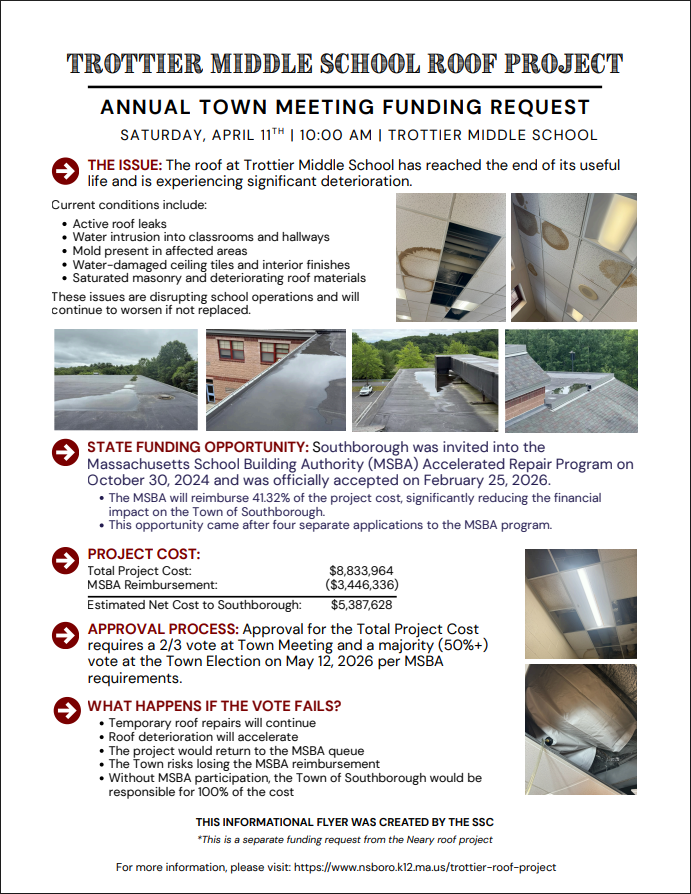 Updated (4/9/26 4:52 pm): The School Committee asked me to share the related flyer right.
Updated (4/10/26 9:24 am): The planned presentation has been posted. You can view a pdf of it here.
