
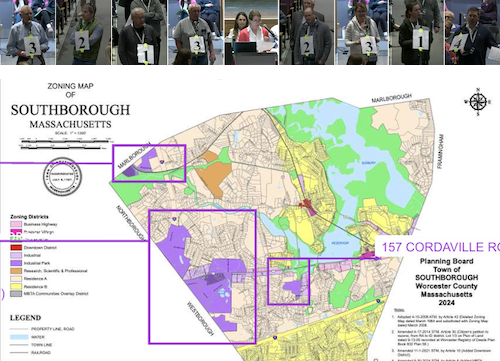
Above: A Planning Board Member tried to find balance between voters seeking to make zoning more enticing for commercial development and those worried about the potential risks of zoning changes. (images cropped from meeting video and presentation)
Earlier this week, I wrote that Annual Town Meeting passed everything Town officials asked for and rejected the only thing officials opposed.
It turns out, that’s not quite accurate — since not all officials were on the same page. A key example was the Industrial Park zoning changes proposed under Article 17.
It is true that Town Meeting approved all of the requests made by the committees/boards that sponsored each Article. That included rejecting attempts to amend the Planning Board’s overhaul of Industrial Park zoning.
One failed attempt, supported by the Select Board, sought to loosen some of the proposed restrictions. Another failed attempt sought to make them much tighter. (That version called for 19 times greater setbacks on all projects in the Industrial Park zone that abutted residential zones. Given zone layouts, it may have made most IP zoned parcels impossible to build anything in.)*
Planning’s Article to Update IP Zoning Bylaws
As I’ve previously written, the Planning Board proposed new modern uses in the Industrial Park (IP) zone. (You can read about the new uses here.) The intent was to help the Town attract and retain commercial development. That includes attracting the types of amenities residents want, and increasing tax revenue from businesses.
However, the board also prioritized ensuring that new uses wouldn’t result in harms to the Town and abutting residential neighborhoods. So the board added new restrictions and clarifications about regulations.
Data Center zoning & Related Amendment
The restrictions included at least doubling the setback for projects that abut a residential/conservation district. The minimum setbacks would increase from 50 ft to 100 ft. But for an abutting “Small Clean Energy Infrastructure” or Data Center, the Planning Board decided the setback should be much greater — increasing to 1,000 feet. They also capped the size of Data Centers to 50,000 sq ft.
Planning Vice Chair Marnie Hoolahan explained that the board was taking a cautious approach based on the rise of AI (Artificial Intelligence) Data Centers:
We want to be able to open the doors for data centers. But we also want to be very cautious since we don’t know how they impact our natural resources, particularly electric and water resources, and what impact they might have on just human beings in existence.
Sam Stivers proposed an amendment to remove the extra setback for Data Centers and double the maximum size to 100,000 sq ft. He argued that Planning’s zoning would make it unattractive to a potential business. And he wanted to encourage the use:
Data centers are useful because they generate good commercial tax revenue. They’re high value buildings and filled with expensive equipment and few people on site, no traffic and no impact on town services typically.
He pointed out that a current Data Center in town generates over $600K in taxes annually, “more than that we expect from the Costco facility that’s going in.”1 He urged voters who want tax relief to support his amendment.
Stivers noted that he understood that the Planning Board wasn’t expecting his amendment. But Hoolahan’s long rebuttal (using written remarks) made clear that she had come fully prepared for an amendment along those lines.
In her response, she stressed that the existing Data Center Stivers referred to isn’t an AI center. She told the hall:
Traditional data centers were designed for moderate power density, air based cooling, and predictable demand. New AI scale facilities operate at dramatically higher electrical loads, increasing rely on liquid or hybrid cooling systems with water implications and behave more like continuous industrial infrastructure than conventional commercial development. . . zoning exists to anticipate impact before it becomes permanent.
Setbacks are not obstacles to development. They are risk management tools. Reducing them increases exposure to . . . impacts that directly affect residents. Once a building is constructed at scale and closer to homes, the town loses leverage. If unintended consequences emerge, those impacts are absorbed by the community, not the applicant. . .
Tax benefit alone cannot outweigh irreversible siting decisions. The zoning we crafted does not prohibit AI data centers. It allows them, but with caution.
During the amendment debate several voters and officials sided with Stivers, echoing his belief that the restrictions were overkill and exclusionary zoning. Most focused on the size limit, arguing that 100,00 sq ft is a reasonable size for a data center.
Jim Colleary warned voters to keep in mind the danger that the Town is facing a Proposition 2½ override next year. He argued that a setback that is more than three times the size of a football field is too restrictive.
Early in the discussion, Jon Green told the hall that he planned to propose his own amendment. He was seeking to increase setbacks for any types of IP projects abutting Residential or Conservation zones to 2,000 ft. (He was forced to wait on that debate until the original amendment was dealt with.)
Green later asked voters to be empathetic to residential abutters. He argued that supporting a low setback is selfish.
Some voters discussed the worries they had about Data Centers based on news reports and what they’ve read. Diana Bell worried that they might bring initial money but leave residents paying more for water and electric rates.
Select Board member Al Hamilton argued that water isn’t an issue with MWRA seeking more water customers. Paul Desmond said the trend in Data Centers is to recycle water and he pitched that they seek to be as energy efficient as possible to save money.
Freddie Gillespie worried that the centers would generate a lot of heat and noise. She said she kept reading about towns that had let Data Centers in and are now “freaking out”. She noted that only a majority support was needed to pass it, but that opponents to lowering the Data Center restrictions could stop the overall zoning amendment, which requires 2/3 approval.
Mary Tinti, Kristen Lavault, and Paul Carter argued that supporting the Planning Board’s original Article, would still leave the door open for future changes. Tinti pointed out that amending the Article could tank passage of the zoning improvements in the overall Article. And she suggested that if people wanted to decrease the protections that should first be a larger community-wide conversation.
That was echoed by Lavault who pointed out how few voters were in attendance. She believed that if people knew there would be an in depth debate about zoning for AI Data Centers, more would have turned out. She warned that passing the unexpected change would “piss off our town” without better representation.
And Carter noted that if a Data Center wanted to come to town and needed larger buildings and less setbacks, the Town could still do what it did with Costco and customize zoning revisions for the project.
In arguments against the zoning, Carter and Tom Gittens incorrectly referred to it as lowering the setback to 50 ft. No one corrected them, but Stiver’s amendment actually would have reduced it to 100 ft.2
On a different note, Jonathan Gibson pointed out that Data Centers don’t create many jobs for the town.
The Select Board favored the amendment 4-1, but the hall disagreed. The amendment failed with a vote of only 50 in favor and 73 opposed.
Argument to Make All Setbacks Greater for Residential Abutting Projects
Green then made his motion to make a more extreme change to the zoning regulation in the opposite direction. It would have added to the IP zone a 2,000 ft setback to any type of project (not just Data Centers and Energy Infrastructures) if it abuts a residential zoning district.
Green argued for bigger buffers to protect residents, and claimed that even 2,000 ft wasn’t enough. Green lives on Tara Road, a neighborhood that abuts the IP zoned Park Central. He told the hall that he’s not an IP zone abutter, but he’s an abutter to an abutter, and was thinking of his neighbors.
He argued that for a homeowner, the idea of a large project 100 ft from their property line was “pretty scary”.
Hoolahan appeared to have also prepared for an argument like this one. She read aloud her position that a setback that large is exclusionary zoning that is:
disproportionate, undifferentiated, and inconsistent with sound zone sound zoning practice
She described by-right uses under the IP zoning as including many with “low impact commercial activity”. She noted that the board’s proposed zoning change does include new, “strict performance standards”. And she pointed out that many of the uses are “routinely permitted adjacent to residential districts” throughout the state.
Hamilton said that looking at the GIS Map, he didn’t think a setback that large would be remotely possible to allow any project. Others agreed. Green argued that it only relates to the distance from residential districts.
No one spoke in favor of the Green’s amendment. The motion failed.
Back to the Main Motion
Tyler Oakleaf asked the Planning Board about the impact of their changes to ground mounted solar PV projects. Chair Meme Luttrell clarified that the current setback is 50 ft. Then she confirmed that the new zoning “Small Clean Energy Infrastructure” projects does include solar projects.
Oakleaf said he wasn’t sure he could support the Article. He argued the new requirements 1,000 ft setbacks, and requirements like submitting an emergency operations plan and decommissioning plan “seems completely ridiculous for someone who wants to put solar PV on their land”. He also worried that it would have an unintended impact on standalone electrical vehicle charging stations getting “swept up” into the category based on their use of lithium ion batteries.
No one addressed his point. With no other public comments, the meeting voted on the original Article. It passed 90 to 32 (73%).
Now the zoning change will need to be forwarded to the Attorney General’s office for vetting. An attorney will need to verify it complies with the state laws and constitution.
*[Editor’s Note: Based on past zoning bylaw discussions, I’m unsure how the setbacks will be interpreted. (For example, ones that don’t directly border residential zones but are less than 1,000 ft from residential neighborhoods.) Once I have the answers that I’m seeking from Town officials, I’ll update this post with more details — and potentially post a new story clarifying the changes.]
- Both Stivers and Hoolahan clarified that the existing Data Center they referred to won’t be impacted by the zoning change, since it is “grandfathered in”.
- The pre-existing IP zoning bylaw’s setback was 50 ft. Stivers’ amendment was to make the setback for Data Centers the same as all of the regular uses in Planning’s proposed bylaw changes, which increased the setback to 100 ft.
