
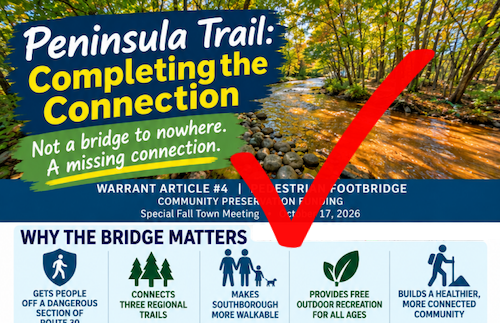
Above: Town Meeting approved funding the final piece in the Trails Comittee’s work to bridge a gap in the town and regional trail system. (images edited from flyer)
Today, I’m wrapping up my coverage of last weekend’s Special Town Meeting. My main focus is looking at voters’ decision increase funding for a footbridge on the Peninsula Trail (Article 4).1
But, I’ll also quickly recap Articles 5-8. (Scroll to the bottom for that.)
STM agreed to fund a footbridge to help complete the Peninsula Trail “Connection”
The project under Article 4 was designed to close a small gap in a large network of Town trails and regional connections.
Town Meeting’s independence in approving Community Preservation Act funding through Article 4 was even more striking than its vote to support the prior CPA Article — Article 3 for golf course irrigation.
Like the prior Article, the funding request was opposed unanimously by the Advisory Committee. But the same Select Board that unanimously backed Article 3 voted in a 4-1 majority to oppose the Trails project expense. Another strike in the Article’s favor was that a number of golfers who attended to support the Community Preservation Commission’s project under Article 3 didn’t stick around to support their Trails project.
However, although it was a smaller group, some voters did turn out for the Trails Article.2 And in the eyes of other Town Meeting participants, the Select Board’s endorsement of using CPA funds on the golf course may have weakened its own arguments against the trails project.
Article 4 Presentation
Community Preservation Commission member Grant Farrington introduced Article 4 as:
a very similar situation to the article that you just approved. . . essentially seeking additional funding for an existing recreational asset.
Article 4 asked voters to reauthorize $211K of previously approved CPA funds for a narrowed project purpose (and extended timeline), while adding another $217K to the budget.
Before getting into the Article details, Trails Committee Chair Kathryn McKee described the context of the larger, long term initiative that the project would complete. She painted the picture of the 1.9 mile Peninsula Trail as a unique asset in town, and more than just another trail.
McKee highlighted the quietness and beauty of the trail set off of the highway. And she described it as both the Town’s first accessible trail (with paved parking and a paved section 0.4 miles long) and the Town’s first trail with an “interpretive sign project”. The sign project informs about the wetlands and watershed, and:
highlights the history of the people that used to live where the reservoir is, the native people before that, and the history of the development of the dam.
The trail also closes the last gap in the 33 mile Boroughs Loop Trail and connects to two other regional trail networks —the over 27 mile Aqueduct Trail, and the 233 mile Bay Circuit Trail.
The Trails Committee worked with the MWRA (Mass Water Resources Authority) and DCR (Mass Dept of Conservation & Recreation) to open the trail (incorporating previously closed off areas and access roads). That was made possible by collecting over 1,600 area signatures and 8 local community letters to show community support for the project.
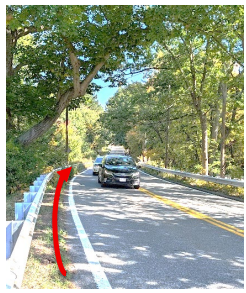 The requested funding was to cover expenses related to constructing a footbridge to cross the Stony Brook stream (a tributary of the reservoir). The pedestrian bridge will allow rerouting the hazardous way hikers currently navigate between the disconnected trails. She played a quick video demonstrating the what it’s like to walk on a busy section of Route 30, with a narrow shoulder between the highway and the poison ivy lined guardrail.
McKee explained high up front costs reflected the use of a modular bridge, selected to have a 75-year low-maintenance life span. Using wood was ruled out, since that would require a high bridge with ramp ups too far out to make sense.
She explained that the Trails Committee will apply for a MassTrails grant to reimburse CPA funds if awarded. (Without funds pledged by the Town, the project would be ineligible for the matching grant.) That could shave up to $100K off the project cost. And the project includes contingency fundings and inflationary escalators that might not be needed. If it isn’t, the total could end up as low as $265,300 rather than the total approved up to $428,550.
McKee told voters that the committee understood that the financial ask was a big one. She stressed that if the CPA doesn’t fund it, the project would be halted, leaving the long worked on project incomplete.
(You can learn more about the footbridge and trail project in my prior post here.)
Concerns and questions over the large spend and officials’ positions
Janet Maney wanted more context on the CPA’s available funds for Recreation projects. She asked how much is collected for that purpose each year. CPC’s consultant Freddie Gillespie explained that while the 10% of the overall contribution each year is dedicated to a pot for Recreation, but 70% the funds can be applied to any eligible use. Select Board Chair Kathy Cook said that the 70% represented $376K last year.
Advisory Committee member Howard Rose questioned the claim that there were no other potential funding sources. He asked if the committee sought private corporate sponsors (such as REI). McKee replied that they were prohibited.
Cook clarified that municipal committees can’t directly solicit donations/sponsorships and, unlike some committees, the Trails Committee doesn’t have a “Friends” group or other 501(c)(3) to do that for them. Rose suggested looking into that. He told the hall that he liked the project, but didn’t think the spending was “the right move at this time”.
Explaining the board’s majority opposition to the Article, Cook said that they felt bad for opposing the request. She commended McKee for her efforts, calling her the “epitome” of the volunteers the Town wants on committees. But they had difficulty justifying spending that much from the CPA. They believed the funds could be put to better use.
Cook acknowledged that CPC member Kristen LaVault was right when she commented under Article 3 that there weren’t competing Recreation projects currently in the CPA pipeline. But she claimed that Select Board Vice Chair Andrew Pfaff had just shown her a list of $4M worth of potential capital projects for the Town that might qualify for CPA funding.
Julie Connelly said that, like vocal opponents of Article 3, she had been hesitant to vote for the golf course project without a holistic budget picture and knowing what might be “coming down the pike”. But she found it “incongruous” to support that and reject this project. She asked to hear the rationale from a member of the Select Board who had voted to support Article 3 but oppose this project.
Select Board member Andrew Dennington responded that to him it came down to his perception of the size of the request versus usage. He described the connection area as “so lightly used”. He noted that without the connection, the trails can still be walked separately.
Echoing Cook’s comments, Dennington said he’d rather reserve CPA funds for other potential Town uses. That was a sentiment also expressed by Advisory Committee member Al Hamilton (whose comments were consistent with his prior arguments against Article 3.)
Support for the project
In Connelly’s comments, she referred to the project as encouraging “connectivity”. She questioned why that wouldn’t be valued in a town where lack of connectivity is a “sore point”.
Maryann Anderson spoke as a member of a group of active seniors who have hided the trails multiple times. She described guided educational walks and pitched that they would be great as after school programs and for scouts. She advocated connecting the trails to make it safer. And she believed that the trails are used more than Town officials think.
Jeffrey Peet said the Town didn’t have real usage stats, and that even if they did, the current usage before the project is done wouldn’t be meaningful:
When you build a connector, the point is that you make the connections and then people will choose to hike there, will choose to walk there and enjoy that space because you’ve connected lots of different trails.
He pointed out that other towns around us have invested a lot more into their trails. Referring to the potential halt of Southborough’s project, he lamented:
think of all the time and effort and energy that has gone into building up the trails around that, which is very, very low investment. and then we’re not able to fully utilize that
Carol Yozzo supported Anderson’s earlier comments. And for those who don’t care about the trails, she said to think about the safety issue from the perspective of their own liability as drivers on Route 30 who could accidentally hit a group of hikers on the side of the road.
Select Board member Sam Stivers explained his minority vote in support of the project. He reminded that Southborough had previously committed to to other communities that it would close the gap in the Boroughs Loop Trail. He believed in following through on the “obligation”. He had also been compelled by the safety argument about walkers on Route 30. He said the Town shouldn’t be promoting an asset that “creates substantial risk to the public”.
Requiring a simple majority, Article 4 passed by a show of hands.
Articles 5-8
Following passage the final CPA Article, the remaining Articles on the Warrant passed fairly easily. But two had brief discussions worth recapping.
5. Create a Stormwater Enterprise Fund
There were some questions and concerns raised about Article 5’s established Water Enterprise Fund. Those revolved around how the board would fund the account and the fees it would charge. Select Board member Andrew Pfaff clarified that the Article didn’t create a fee structure (which he hoped to bring to a future Town Meeting).
Spending and budgeting would still need Town Meeting approvals.
6. Rescind Unused Debt Authorizations
I previously covered the the Stewardship Committee’s desire to leave more authorized borrowing for the restoration of Breakneck Hill than the Select Board planned to ask voters to approve.
Stivers told Town Meeting that $727,960 of authorized borrowing for the project related to remediating the Breakneck Hill Farm Dump is no longer needed.
Stewardship Committee member Freddie Gillespie told voters that wsn’t accurate. The committee would prefer having more money in case it si needed. But they voted to not ask Town Meeting to amend the Select Board’s Article.
Instead, if through the bidding process they learn that more borrowing is required, they may come back to a future Town Meeting.
7. Appropriation from Water Fund for connecting properties to Town Water
8. Increase Personal Property Tax Exemption Amount
- Editor’s Note: I had accidentally used two different tags for the meeting, causing each to pull up only about half of the stories. So, some readers may have missed some of the coverage. (Sorry about that!) The issue is now fixed. You can find all related posts here.
- I’m judging that based on who departed immediately following the successful vote.
