
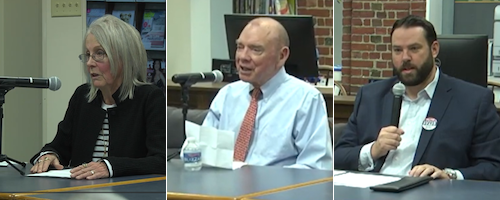
Above: My recap of what the candidates running for the one of (if not the) most powerful boards in the Town’s executive branch board told voters at last week’s forum. (images cropped from SAM video)
In this Tuesday’s election, voters will choose between the three residents running for two seats on Southborough’s Select Board. Last week, the candidates spoke to voters and fielded questions at a public forum.
While I encourage readers to watch Southborough Access Media’s video and form their own impressions, I know many won’t. So, below are my highlights from the annual Candidates Night.
I’ve broken up my recaps by:
- Candidate Speeches
- Questions & Answers on the following topics:
- Overcoming Obstacles, Slow process & Learning from Mistakes
- Addressing Fiscal Problems (& looking back at New Neary Votes)
- Controlling impact of commercial development on the town (especially Flagg Road)
- Increasing engagement and equitable participation in Town Meeting/local government
- Support for spending on Affordable Housing
- Who Are You?
But, before I get to those details, a quick reminder that the election is on May 12th and also includes debt exemption ballot questions. You can find all of the election details here.
Candidate Speeches
All three candidates have lived in town for decades and served on multiple boards. And all three discussed difficult challenges the community faces — though one put more emphasis on a non-fiscal aspect.
Current Select Board Vice Chair Marguerite Landry and recent-former Select Board member Sam Stivers spoke about their history of listening to voters. Landry highlighted the need for the community to make decisions together. Stivers focused more on the time he devotes to working on solutions to challenges.
Advisory Committee member Andrew Pfaff spoke about deciding to run for the Select Board after realizing:
Too often, by the time issues reach the Advisory Committee, many of the key decisions have already been made, reducing our ability to affect change.
Pfaff spoke about his desire to bring in “a more proactive, data driven approach earlier into the process”. He also touted the need for transparency and collaboration, and explaining to residents “not just what decisions are being made, but why.”
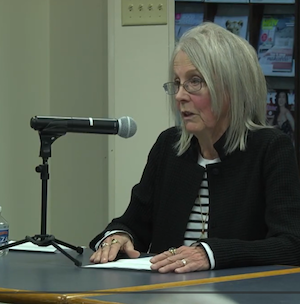 Landry told voters that when she first moved to Southborough in 1992, she was a single mother “and broke”. She followed: “I know what it’s like to worry about your financial situation because I did.”
The retired Fitchburg State professor later noted that her son is now working as a professor. She credited a “large part” to the “excellent education” he received attending Southborough public schools.
She told the room, “I think at this point we’re at a really nice place in Southborough. We have very efficient departments that are functioning well.” But she noted they are “looking at ” taxes and have areas they need to do some work.
One of the complicated issues she highlighted was a future decision to be made on the renovation of Neary School. Referring to the $25M road and sidewalk Article approved at Annual Town meeting, she told attendees that the lesson she learned is that voters won’t say no to every new tax. “They will say yes if they really want what they’re getting for the money.”
On a different front, she pointed to property “opening up south of Route 9” as one of the most important things the Town needs to deal with:
We have to decide what we want to see there. How we want it zoned, what kind of businesses or open space or whatever we want there. And I think that we need to discuss this before we’re reacting to something coming in that we don’t really want to have.
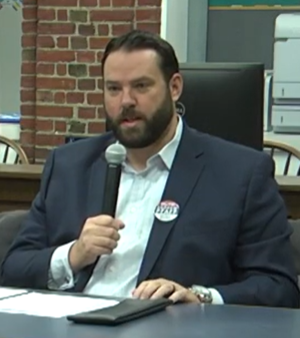 Pfaff is the youngest running, and yet the longest term resident. Southborough has been his home since he was a baby. He and his wife are now raising their daughter “in the same community that has given me so much.” He told attendees that he’s running because:
Southborough is at an important moment and a critical juncture in its history. We’re facing rising costs, a possible override, declining state aid, aging infrastructure, and increasing pressure on our aging schools. The decisions we make now will shape our town for years to come, and we need to approach them with discipline, clarity, and long-term thinking.
In Pfaff’s day job for Santandere Bank, he leads strategic initiatives, involving budgeting, planning, organizational transformation, and solving complex challenges. On the board he would “make tough decisions, balance priorities, stay focused on long-term results.” He wants to preserve Southborough’s character while enabling thoughtful commercial development growth to ease residential tax burdens. And he wants to expand “practical housing solutions” and opportunities for seniors to stay in town.
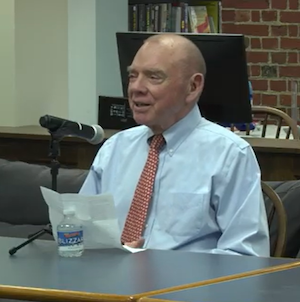 Stivers was a management consultant for 25+ years and a manager in healthcare business for another 20+. Now he’s working for an AI startup.
He has long served in Town government, including on the select board, advisory committee, ZBA, “and at least a dozen other local and and regional committees”. He touted that experience as giving “him real insight in terms of what goes on in town finances, town of business operations”. And he pitched that the expertise will allow him to “hit the ground running. . . at a high speed.”
Issues he’s looking to address include the town’s infrastructure and capital needs, and creating new housing opportunities for seniors and new families, plus a long list of other goals:
Part of the challenge of the job is you got to balance those priorities and come up with reasonable solutions. And I have experience in doing that and I want the opportunity to continue to do that.
Questions & Answers
The audience was fairly small at the forum. But a good number of the attendees had questions for the candidates.
Overcoming Obstacles, Slow process & Learning from Mistakes
One attendee asked about times that the candidates’ priorities came up in the past, and why they hadn’t previously achieve them — what were the obstacles and how would they get past them this time.
Landry spoke of a success during her past term as the Town’s improved dissemination of tax write off options and ability for the Town Treasurer to work with residents who can’t pay their taxes. (She describe the latter effort as organized by the Treasurer.)
Stivers noted that the process of Town government is frustratingly slow. But he gave an example of an improvement effort that he kicked off a few years ago that is now paying off. He explained how the Town paid to have the roads scanned and evaluated, and the work to come up with the new road management plan. And he noted that on housing, they restructured the old committees to a new group that he is optimistic will be better able to get things done.
Pfaff spoke about his collaboration with a Select Board member and Town staff on financial policies. That included his suggested change to allow seniors unable to work have a volunteer “proxy” to earn the senior tax workoff for them. He has a list of other ideas he’d like to implement as a Select Board member.
In follow up questions, attendees asked how the Town can fix the “slow process” and what they could actually accomplish.
Stivers described the slow process as the price of democracy and public participation. And under state law there’s not much that can be done to change that. And he referred to work done to regionalize dispatch as another example of how things can get done if you keep pushing.
Landry described the process problem as caused by state regulations.
Pfaff had a different perspective. He pushed for the board to make more quick decisions as the executive branch. He pitched that could be partially achieved by delegating more authority to the Town Administrator, to let the board focus on “big ticket” items. And he indicated the board had too often created committees to look at things:
we have a little bit of analysis by paralysis and we need to start making some some decisions faster
Another attendee asked the candidates about mistakes/regrets in their leadership roles, and what that taught them to “carry forward and maybe do differently.
Stivers said he learned early on that in order to get things done, he needed to “get closer to the citizens”. That prompted him to start sitting at the Transfer Station where he listens to people. He plans to continue that.
Pfaff learned from the things he was pushing to change that fell on deaf ears or wouldn’t move anywhere. He believes joining the Select Board will put him in a better position to make those changes.
Landry indicated her mistakes included not understanding that residents should have a large say in what’s happening in their own neighborhoods. Issues in her neighborhood were what prompted her to get involved in town politics:
I think that bond that most people have with their home and their area is something that really should determine a lot of what this town looks like.
Addressing Fiscal Problems (& looking back at New Neary Votes)
In introducing her questions, Patty Fiore spoke about the votes last year that killed the “New Neary Building Project”. (Fiore had helped lead a public opposition movement against the project.)
Fiore said that among the concerns taxpayers had voiced was:
we needed to consider needs and not just wants. We needed to
consider the overall tax burden going out 20 plus years. In addition to many of these other issues that we’re currently talking about. . . We had people complaining about the tax burden, the out of control in some people’s words, spending that’s going on, and that we need to consider everyone that lives in this community and how much or little they can afford.
(Later, attendee Tom Gittens, who had voted “No” on the project, questioned Fiore’s characterization of what the No vote meant. But that was cutoff, when he was instructed to address his comments and questions to the candidates.)
Fiore asked the candidates how they would represent the opponents to the prior project, to give at least one way they would control spending/taxes, and to make a commitment to the voters’ expectations.
When asking the question, Fiore appeared to have forgotten that Stivers was on the Select Board at the time the project was brought to Special Town Meeting voters and the ballot. She pointed to Landry’s and Pfaff’s votes in favor of the project and said that while she didn’t know how Stivers had voted, but that was “private”.
Stivers volunteered that he had supported the project.
Pfaff, who had served on the Neary Building Committee, noted that he had been the last holdout on the committee to support the project. He initially supported the 2 grade version, but chose to help make the committee’s position unanimous. He thought the 4-grade version gave more “bang for the buck” but that it “was too expensive for this town to afford”.
He pointed out that he is now on the new Elementary School Building Committee which is charged with only the 2 grade option and looking at a “much smaller tax base” with options for a large or small renovation. He believes that will fit better into what the town can “afford from a tax perspective”.
He spoke about ideas he has to cut staffing costs including more department collaboration and use of technology (including AI). As an example, he said that the Belchertown police department uses AI to redact police body cam footage reducing the staff involvement from three hours to three minutes. He also raised the possibility of charging nonprofits a stormwater usage fee.
Stivers told Fiore that the “process actually made your point”. Based on the overwhelming vote, a new plan and new committee has been formed.
He agreed with Pfaff on cost control measures, but also believed that drawing in more revenue through attracting businesses to route 9 is important. He said it takes multiple approaches and doesn’t happen quickly.
Landry took issue with Fiore’s characterization that she had voted for the Neary project. She made the distinction that as a member of the Select Board she supported bringing the question to Town Meeting. She followed that no one knew how she voted using her clicker.
She said the outcome was an example of Town Meeting working really well, and the project was dead.
Fiore tried to follow up to get her to answer about a commitment to working to lower costs. Pfaff interrupted to say that others were waiting to ask questions and that Landry had already answered “four of them”.
Later, Ellen Marya asked what lessons could be learned and applied from other communities across the state facing similar financial challenges and really difficult decisions about closing facilities and cutting staff.
Pfaff said that he saw the “crazy things” towns have to do when Proposition 2½ Override votes failed. His lesson was that we need to “try everything in our power to avoid an override.” That includes improving staff efficiency, streamlining operations, and inserting technology to cut costs without impacting services — except maybe services not utilized as much.
Referring to an issue raised in opening remarks by both Landry and Stivers, he explained that when employees are approved at Town Meeting, they don’t discuss the millions of dollars the Town will have to spend over the life of an employee based on their retirement benefits.
If the Select Board ends up having to ask voters for an override, they’ll need to first come up with a good plan and :
show the town that we’re doing everything in our power to be using the tax dollars as efficiently and effectively as possible and good stewards of their money.
Stivers agreed, and followed with an example. He brought up again the potential for regionalizing services, like the fire department. But he noted that it is also important to attract development and revenue to help.
Following up on potential regionalization efforts, which she had also mentioned in her opening statements, Landry pointed out that the Town had a “successful regionalization” that people no longer even think about — the regional high school. In addition to the Fire Dept talking with Westborough, she noted that Youth & Family Services collaborates with Northborough and Westborough.
Controlling impact of commercial development on the town (especially Flagg Road)
Tom Gittens asked the candidates about how they would address problems in the “Costco corner” of town.
Gittens noted that the future Costco, plus an approved Valvoline at the end of Flagg, “will add to the “folks coming up Flagg Road” where he lives. He reminded about the concerns raised when Capital Group sought housing developments at Park Central.
He described the past talks about Flagg Road as including safety improvements but not “to improve it in a way that addresses this likely increase in traffic.” And he noted that efforts to address issues were put off when Park Central went to court. But he also noted that the potential project isn’t “gone”.
He asked how candidates would address traffic and safety concerns on Flagg and “how do we make it viable for businesses but also not ruin the character of our town”. He followed that as a Select Board, it starts with them.
Stivers said that about ten years ago, the Select Board voted to “close Flagg Road at the end if Park Central was going to have access to it.”.1 While he doesn’t believe that a Park Central development is likely, there are also conversations about making Flagg Road one way to limit neighborhood access.
Given the narrow windy road with pedestrians and strollers, he agreed that studying the traffic and protecting flow through neighborhoods is important. He doesn’t have a plan but is willing to consider a variety of options.
As a resident of Oak Hill Road, “the largest truck route in town”, Pfaff sympathized with Gittens concerns. He suggested potentially installing traffic cameras or license plate readers to continually monitor the traffic, to have “good data”. If it gets too busy, they may need to expand the road. That would have a huge impact in cost, but everything should be on the table.
Landry took a different tact, ” at the risk of sounding like a total heretic”. She questioned the assumption that increased development on Route 9 is going to be good for the town. She followed that some of the properties small properties don’t bring in enough revenue to appear to be worth the impact on traffic and abutters. As an example, she asked if it was worth saving $500/yr in taxes if a car dealerships lights would be shining over your house all night.
Increasing engagement and equitable participation in Town Meeting/local government
Kelly Conklin (who will soon be joining the School Committee) pointed out that Town Meeting is Southborough’s primary instrument of local democracy. But she was concerned about the persistent challenge of turnout and participation and a format that may disadvantage some residents. She asked:
Do you think our current structure is working and what specific changes if any would you make to increase engagement and make participation more equitable?
Stivers said that the turnout has been “pathetic” despite a variety of efforts over the years. He believed the only “surefire” way to increase participation is a “big project like the Neary School”. He noted that the Town is in the midst of conducting a community engagement study covered by a grant. He doubted there is a “magic answer”, but said they do need to keep working at it. He believed they could do a better job communicating with people through the town website, and possibly improve social media connections.
He expressed surprise that more people aren’t watching more closely how the government spends our money.
Referring to the most recent Town Meeting, Pfaff agreed that it’s not ideal “having 180 people deciding the largest bond issuance we’ve ever done in town”. He thought something could be done like the recent (failed) Select Board effort to have a governance committee look at potential representative Town Meeting. And he hoped the state would start to allow some remote participation.
He also opined that the Town should regularly do what they had done for the past Special Town Meeting on Neary School — close all town facilities including fields on Town Meeting days.
He recalled that his wife couldn’t make Town Meeting because his 4 yr old had soccer that morning. He said the fields were busy and parking was a nightmare.
He also wondered if they could convince the School Committee to hold school on a Saturday so that parents could attend Town Meeting.
Both he and Landry noted that they have tried Saturdays and weeknights and neither seem to work.
Landry said that it’s frustrating, but she believes that Town Meeting is the best democracy option out of “a bad bunch”. She said that Representative Town Meeting seems to work for Framingham, but they’re much bigger.
The mayor and city council method (in Mass cities like Marlborough) and county governments in southern states “frequently leaves neighborhoods vulnerable”. She said that whole neighborhoods sometimes get wiped out and strip malls cover everything:
All I can say is I’m glad we don’t have a mayor. I’m glad we don’t have a county government. I don’t think representative would work. We’re too
small. So, I just see the people who attend are kind of self- selecting for being our senators. . . it’s a decision to stay with with a form that protects us better.
But Landry also noted dismay that too many people don’t seem to even understand that Town Meeting controls the tax rate.2
Support for spending on Affordable Housing
Paul Desmond of the of the Affordable Housing Trust (AHT) board asked candidates if they were willing to prioritize and invest in affordable housing projects.
Landry said that a lot of people support affordable housing in principle, but worry about project details, including whether it would be open to the state or allow a lotter for residents/town employees. She said she’d like to see the AHT and Southborough Housing Authority “brainstorm together”.
Stivers said he would support contributing town land to “prime the pump” for a developer to build affordable housing. He stressed that he would want to have housing that is more affordable than the state’s definition of an $80,000 AMI (Area Median Income) level. He believed that someone making $50-60K should be able to afford to live thee.
He also posited using some of the money in the trust fund to pay developers to build units for a flat single fee, then make it available for low income in perpetuity. He summed up that he’d be willing to “support finding ways to throw what the town can into the pot to start those buildings.”
He believed it was a shame that the Town had been collecting Community Preservation Act funds for affordable housing without building anything over the past 15-20 years.
Pfaff said he thought some land parcels in town would be good acquisitions for that, and he was open to ideas.
Who Are You?
For the final question, an attendee wanted to get more personal and philosophical. She asked “what do you see yourself as first?” and their core identity as a Select Board member.
Landry described herself as a listener:
I think sometimes things don’t do well at town meeting because the conversation beforehand was not adequate. And so I think a lot of it is, people know how they want to live in this town. It’s important to listen to that.
Stivers called himself a “manager”:
I’ve spent the last several decades doing that and I think it’s an important function in the town. And not you know necessarily want everybody on the select board with the same background, but I think I offer considerable strength in that department.
Pfaff started with management, but quickly followed:
But probably more “Change Agent”. So you how do we drive change in this town? Do things a little bit differently look to optimize and there’s a lot of, “Well we used to do it that way.” And I think there’s a lot of things that we can do better.
- The vote was actually to cut off the access from Park Central to Flagg Road unless the developer and MassDOT to work out access to Route 9.
- More accurately, Town Meeting decides the amount of money that needs to be raised to be covered by taxes (and authorizes borrowing). The Select Board has a role in the tax rate, since they decide whether to approve a single or split rate, etc. Once that decision is made, the Assessor sets the rate based on the calculation of updated property values and the amount of revenue that needs to be generated.
