
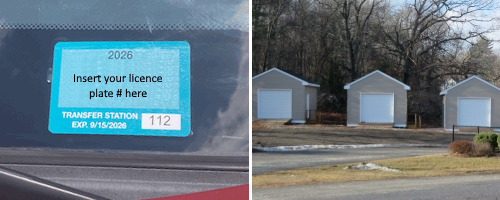
Above: Residents, especially seniors, may experience sticker shock when they go to renew Transfer Station permit stickers that expire in a couple months. Plus, potential rule changes may spark some strong reactions from Swap Shop users. (images by Beth Melo)
Last night, the Select Board unanimously voted to increase the permit fees for the Transfer Station Stickers for the coming season, which starts on September 15th. The biggest percentage increase was to the still-steeply-discounted stickers for residents ages 65+.
Under the new fee schedule, the price for the “1st permit” per household will increase by $25 for all users. For non-seniors the change goes from $295 to $320 and for seniors it increases from $50 to $75.
Permits for additional permits will be $25 per vehicle. That’s static for non-seniors but a $10 increase for seniors.
The board also looked at proposed rule changes for Transfer Station use. On Tuesday night, after long discussion and debate over proposed changes to Swap Shop rules, the board agreed to hold off on voting on the coming season’s new rules until their August 11th meeting.
That could complicate the Town’s efforts to communicate new rules. Early in the discussion, Cundiff noted that the new rules would be provided with the new stickers. But the DPW traditionally begins selling the upcoming season’s stickers in July.
Fee Increases Due to Cost Increases
Before voting to support the fee changes, Select Board member Tim Fling got reassurance that the Town would publicize the ability for people who need financial aid to have their fees waived.
The fee changes were driven by increased Transfer Station operating costs this year. One major factor was a $60K temporary increase due to retirement and recent staff changes. No one on staff is currently able to use the manual transmission tractor that hauls the waste. According to Superintendent Bill Cundiff, training and a specific license are required to operate the machine.
For now, the DPW is “hiring out” for the function for 6 months while they get 1-2 staff members trained to use the tractor. (The tractor is too new to get rid of, but they will purchase one with an automatic transmission when the time comes to swap it out.)
The Town has typically sought to cover about $100K of the Transfer Station’s operating expenses. That has been a compromise and point of contention in past years with some arguing that users should fully cover costs and others advocating that it should be a free public service to residents.
Last night, Select Board Chair Kathy Cook stated that the origin of the figure was 20% of the operating cost. And she noted that the rationale included the fact that the Town itself is a Transfer Station user.
The board considered a variety of scenarios (both ones presented by Cundiff, and multiple members’ suggestions). Other options included higher fee spikes or put more of a burden on the Town’s budget. As it is, this year, the share covered by the Town is projected to increase to $132,730. (That’s a big spike given that the presentation showed that over the past year the actual expense not covered by fees was less than $85K.)
In discussing the “fairness” of increasing senior fees, both Cook and member Sam Stivers said they have heard from many seniors that say they can afford to pay for full price stickers. But Cook still didn’t want to increase fees to the even higher proposed costs of $100/$150. She argued that seniors don’t dispose of as much trash.
Illegal Transfer Station Use — Monitoring Challenge
Last year, there was discussion and public debate about the cost that users and taxpayers are bearing for illegal use of the Transfer Station by commercial contractors. Select Board members proposed adding license plate readers to monitor the issue.
This week, Cundiff told the Select Board that he hears the complaints. But he claimed that when they do their “due diligence”, they usually discover that the users weren’t actually breaking the rules.
Still, Cook wanted to revisit the license plate readers. She believed it would be inexpensive. Cundiff reminded her that the issue they ran into was “getting the internet interface up there”.
They didn’t discuss an update on the non-tech solution that was discussed last year.
Last summer, then-Select Board member Al Hamilton updated the board on his look into monitoring solutions. He report that Cundiff told him he planned to use one of the Town’s “senior workoff” employees sit at the station to monitor the situation. That person would just document what is happening and “keep a tally, not intervene”. Then he would follow up with a report to the board.
General Rule Changes
The board’s packet included Cundiff’s recommended revised rules for FY27. He confirmed that they were based on feedback from Transfer Station staff.
Changes include making clearer that the “Temporary Pass” option for unregistered vehicles is “solely for use by the permit holder and members of the permit holder’s household”. It also adds a fee for the passes — $15 per day or $25 per week.
Board members appeared to agree with most of the draft revisions. That included allowing the Town to revoke permits for “repeated or egregious violations”. Cundiff agreed to clarify that the appeal process for fines also applies to revoked permit.
Vice Chair Andrew Pfaff suggested adding to the section on “Conduct”:
users may not loiter, block traffic, interfere with staff or volunteers, engage in abuse of threatening or disruptive conduct, dump after hours, leave materials outside designated containers or buildings, or remove items from areas not expressly designated for public reuse.
Stivers, who frequently uses the Transfer Station to engage with residents and welcome questions and feedback, quipped it would “exclude” him as a “loiterer”. Members noted that people use the Transfer Station to collect signatures, and for community activities like scout sales.
Pfaff said he didn’t consider that activities “loitering” but they could refine the language.
But the bulk of the board’s long discussion was spent on proposed rewriting of Swap Shop rules and restrictions. The debate wasn’t surprising given the history of public reaction to the Town’s attempts to change or manage the sheds that allow Transfer Station users to leave and take reusable items.
Swap Shop Changes
Cundiff’s proposed revisions included a ban specifying many of the items people leave at the Swap Shop. Upon questioning, he specified that currently about 60-70% of items left end up getting tossed in the trash hopper.
The draft rules state:
Prohibited Items
The following items may not be left at the Swap Shop under any circumstance. Many are prohibited due to safety, sanitation, regulatory, or disposal restrictions already present in the Transfer Station Rules and in state waste regulations (e.g., CRTs, mattresses, tires).A. Hazardous or Hard-to-Manage Materials
- Paint (all types: latex, oil-based, stains, varnishes, sealers)
- Solvents, thinners, chemicals, or similar materials
B. Electronics & Technology
- Televisions and computer monitors (CRTs and flat screens banned from disposal per state law)
- Electronics (Obsolete, damaged, or non-functioning electronics), including:
- Stereos, radios, DVD players
- Computers, laptops, tablets
- Game consoles, printers, and peripheral equipment
C. Glass & Breakable Items
(No glass of any kind, due to breakage risk)
- Mugs, drinkware, plates, vases
- Lamps or lamp bases with glass components
- Mirrors or picture frames with glass
D. Bulky or Unsuitable Household Items
- Mattresses or box springs (state waste ban items)
- Furniture of any kind (upholstered, wooden, metal, or composite)
- Tires (prohibited in disposal regulations)
- Large or heavy items that cannot be safely stored in the Swap Shop
E. Toys & Games
- Broken toys
- Toys or games with missing pieces
- Toys with sharp edges, damaged wiring, or safety hazards
F. Sports Equipment (including skis, ski boots, and helmets)
All used sports gear and protective equipment is prohibited, including:
- Skis and ski boots
- Helmets of any type (bike, hockey, football, lacrosse, ski, etc.)
- Shoulder pads, guards, and other protective gear
- Used sports equipment subject to sanitation or safety concerns
(At staff discretion, clean non-protective items such as balls may be refused or accepted.)
Cook expressed strong support for making changes, describing the shops as a mess. She noted that she isn’t a Swap Shop user, but advocated that the DPW staff should decide what changes are needed. And since so much gets thrown out, member Andrew Dennington agreed with making the changes to have people leave less stuff.
But both Fling and Vice Chair Andrew Pfaff were opposed to proposed outright bans on furniture and sports equipment.
Fling referred to furniture at the Swap Shop it as a goldmine for some users. First he wondered about limiting days people could leave furniture to Wednesday. Later he suggested that if clutter in the shops is an issue that people could be limited to leaving items that fit in the shop and without overlapping a painted area down the center of the shop.
Pfaff suggested that it be allowed if it’s not upholstered, small enough for one person to carry, and there’s room inside the swap shop.
Pfaff apparently shared a document with members (not included in the meeting packet) that proposed adding more details.
He described his changes as allowing a more “nuanced” approach and than Cundiff’s full bans on certain categories of items. That included allowing some clean sports equipment (like hockey sticks, bats, balls, and frisbees) while banning “helmets, pads, guards, ski boots, skates, cleats, and other protective or sanitation sensitive equipment”.
But he also added prohibitions from other town’s policies:
food, medicine, cosmetics, toiletries, cleaning products, pesticides, batteries, light bulbs, smoke detectors, car seats, cribs, high chairs, pack and play, stuffed animals, pillows, bedding, clothing, shoes, textile rugs, upholstered items, wet, moldy, pest infested items, and recalled items.
Like some of Cundiff’s rules, Fling opined that Pfaff’s additions were excessively restrictive.
He explained that while used child car seats can be unsafe to use, many people (including him in the past) grab them to “trade in” for a discount from Target when they buy a new car seat. And he noted that his family got their high chair from the swap shop.
He also worried that long detailed rules would be “not really usable or enforceable and it takes away the the whole point of a swap shop”.
His sentiment was shared by public commenters Paul Carter and Kristen Lavault. Carter supported the “important recycling” aspect of the Swap Shop. He also acknowledged the problem of junk at the shop. But he believed the legalese rules were too much:
people need to be informed and this needs to be very general is that you can’t leave trash here and use general words for that. Okay. And if you don’t, you know, you can be fined, you know, or lose your privilege.
And referring to Tim’s defense of the Swap Shop for people saving money, LaVault said that he had his fingers on the community’s pulse.
LaVault said her main point for calling in was to suggest finding a way to allow Swap Shop volunteers again. Earlier in the meeting, Cook reminded that:
Years ago a group of women volunteered to monitor the swap shop and they would go up there, they would straighten it up, they would talk to people about what they could or couldn’t do, and it actually was really pretty nice looking as far as that goes.
But the former DPW chief, Karen Galligan, banned the volunteers due to liability issues. Last night, LaVault asked:
How can we overcome the liability issue and get the volunteers back in so we don’t put the onus as much of the onus on policing it to the transfer station and try to educate the community?
The board expects to revisit and vote on the rules that will be effective Sept 15th at their meeting on August 11th.
Updated (7/9/26 6:29 pm): I accidentally included the word “avoid” in the sentence stating that the DPW would purchase an automatic transmission tractor. The error was highlighted by Tim Fling who shared additional detail about something he referred to in the meeting when asking about the tractor:
In recent years, CDL licensing requirements have changed so that drivers are only endorsed for the type of transmission they test with. As I understand it, our current CDL-licensed transfer station staff do not have manual transmission endorsements, which is why a manual tractor would present operational challenges.

To the SB:
· Did you ask how many enforcement acts were completed successfully over the last year? And keep track / trend this compared to the last 5 or 10 years? This would be important to keep track of in light of rising costs. Who and what are the infractions.
The policy, procedures, and enforcement (currently little to none that are known publicly) actions can be improved and implemented better.
Suggestions:
· A separate / different color sticker / designation for contractors who are dumping into the hopper, with a separate fee level specific to them. Those who are dumping into the hopper are avoiding getting their own commercial dumpster and the non-commercial / residential users are unfairly subsidizing this volume of waste disposal. Seniors shouldn’t be subsidizing commercial contractors.
· Examples: Have seen commercial clean-outs dumped into the hopper, including a full size couch. Many flatbeds, some with trailers attached also full to the hilt, full of contractor waste completely filling the hopper. Completely filling the hopper, with little room left for residential waste.
· Enforcement: A separate bay (open to all) set aside for contractors dumping their commercial waste, the bay closest to video cameras. The contractor / flatbed / trailer owner can beep once to signal the staff in the office that they are getting ready to dump their contractor waste.
· Manpower an issue? Lack of will to enforce an issue? Not my job, an issue? The new policies should address these matters. Perhaps contractor dumping can be limited to a specific day(s) or morning hour(s) to ensure monitoring. Those who choose not to enforce can be shown the door. Again, our senior citizens shouldn’t be subsidizing commercial contractors or others abusing the system.
· Once under control, the seniors who have paid a lifetime into this tax system should be rolled back to zero cost.
· As for contractors dumping their entire flatbed and a trailer into the hopper, they should be forever banned from the dump.
Thank you.