
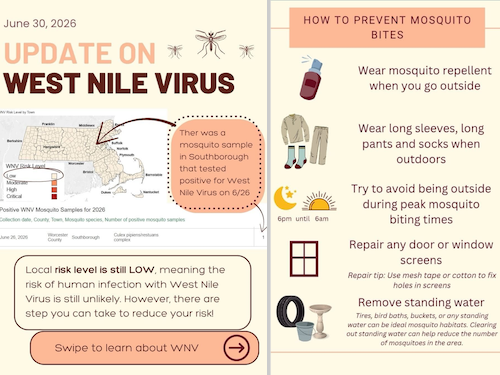
Above: The BOH posted a warning on social media (but not an alert through the Town website) on West Nile Virus. (images of cropped flyers)
On Monday, the Board of Health announced on Facebook that a sample of mosquitos from Southborough were tested positive for West Nile Virus. (The mosquitos were apparently collected last Friday, June 26th.)
Our town was the fifth Massachusetts towns to have positive findings this summer. But the entire commonwealth is still designated by health officials as “low risk” for contracting the arbovirus. (At this point, there have been no human, or even animal, cases reported in the state.)
When sharing the news on Facebook, the Board of Health also recommended that the public take precautions to lower the risk of getting bitten. That includes and minimizing the population in your yards. (Scroll down for that.)
The flyers also pointed the public to the Central Mass. Mosquito Control Project here. That website revealed that spraying was conducted on July 1st in a section of town:
Mosquitoes with West Nile Virus (WNV) were confirmed June 30 by MDPH in the southern section of town. Working with the Southborough Board of Health, truck-mounted Ultra-Low Volume (ULV) spraying was completed in the area below on July 1 after sunset.
It’s important to note that spraying can reduce but not eliminate the threat of mosquito-borne illness in the areas that are sprayed. That’s why it’s important for individuals to continue to take personal precautions against mosquito bites, both before and after any spraying is conducted.
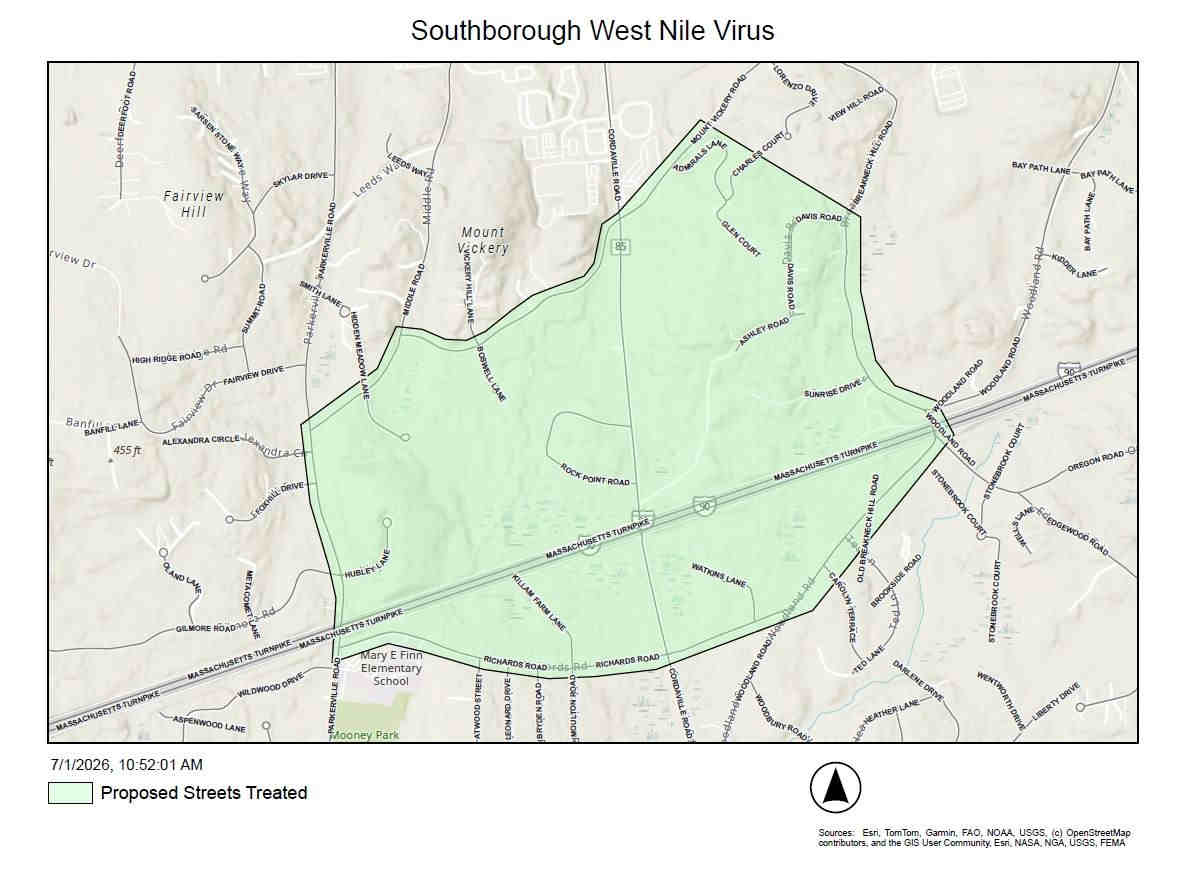 Looking at the map, for some of the roads listed (like Woodland) only a section of it was in the vicinity sprayed. The identified roads are: Admirals Lane, Ashley Road, Boswell Lane, Breakneck Hill Road, Charles Court, Cordaville Road, Davis Road, Glen Court, Hidden Meadow Lane, Hubley Lane, Killam Farm Lane, Mount Vickery Road, Old Breakneck Hill Road, Richards Road, Rock Point Road, Sunrise Drive, Watkins Lane, and Woodland Road.
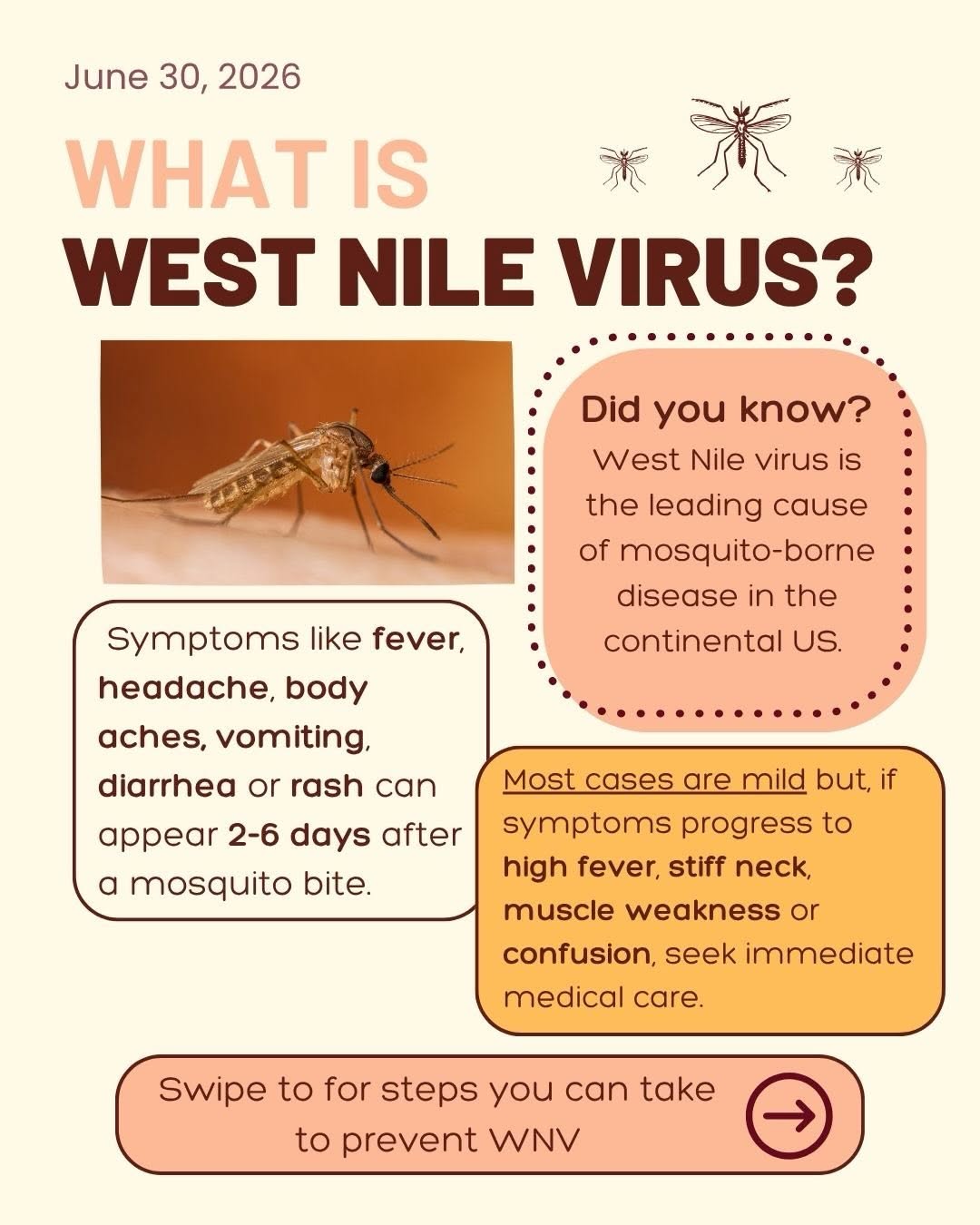 BOH also posted info about the West Nile Virus symptoms and warning signs:
Symptoms like fever, headache, body aches, vomiting, diarrhea or rash can appear 2-6 days after a mosquito bite.
Most cases are mild but, if symptoms progress to high fever, stiff neck, muscle weakness or confusion, seek immediate medical care.
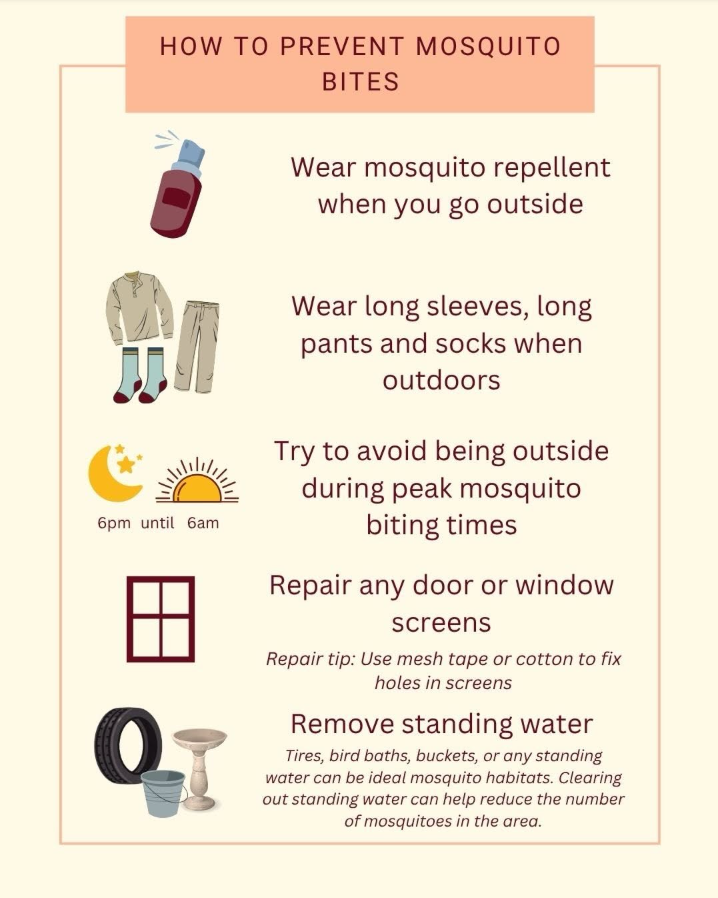 Below are the safety tips the BOH posted. (Given the excessive heat during the day, some steps are easier to take than others.):
- Wear mosquito repellent when you go outside
- Wear long sleeves, long pants and socks when outdoors
- Try to avoid being outside during peak mosquito biting times (6pm until 6am)
- Repair any door or window screens
- Repair tip: Use mesh tape or cotton to fix holes in screens
- Remove standing water
- Tires, bird baths, buckets, or any standing water can be ideal mosquito habitats. Clearing out standing water can help reduce the number of mosquitoes in the area.
You can find the state’s risk map for West Nile Virus (with a list of the samples collected) here, and it’s posted safety tips and info about West Nile Virus here.
