
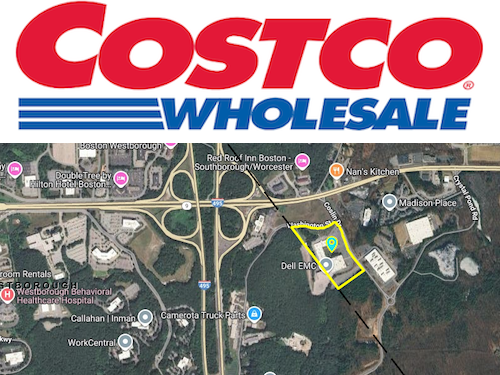
Above: An update on Costco’s pursuit of a project in Southborough. (map from GIS map using Google satellite images prior to demolition of EMC building)
A high-interest retail project is taking important steps and looking for key approvals this summer. That includes decisions by both Town and state officials.
Approvals in the hands of Town officials
Costco filed an application for zoning variances with the Zoning Board of Appeals. The hearing will open on Wednesday, July 15th.
To pursue building the big-box wholesale club at 21 Coslin Drive, the business is asking for the ZBA to approve exceptions to the default restrictions for project height and setbacks (how close structures can be built to property lines).
The hearing notice specifies:
The petitioner is seeking a Variance to allow lighting fixtures that exceed the maximum allowable height and retaining walls that encroach on the front and side yard setbacks. The property is located in the Industrial Park district. Relief is requested under Section 174-10.D(1)(d), Section 174-12.1.O(2), Section 174-8.6 E(3)(a), and Section 174-8.6 E(3)(c). A copy of the application may be requested through the Principal Assistant to the Zoning Board of Appeals at (508) 485-0717 or ldavis@southboroughma.gov.
The meeting will take place in the Town House hearing room, but I expect there will also be zoom participation.
The Costco project is one that many residents have been eagerly awaiting. But it will also be under scrutiny by those worried about its impact on nearby open space and less nearby neighborhoods.
Before voters approved zoning changes to open the possibility of Costco coming to Southborough, some residents asked questions about the potential traffic impacts and other details. They were assured that the project would go through Site Plan approval hearings to deal with those issues before it can be built.
At their most recent meeting, the Planning Board learned that Costco hopes to submit its major site plan application to the board after it gets variances approved by the ZBA.
Approval that is out of the Town’s hands
Even if the zoning and siting are all approved, there’s another important approval the project hinges on. . . the alcohol license. This spring, the Town petitioned the state for an additional license for retail sales that the Select Board could approve for Costco’s use.
In a June Select Board meeting, Town Administrator Mark Purple updated that the state legislature’s “House Council” made tweaks to the version that would be considered by the state House and Senate.
Purple described it as giving the Town a 2 year deadline to award the license. It also adds a clause that would return the license to the state legislature if it goes dormant in the future and isn’t reassigned within 3 years.
Last week, the petition was finally included in a joint committee hearing of the state legislature. It appears that the petition is one of many bills that the house and senate have yet to act on. (It doesn’t look like the committee has even recommended it for a vote yet.) But the legislature doesn’t officially “recess” until the end of July.
The state legislature’s control of the ability to decide the number of licenses each town is allowed, rather than allowing cities and towns their own freedom to decide, has been widely criticized as creating a too-long bureaucratic tie up that complicates economic development. But it’s a control the legislature has been unwilling to let go of.

Absolutely ridiculous. Looking for variances on height and setback?? In other words, the main zoning requirements??
They already got the generous amendment change to retail.
What about precedent and implications for other sites? Grant whatever everyone wants anywhere they want it? Why bother with zoning at all? Costco should have considered this when buying the site. And let it be known up front to the town. Disrespectful ingrates.
I do not think the Costco variance requests are ridiculous at all. Quite the opposite. I am confident the ZBA will do their job and protect the Town’s interest in the requests.
This is a project that was overwhelmingly approved by Town Meeting and continues to generate much positive discussion. Yesterday’s WSJ front page reported a lengthy article that focused on what a good employer Costco is – https://www.mysouthborough.com/wp-content/uploads/2026/07/WSJ-article.pdf. I hope residents take the time to read this and realize how positive Costco’s addition to Southborough should be.
The above false argument is a look-over-there, shiny thing distraction to the following important process and impact concerns:
It is irrelevant who the end user is, i.e. Costco. This is a matter of proper disclosures and up-front transparency on major impacts to the town and residents, BEFORE they vote, so they know what they are voting for in its entirety. It doesn’t matter what the project is — if a major end user seeks to light a massive 825 space parking lot with sky high lights, do residents live in the land of the midnight sun? How is that fair to residents? The existing glow from Westborough already impacts neighborhoods and not necessarily abutting.
It is ridiculously misleading to Town residents / voters (especially those who live near this project) to have the town vote in a major zoning use change (in this case, retail) — get that affirmative vote — and THEN spring the impactful “asks” later.
Also, the voters do not appreciate any behind-the-scenes meetings with developers, either by singletons, in twos, or the trickier serial meetings in attempts to bypass Massachusetts Open Meeting Law. These types of meetings fly in the face of the spirit of OML and the Town’s proper application processes. Generally speaking, it is essential to NOT set up unrealistic expectations or to subvert or pressure any board, committee, or commission — such as the Open Space Commission.
Zoning, variances etc. all exist for a good reason: so not to ruin the lives of the residents — and to provide protections from ruining the tax base, i.e. destroying the equity in homes of homeowners with, for example, excessive traffic, light, noise, vibrations, traffic.
Importantly, it doesn’t matter how many Costco deals happen — it’s the overspending and poor fiscal management of the Town that is the main problem. The evidence of this is the continued misuse and repeatedly overuse of Special Town Meetings to yet again pick the tired taxpayers’ pockets. Virtually all cities and towns, from Boston to western MA, have made essential cuts to balance their budgets. Sooner or later, costs must be contained.
Thank you.
I need to take issue with 2 of your propositions. The first, that a Select Board member meeting with a developer is improper and that appointed boards and committees should not be influenced by their elected appointing bodies.
One of the basic responsibilities of an elected official is to meet with and solicit input from various constituencies in their communities. This is done both in public and in private. Like it or not the developers in town are an important part of our community. They pay millions in property taxes and have a perspective that deserves to be heard and understood. During my term on the SB I met, in private, with residents, business owners, and developers. The idea every interaction that an elected official must be in public is, frankly, ridiculous and unworkable. For example, I met with several residents in private that had concerns about the performance of a official. These issues would never have seen the light of day if they had to happen in public. Such meetings are a fundamental part of the role of an elected official not a sign of nefarious behavior.
I am not a fan of the Open Meeting Law as currently enforced. In my opinion it limits free speech and the right of association. I have real doubts that is would survive serious federal judicial scrutiny. In my experience it has been used more as a tool used to harass than to enlighten. I was subject to 4 open meeting complaints because I did not go along with the established order. All were, in the end found, to be frivolous and without merit. What a waste of public resources.
Secondly, the idea that elected officials should not weigh in on the performance boards they appoint is fundamentally undemocratic. I start from the premise that every public official needs to in some way be accountable to the voters. Today, the only formal accountability tool that exists is the power of appointment. It is perfectly reasonable for an elected official alone or as part of an elected board to weigh in on matters before appointed boards. Further, if in the end the performance of a member of that board is not consistent with the goals of that elected board the board should replace them with one more attuned to the boards goals. The voters elected them to govern not sit on the sidelines. That power has been diluted in recent years as appointed board make their own appointments to other boards. How is a board so appointed accountable to the voters? It is not and is undemocratic.
There is a view that once appointed to a board or commission the appointment should be automatically reappointed. If you believe this then perhaps it would be more efficient to simply make the appointments for life. With the proper enabling legislation we could give such appointees a special title, perhaps the Dukes and Duchesses of Zoning, or the Counts and Contessa’s of Open Space. I was under the impression that we settled this matter 250 years ago but perhaps I was mistaken.
REGARDING THE IMPORTANCE OF OPEN MEETING LAW: To AH: Your positions are irrationally overstated. One on one meetings are not the focus of Open Meeting Law. Also, it’s irrelevant that you disagree with the law or how it is enforced. Open Meeting Law exists to protect the public from secret and back-room dealings, i.e. public business matters need to be discussed in public with minutes kept. Protecting the public from abuses does not equate to “freedom of speech” and your analysis about federal scrutiny is simply ludicrous, i.e. even the state’s website states that “the law fundamentally protects the democratic process by granting citizens the right to witness and understand governmental actions.“
This SB has been adept at its own attempts to skirt the law with the singletons and claims of “not deliberating” (in spite of alleged serial meetings). However, the fact of the matter is “behind the scenes” meetings to build consensus in anticipation of public matters is prohibited. It’s probably a good thing you have moved on if you cannot understand, agree with the law or the spirit of the law.
Also, the idea that Boards, Committees, Commissions should not operate independently of Select Board is ludicrously wrong and dangerous. These entities are vitally important for checks and balances and protecting citizens from an overzealous, overreaching Select Board.
To fellow citizens / taxpayers: See important links below. The Massachusetts Open Meeting Law protects citizens from secret government decision-making, backdoor political deals, and a lack of transparency in local and state government. It ensures that the democratic process stays visible by preventing public bodies from hiding the discussions, arguments, and considerations that shape public policy.
Specific Protections Provided to Citizens
The law guarantees Massachusetts residents several core protections to hold public officials accountable:
The Massachusetts Open Meeting Law (OML) is important because it ensures transparency in the deliberations on which public policy is based, preventing public officials from making community decisions behind closed doors. Governed by M.G.L. c. 30A, §§ 18-25, the law fundamentally protects the democratic process by granting citizens the right to witness and understand governmental actions.
Core Benefits of the Law
· Eliminates Secrecy: Forces elected and appointed boards to conduct public business openly.
· Enables Accountability: Empowers residents to monitor how their tax dollars and local laws are decided.
· Builds Public Trust: Encourages faith in local leadership by exposing the reasoning behind key policies.
· Provides Legal Balance: Permits private “executive sessions” only for sensitive topics like litigation or land purchases.
Key Requirements Mandated by the OML
To enforce this transparency, the Massachusetts Attorney General’s Division of Open Government enforces strict rules on public entities:
· 48-Hour Notice: Public bodies must post meeting notices and agendas at least 48 hours in advance.
· Quorum Restrictions: A majority of a board cannot discuss public business privately via email or text.
· Accurate Minutes: Boards must create and maintain detailed records of all discussions and votes.
· Public Access: Meetings must be physically or remotely accessible to the general public.
If any fellow citizen feels that Open Meeting Law has been violated, two actions can and should be taken: Review past decisions on Southborough officials located on the Attorney General’s website and file an OML complaint. Please see the following links:
The official database to look up and search for Massachusetts Open Meeting Law decisions (officially called “determination letters”) is available on the Mass.gov Open Meeting Law Determination Lookup page.
The tool can be accessed directly at the Massachusetts Attorney General’s Official OML Portal.
Report Violations of the Open Meeting Law to the Attorney General’s Office | Mass.gov
Thank you.