
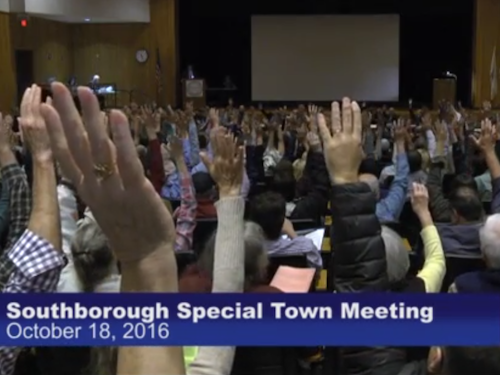
Above: Once upon a time, Town Meeting voters stripped a Town board of its authority to allow uses not covered by Town zoning. A new state law changes things. (image cropped from meeting video)
Ten years ago, a well-attended Town Meeting voted to eliminate “Use Variances”. The vote was prompted by anger over a controversial housing project. Changes in state law passed this month now reinstate use variances for residential uses.
(Coincidentally, the timing of the change is during the month that a legal case stemming from the same 2015-2016 controversy is headed to trial.)
On Friday, Southborough’s Town Counsel issued a memo to its municipal clients. In it, the law firm (Mead, Talerman & Costa) opined on impacts from recent changes in state law. That included:
Section 10’s prohibition of use variances unless “expressly permit[ted]” by a zoning ordinance or bylaw has been modified. The restriction that “no variance may authorize a use or activity” absent allowance by ordinance or bylaw has been amended by adding, thereafter, “other than residential.”14 Thus, municipalities are no longer free to prohibit variances for residential use.
It’s one of multiple significant changes under the laws that were passed as part of the state budget and promoted by the Healey administration as meant to increase much needed housing supply. A July 9th press release on the budget includes:
Making it easier to build housing and lower costs
To help build more homes and lower housing costs, the budget includes policy reforms that create a more predictable permitting process, reduce unnecessary delays and provide greater certainty for housing developments moving through local review. These changes will help accelerate housing production while preserving local decision-making.
Town Counsel’s opinion indicates that the impact of some of the changes is still unclear. One example:
The New Law eliminates the former statute’s express authorization for permit granting authorities to “impose conditions, safeguards and limitations both of time and use,” “excluding any condition, safeguards or limitations based upon the continued ownership of the land or structures…”15 It is unknown whether the courts will interpret the omission from the statute as meaningful, e.g. as restricting the extent to which a variance may be conditioned.
I received Town Counsel’s memo from the Building Commissioner Mark Robidoux when I reached out for his interpretation of the impact of the legal changes on Southborough’s Use Variance ban. He noted that his department was working with Town Counsel on training.
You can read the full memo here. You can find links to details on all of the changes just signed into law here.
The 2016 decision to eliminate the Use Variance was led by voters who were angered over a ZBA decision that allowed a Town House project at Park Central. Voters angry at the ZBA chose to strip the board of the specific authority.
At that time, some Town officials argued that the option was needed to allow flexibility for projects that are financially beneficial to the Town. Proponents of the Citizen’s Petition to eliminate the variances rebutted that if a project was beneficial, officials could bring it to Town Meeting and let voters decide. That’s precisely what happened last fall when voters approved zoning changes to accommodated the proposed Costco project.
In updating on the Costco project earlier today, I wrote about a change in the state laws that provides the Zoning Board of Appeals a simpler ability to allow zoning variances (for setbacks, height, etc) justified by “practical difficulty” in complying with the zoning bylaws. That same change also applies to the Use Variances. (Although, for Towns like Southborough, it only applies to residential uses.)
Still the variances aren’t meant to be automatically granted because of the applicant’s difficulties. The ZBA can still decide that applications aren’t in the public interest. Town Counsel’s memo explains:
The permit granting authority is instructed, i.e. via use of the word “shall,” to weigh the benefits to the variance proponent and to the public interest, expressly including “the interest in supporting the production of housing,” against the detriment to the public health, safety and welfare of the neighborhood.
And it’s worth noting that four of the five current members of the ZBA didn’t serve on the board at the time of the controversial Park Central decisions.
As for the court case I mentioned. . .
The same 40A townhouse project that prompted the public outrage in 2016 was the subject of a negotiated Covenant Agreement between Park Central developers and abutters.
The ZBA’s project approval was later vacated by a 2022 court ruling that the project was improperly combined with a 40B condo project. (You can read about that here.)
In 2023, developer Bill Depietri pursued a new 40B project at Park Central. Abutters publicly objected that Depeitri was violating the terms of the agreement. Depeitri then filed a lawsuit against abutters, requesting Declaratory Relief from Land Court that the Covenant Agreement is unenforceable and/or inapplicable.
Three years ago, the developer pushed to keep open paused hearings on the 40B. The ZBA eventually denied the application based on the unresolved legal issues. They told the developer that he could reapply once the case was resolved.
The trial is scheduled to run this week — Tuesday, July 21st through Thursday, July 23rd.
